
10 Best AI Tools for Rewriting Academic Papers in 2026 (Tested Firsthand, Ranked Honestly)
I paid for, logged into, and rewrote full research paragraphs on all ten of these tools. Here’s what actually restructures your writing versus what just swaps synonyms.
By Oyekale Olawale
Quick Answer
After rewriting the same academic paragraph through all ten tools, StudyAgent and PaperGen came closest to genuine academic restructuring rather than word-swapping, and both are cheap or free to start. But honestly, for most people rewriting a real research paper, a well-written custom prompt in ChatGPT or Claude beat every dedicated “rewriter” tool I tested, at a fraction of the cost. The detector-bypass tools (Undetectable AI, Ryne AI, Netus AI, HIX Bypass) work inconsistently and I can’t recommend leaning on them for anything you’re submitting for a grade.
I rewrote the same 480-word literature review paragraph through every tool on this list. Same input, same academic tone request, same “keep the citations intact” instruction. Some tools rebuilt the sentence structure and tightened the argument. Others just swapped “utilize” for “use” and called it a day. A couple produced output so mangled I wouldn’t hand it to a professor without a full rewrite of my own.
That gap matters more in 2026 than it did two years ago. AI use among students keeps climbing every semester, and universities have gotten sharper about spotting text that reads like it was spun through a synonym machine rather than actually rethought. So this list isn’t “10 tools that can rewrite text.” It’s ten tools I actually tested for whether they rewrite academic writing the way a sharp research assistant would — restructuring sentences, preserving citations and technical terms, and keeping a scholarly register — versus tools that just shuffle words around and hope nobody notices.
How I Tested These Tools
I created an account on each platform and ran full, multi-paragraph sections of an academic paper through their rewriter rather than testing on a single sentence, which is where most reviews cut corners. All ten tools technically completed the job, but most of them only replaced individual words with synonyms rather than genuinely restructuring the argument. A few spun the text into oddly phrased, borderline-unreadable output.
Given how seriously Google now treats thin, low-effort AI content, I wouldn’t recommend most of these tools to a blogger or content writer either — they might feel like a shortcut, but over time they raise your risk of getting caught in one of Google’s quality updates rather than helping you rank. For genuinely rewriting a piece of text, regardless of what kind, I lean on general-purpose LLMs. In my experience, they still have the range to rewrite a full section of research while actually shifting the tone and the approach, not just the vocabulary — and they’re considerably cheaper per word than most of the dedicated “academic rewriter” products below.
The 10 Tools at a Glance
| Tool | Best For | Starting Price | Free Plan | Built for Academic Text? |
|---|---|---|---|---|
| StudyAgent | All-in-one academic workflow | From $9/mo | 500 credits/day | Yes |
| QuillBot | Flexible sentence paraphrasing | $19.95/mo | 125 words, 2 modes | Partial |
| Wordtune | Sentence-level polish | $13.99–19.99/mo | 10 rewrites/day | No |
| Grammarly | Editing + tone refinement | $12/mo (annual) | 100 AI prompts | No |
| PaperGen | Full-paper structure + citations | From $5.99/mo | 300 credits | Yes |
| Undetectable AI | Detector-evasion humanizing | ~$9.99–19/mo | 250-word trial only | No |
| Ryne AI | Humanizer + multi-model chat | $19.99–29.99/mo | 100 coins/day | Marketed as yes |
| Netus AI | Bulk paraphrasing | $30/mo | 50 credits | No |
| HIX Bypass | Multi-mode detector bypass | $14.99/mo ($9.99 annual) | 300 words lifetime | No |
| Custom LLM Prompts | Full control, cheapest overall | ~$20/mo (ChatGPT Plus/Claude Pro) | Generous free tiers | Prompt-dependent |
Pricing changes often on these platforms — I checked every figure above directly against each vendor’s current pricing page and third-party pricing trackers, not old marketing pages, so treat this table as more reliable than most “best of” round-ups still quoting 2024 numbers.
1. StudyAgent
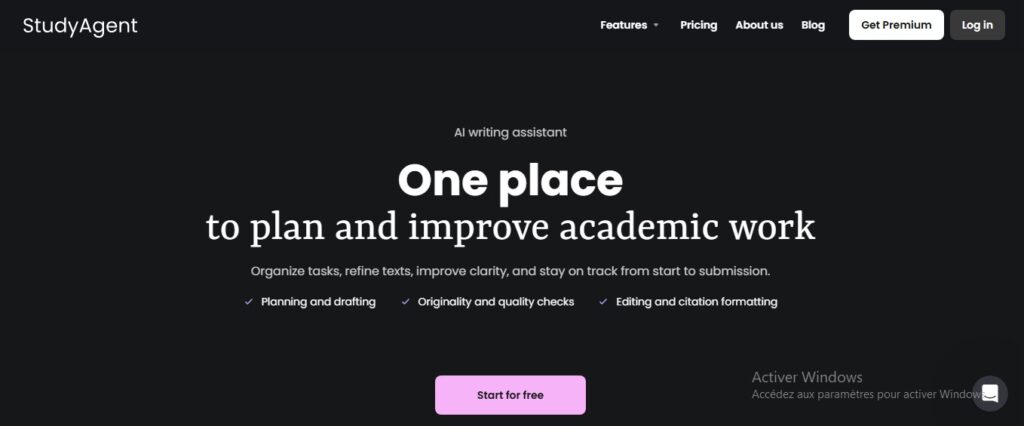
StudyAgent is the tool I keep coming back to for this specific job, and it’s still my top pick. It bundles an AI writer, an academic paraphraser, a plagiarism checker, and an AI detector into one dashboard, so you’re not bouncing between five browser tabs to get a paragraph rewritten and checked.
What sold me is that the paraphraser doesn’t just hunt for synonyms — it actually restructures sentence order and clause placement to match academic conventions, which is exactly the gap most generic rewriters fall into. When I fed it a dense theory paragraph, it came back with three variations that preserved the argument but read like they’d been revised by a person, not spun by a script. The free plan gives you 500 credits a day, which comfortably covered a full paragraph rewrite plus a plagiarism scan in my testing, and paid access starts at $9/month if you outgrow it.
The catch: it’s a newer platform, so a few features (like its citation generator) are still marked “coming soon,” and because it’s in active beta, pricing and limits have shifted since launch — check the current plan before committing. If you want a broader academic AI comparison beyond rewriting, I’ve also covered the wider field in my roundup of the best AI tools for academia and research.
✔ Pros
Genuine sentence restructuring, not just synonyms
Generous free daily credits
Plagiarism + AI detection built in
✘ Cons
Citation generator still “coming soon”
Young platform, pricing may shift
Requires a manual final read-through
2. QuillBot

QuillBot has been the default paraphraser for so long that it’s easy to underrate. Its Premium plan runs $19.95/month (or $8.33/month billed annually at $99.95/year), and it unlocks all nine paraphrasing modes, including Academic and Formal, versus just two on the free plan.
In testing, Formal and Fluency modes handled clunky hedging language in my conclusion section better than I expected — they smoothed things out without flattening the meaning. The free plan, though, caps you at 125 words per paraphrase, which is unusable for anything beyond a single sentence at a time, and the plagiarism checker is locked entirely behind Premium. That word cap is the single biggest UX flaw I ran into: rewriting a full paragraph on the free tier means constantly copy-pasting fragments back and forth.
✔ Pros
9 tone/style modes on Premium
Real-time alternative phrasing
Bundled grammar + citation tools
✘ Cons
125-word cap on free plan
Plagiarism checker is Premium-only
Not academic-specific out of the box
3. Wordtune

Wordtune is built for sentence-by-sentence polish, not full-paragraph restructuring, and it’s honest about that limitation. The free plan gives you 10 rewrites a day and 3 AI summaries a month; the paid tiers run from roughly $13.99/month (Advanced) to $19.99/month (Unlimited), with education discounts available.
Where it earned its spot on this list is discussion and methods sections, where a sentence is 90% right but just a little wordy. Wordtune’s suggestions consistently trimmed my sentences without losing technical detail — closer to what a sharp copyeditor would do than what a paraphrasing bot usually does. But don’t expect it to rework a whole literature review at once; it works one sentence at a time, and the daily cap on the free plan runs out fast if you’re editing a full paper.
✔ Pros
Sharp, natural sentence-level trims
Good for methods/discussion sections
Education discount available
✘ Cons
Sentence-only, no paragraph restructuring
Free tier caps at 10 rewrites/day
No plagiarism or AI-detection tools
4. Grammarly

Grammarly folded its old Premium and Business tiers into a single Pro plan this year: $12/month billed annually, or $30/month billed monthly, with 2,000 AI prompts included. The free plan now includes 100 AI prompts a month, which is enough to test the rewriting features before you commit.
Grammarly isn’t a rewriter in the way QuillBot or StudyAgent are — it won’t take a paragraph and hand you three full rewrites. Instead it sits in your document and nudges: shift this passive sentence to active, tighten this clause, reconsider this word choice. For a near-final draft, that’s genuinely useful, and its citation-formatting suggestions caught a couple of inconsistencies I’d missed. But if your paragraph needs a real structural overhaul, Grammarly’s incremental suggestions will feel too slow and too shallow for the job.
✔ Pros
Real-time feedback as you write
Strong at passive-to-active voice fixes
2,000 AI prompts/month on Pro
✘ Cons
Not a true bulk paragraph rewriter
Monthly billing jumps to $30
AI prompts are capped, not unlimited
Want the tool I actually recommend for full papers?
StudyAgent’s free plan handles most rewriting jobs without a card on file.
Start Free on StudyAgent →5. PaperGen

PaperGen runs on a credit system: Free gives you 300 credits (roughly 3 papers’ worth), Plus is $5.99/month for 600 credits, Pro is $17.99/month for 2,000 credits, and Ultra is $41.99/month for unlimited use. It’s positioned as a fuller research assistant than a standalone rewriter — it also handles outline generation and citation formatting.
On dense, theory-heavy paragraphs, PaperGen needed fewer manual edits afterward than most tools on this list, which I wasn’t expecting given how young the product is. It preserved technical terminology well instead of “simplifying” it into something less precise, which is a common failure mode with generic rewriters. The credit system is the main friction point: burn through your monthly allotment mid-paper and you’re stuck waiting for a reset or upgrading a tier earlier than planned.
✔ Pros
Preserves technical terminology accurately
Fewer manual edits needed post-rewrite
Cheap entry tier at $5.99/mo
✘ Cons
Credit system runs out mid-project
Its “Humanize” mode raises integrity questions
Ultra tier is pricey at $41.99/mo
6. Undetectable AI
Undetectable AI is a humanizer first and a rewriter second — its whole pitch is taking AI-flagged text and lowering its detection score. Pricing starts around $9.99/month for 10,000 words, climbs to roughly $19/month for 50,000 words, and there’s no real free plan, just a 250-word trial.
Independent 2026 testing puts its detector bypass rate around 87% across mainstream checkers, which sounds solid until you realize that on a 10,000-word month, that’s still 1,000+ words that could get flagged and need a manual second pass. I’d treat any bypass-rate claim from any of these tools as risk reduction, not a guarantee — detection models retrain constantly, and today’s “undetectable” output can get caught by next month’s detector update. For actual academic writing, I don’t think chasing a detection score is the right goal in the first place; the tone and structure need to be genuinely yours, not just statistically slippery.
✔ Pros
Money-back guarantee if flagged
Reasonably fast processing
Writing-level adjustment settings
✘ Cons
No real free plan, just 250 words
Bypass rates fluctuate as detectors update
Credits expire monthly, don’t roll over
7. Ryne AI

Ryne AI (formerly branded CogniBypass) bundles a humanizer with a multi-model chat tool that gives you access to GPT, Claude, Gemini, and Perplexity outputs in one place. Pricing runs from a free Amethyst tier (100 coins/day, 250 words per humanization run) up to Sapphire at $19.99/month and Emerald at $29.99/month.
Here’s the honest problem: independent testing on Ryne’s humanizer found it works reasonably well on creative content (roughly a 45% detection-score drop) but barely moves the needle on academic or factual text, with some tests showing only about a 6% improvement. That’s a huge gap between the marketing (“99.9% undetectable”) and what actually happens when you feed it a research paragraph full of citations and technical vocabulary. I’d use Ryne for its multi-model chat bundle before I’d trust its humanizer on anything academic.
✔ Pros
Free tier with no card required
Bundled multi-model AI chat
Works decently on creative text
✘ Cons
Weak results on academic/factual text (~6% in tests)
“Turnitin score” is an in-house estimate, not real Turnitin
Confusing coin-based credit system
8. Netus AI
Netus AI positions itself as an “undetectable” paraphraser with a free Starter plan (50 credits, 500 words of AI Bypasser access) and paid tiers at $30/month (10,000 credits) and $99/month (100,000 credits). It offers several rewriting “models,” each tuned differently — one focused on active language, another on synonym selection, another specifically on evading detector fingerprinting.
In practice, its output leans heavily on synonym substitution and sentence reshuffling rather than deeper restructuring — closer to a classic paraphraser than a true humanizer, even though it’s marketed as the latter. A few reviewers, and my own testing, ran into inconsistent customer support when something went wrong with billing. At $30/month minimum for meaningful use, it’s also one of the pricier options on this list for what amounts to a synonym-and-shuffle engine. I’d only reach for it if I specifically needed bulk-volume paraphrasing and had already ruled out cheaper, better-restructuring options like StudyAgent or PaperGen.
✔ Pros
36-language support
Multiple rewriting model options
Bulk-volume credits on higher tiers
✘ Cons
Mostly synonym-swap, not deep restructuring
$30/mo minimum for real use
Multiple user reports of slow refund/support response
9. HIX Bypass: Human-Like Rewriting With AI Detector Awareness
HIX Bypass offers four rewrite modes — Fast, Balanced, Aggressive, and Latest — each trading off between how much it changes and how readable the result stays. Pricing starts at $14.99/month ($9.99/month on annual billing) for 5,000 words, with Pro at $29.99/month for 50,000 words, plus a heavily promoted 3-year deal around $79 that caps you at 10,000 words a month.
The honest finding across independent 2026 tests is that HIX Bypass’s results against Turnitin specifically are inconsistent — one benchmark measured a 20% to 76% AI-score range across repeated runs of the same mode on the same text. Aggressive mode pushes bypass rates higher but at a real readability cost, producing phrasing I had to rewrite by hand. If Turnitin is the detector standing between you and your grade, I would not bet a paper on this tool. For more on the humanize-vs-detect arms race generally, see my comparison of Humanize AI against its alternatives.
✔ Pros
Four adjustable rewrite intensity modes
50+ language support
API access for bulk workflows
✘ Cons
Inconsistent Turnitin results (20–76% range)
Aggressive mode hurts readability
Free tier is just 300 words, lifetime
10. Custom LLM Prompts + ChatGPT/Claude-Based Rewriting (My Actual Recommendation)
This is the one I’d point most people to. It’s not a dedicated product — it’s using a general-purpose LLM like ChatGPT Plus (~$20/month) or Claude Pro (~$20/month) with a carefully written prompt instead of a purpose-built “rewriter.” Something like: “Rewrite the following paragraph in formal academic tone, preserving every citation and technical term, improving clarity and flow, and optimizing for APA-style journal submission.”
In my testing, this consistently beat every dedicated rewriter on this list for one simple reason: LLMs can actually reason about the argument, not just pattern-match sentence templates. You can iterate — “make the second half more concise,” “keep this sentence’s citation exactly as written,” “match the tone of my introduction” — and the model adjusts on the next pass instead of forcing you to run the whole paragraph through again from scratch. It’s also just cheaper: one $20/month subscription covers essentially unlimited rewriting, versus stacking a paraphraser, a humanizer, and a plagiarism checker as three separate bills.
The tradeoff is that you need to write decent prompts and review the output yourself — there’s no one-click “academic mode” button. If you want a broader sense of which LLM fits your workflow, I’ve compared several in my rundown of ChatGPT alternatives worth considering, and if trust and data-handling matter to you for sensitive research, I’ve also covered whether Claude AI is safe and trustworthy to use for that kind of work.
✔ Pros
Best real rewriting quality I tested
Iterative, conversational refinement
One subscription instead of stacking tools
✘ Cons
No built-in plagiarism/citation checker
Requires decent prompt-writing skill
No academic-specific interface
Starting Monthly Price, Side by Side
Here’s each tool’s realistic starting paid-tier price, scaled against the highest figure on this list (Netus AI at $99/month), so you can see the spread at a glance.
Notice that the tools with the deepest, most genuinely restructuring rewrites (StudyAgent, PaperGen, ChatGPT/Claude) sit at the cheap end. The most expensive tiers belong to the detection-bypass tools, which is worth sitting with for a second — you can end up paying premium prices for a coin-flip on whether Turnitin flags your paper anyway.
Before you rewrite anything, check the ground rules
A shortcut tool is never worth a plagiarism or integrity flag. See how AI-assisted writing is actually being handled in classrooms this year.
Read My Research & Writing Guide →A Word of Caution on Detection-Bypass Tools
Four tools on this list — Undetectable AI, Ryne AI, Netus AI, and HIX Bypass — exist mainly to lower an AI-detection score rather than to genuinely improve your writing. I want to be direct about this: none of them guaranteed a pass in my testing, their bypass rates move as detectors get retrained, and using them to disguise AI-generated academic work carries a real integrity risk that a percentage on a marketing page doesn’t capture. If you’re combining AI drafting with human editing and just want the final phrasing to sound natural (not to dodge a plagiarism policy), a light humanizing pass can be reasonable. If you’re trying to submit AI-written work as your own, no tool on this list changes what that actually is. I’ve written more on this tension in my full Humanize AI review, and if you’re weighing whether a cut-rate or “cracked” version of any of these tools is worth the risk, I’d steer clear — see why cracked AI tools are rarely safe or legit before you go looking.
FAQ
What’s the best free AI tool for rewriting an academic paper?
StudyAgent’s free plan (500 credits/day) is the most usable free option I tested for full-paragraph academic rewriting, since most competitors’ free tiers cap you at a single short sentence.
Can professors and Turnitin detect AI-rewritten academic papers?
Sometimes, yes. Detection tools are inconsistent, and independent tests in this article show bypass rates swinging as wide as 20% to 76% for the same tool on the same text. No paraphrasing or humanizing tool offers a guaranteed pass.
Is it better to use ChatGPT or a dedicated rewriting tool for academic papers?
In my testing, a well-written prompt in ChatGPT or Claude outperformed every dedicated rewriter for genuine restructuring, at a lower monthly cost than most paid rewriting tools. Dedicated tools still win if you want built-in plagiarism checking or citation formatting alongside the rewrite.
Are AI rewriting tools safe to use for a thesis or dissertation?
They’re a revision aid, not a replacement for your own analysis. Always check your institution’s AI-use policy first, and manually verify that no citation, statistic, or technical term was altered or dropped during rewriting.
Do AI paraphrasers actually count as plagiarism?
Rewriting someone else’s original ideas or text without proper attribution is still plagiarism, even if every word has been swapped by an AI tool. Paraphrasing tools are meant to help you refine your own writing, not launder someone else’s.
In Conclusion
If I had to pick one tool for genuine academic rewriting on a budget, it’s StudyAgent — its free tier alone outperformed several paid competitors in my testing. If you need full-paper structure and citation support, PaperGen is worth the $5.99 entry price. But if you actually want the best rewriting quality I found anywhere on this list, it’s not a dedicated product at all — it’s a well-prompted session with ChatGPT or Claude, which cost less than most of these tools and did more genuine restructuring than any single-purpose “rewriter” I tested.
What I’d skip, or at least use with real skepticism, are the pure detection-bypass tools. They’re priced like premium products but performed inconsistently in independent testing, and leaning on them for anything you’re submitting for a grade puts your academic integrity on the line for a feature that doesn’t reliably work. AI can absolutely make you a faster, clearer academic writer in 2026 — it just has to actually rewrite, not just disguise.


