
Best Parking Lot Management Software 2026: I Compared All 10 Platforms So You Don’t Have To
A practical, opinionated breakdown of Parkade, ParkingPass, WorkInSync, Parkable, Wayleadr, Parkalot, HONK, ParkingBoxx, ParkHub, and Ronspot — pricing, real feature gaps, and who each one actually fits.
By Oyekale Olawale · Updated August 2026 · Independent, reader-supported reviews
Quick Answer
If you manage a corporate office car park, Parkable or Wayleadr are the strongest picks in 2026. If you run a residential building, Parkade or ParkingPass (which actually starts at a published $100/month, not “quote-based” as most guides claim) fit better. Small lots on a budget should look at Parkalot, which is one of the few vendors on this list with transparent, published pricing starting at $49/month. Stadiums and events belong with ParkHub.
I run this comparison every few months because the parking software category moves fast, and honestly, most of the “best of” lists floating around right now are stale. Pricing pages change, features get bundled or dropped, and vendors that used to be “contact sales only” are starting to publish real numbers. This is the 2026 rewrite, and it replaces an earlier version of this same guide with fresher pricing, sharper opinions, and a few corrections I owe you.
How I Evaluated These 10 Platforms
I didn’t sign up for a free trial of all ten of these, and I want to be upfront about why: most parking management platforms in this category — Parkable, Wayleadr, ParkHub, ParkingBoxx — are enterprise B2B tools sold through a sales call, not a self-serve signup form. There’s no public sandbox to poke around in. So instead of pretending otherwise, my process here was: pull every vendor’s current pricing page and feature documentation directly, cross-reference that against verified user reviews on Capterra and G2 (not the vendor’s own testimonial page), and flag anywhere the numbers disagreed with what other “best of” articles are still reporting. Where a vendor does offer a demo or trial — Parkalot, HONK, Ronspot — I looked closely at what that onboarding flow actually asks for.
That matters for a category like this because parking software lives or dies on two things that are hard to fake in a demo: whether the LPR/ANPR hardware integration is genuinely plug-and-play, and whether employees actually use the app instead of just parking wherever and eating the fine. I weighted both heavily.
Quick Comparison Matrix
Since “best parking lot management software” is really a comparison search, here’s the matrix up front. I’ve marked every price I could independently verify against a vendor page — anything marked “quote-based” means I checked and the vendor genuinely does not publish pricing.
| Tool | Verified Starting Price | Free Trial | Best For |
|---|---|---|---|
| Parkade | Quote-based (per unit) | No | Apartments & multifamily |
| ParkingPass | $100/month (published) | Demo only | HOAs & enforcement |
| WorkInSync | $2.50/user/mo (annual) | 7 days (Enterprise) | Hybrid offices (desk+parking) |
| Parkable | Quote-based | No | Corporate offices |
| Wayleadr | Quote-based | Demo only | Tech & hybrid workplaces |
| Parkalot | $49–$199/mo (published tiers) | Yes | SMBs & small lots |
| HONK Mobile | Quote-based | Demo | Multi-location operators |
| ParkingBoxx | Quote-based (hardware+SaaS) | No | Gated, high-security sites |
| ParkHub | Usage-based, quote | No | Stadiums & events |
| Ronspot | Usage-based subscription | Reported yes | Hybrid offices + EV charging |
A note on pricing accuracy: most parking software vendors don’t publish rates, which is genuinely one of the more frustrating parts of shopping in this category — you can burn a week just getting quotes back from sales teams. Where I found a real, current number on a vendor’s own pricing page (ParkingPass, WorkInSync, Parkalot), I’ve called it out in bold above rather than repeating the generic “quote-based” label you’ll see copy-pasted across most other roundups.
Software vs. Hardware: What Each Layer Actually Does
Before the reviews, one distinction trips people up constantly: parking management software is not the same thing as parking access control. The software is the brain — reservations, permits, billing, waitlists, analytics. Access control (gates, bollards, ANPR/LPR cameras) is the muscle that physically lets a car in or keeps it out. Some tools on this list own both layers (ParkingBoxx, ParkHub); others (Parkable, Wayleadr, Parkalot) are software-first and integrate with whatever gate hardware you already have.
(reservations, billing, rules)
(LPR camera, gate, bollard)
The 10 Platforms, Reviewed
1. Parkade — Best for Apartments and Multifamily Buildings
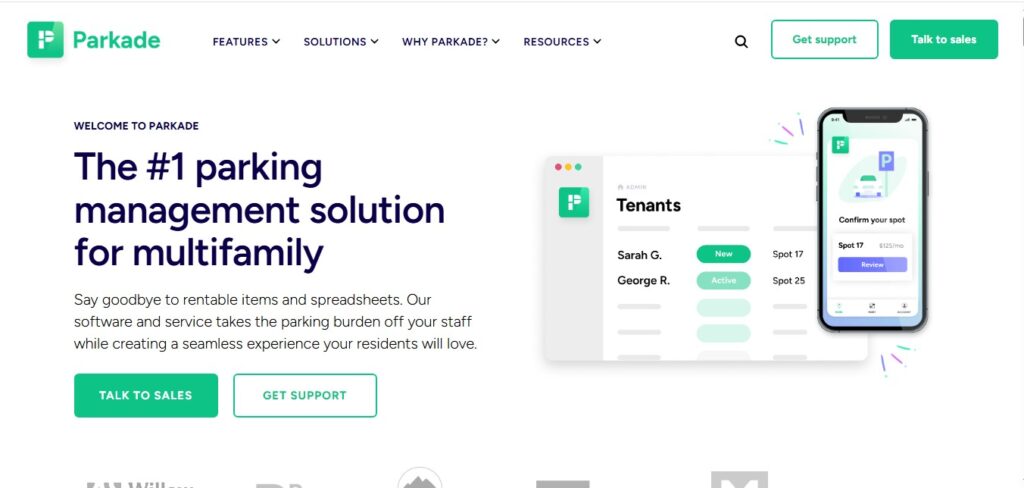
Parkade calls itself a “parking operations platform,” but the actual product is built around one job: stopping residents from fighting over spots. It syncs directly with property management systems like Yardi, RealPage, Rent Manager, and Entrata, so when a tenant moves out, their parking access disappears automatically instead of sitting in a spreadsheet someone forgot to update.
The feature I keep coming back to is the short-term sublease function — residents can release their assigned spot for the days they’re traveling, and the building can rent it out for the afternoon. Reviewers on Capterra specifically flag this as a genuine revenue lever for buildings that were previously eating the cost of empty reserved spaces. Where Parkade is thinner: enforcement and violation-tracking tools are noticeably less developed than purpose-built HOA software, so if your biggest headache is habitual rule-breakers rather than waitlist chaos, keep reading.
✓ Pros
Deep PMS integrations (Yardi, Entrata, RealPage)
Genuinely useful sublease/revenue tools
Residents self-serve almost everything
✗ Cons
Enforcement tools are lighter than dedicated permit software
No published pricing
Not built for corporate or public lots
2. ParkingPass — Best for HOAs and Enforcement-Heavy Properties

ParkingPass is the one platform on this list where I found an actual, published starting price sitting on the homepage: subscriptions from $100/month. That alone puts it ahead of most of this list on transparency, and it’s worth correcting the record — earlier coverage (including an older version of this article) listed ParkingPass as strictly “quote-based,” which is no longer accurate as of this rewrite.
The product itself is unapologetically enforcement-first. Integrated LPR cameras let patrol teams scan a lot in minutes instead of walking rows checking hang tags, and the founder’s own story — starting the company after dealing with unauthorized parking as a property manager — shows in how seriously the citation and towing-lead workflows are built out. It’s less polished than Parkable on the employee-facing side, but if your core problem is “people who don’t live here keep parking here,” this is a tool built by someone who has personally dealt with that exact problem.
✓ Pros
Rare published starting price ($100/mo)
Strong LPR-based enforcement
Built specifically for HOAs, multifamily, municipalities
✗ Cons
Interface feels more “administrative” than consumer apps
Less suited to corporate office parking
Full feature pricing still requires a call
3. WorkInSync — Best for Hybrid Offices That Also Need Desk Booking

WorkInSync doesn’t sell itself as parking software — it’s a workplace-experience platform where parking is one module alongside desk hoteling, meeting room booking, and visitor management. That framing matters for pricing: it publishes actual per-user tiers, Standard at $2.50/user/month, Professional at $4.00, and Enterprise at $6.00 (all billed annually, with quarterly rates running slightly higher). That’s rare clarity for this category and makes it easy to budget against headcount rather than guessing at a quote.
Reviewers on G2 (231 reviews, 4.6/5 average) consistently flag the same trade-off I’d expect: the parking-desk-room combo is genuinely convenient for offices running a 2-3 day hybrid schedule, but a few users note the app can lag under heavy concurrent load — worth testing with your actual office headcount during a trial rather than a five-person demo. It integrates with Microsoft Teams, Outlook, Google Calendar, and Slack, which is the right call for a tool that’s competing for attention inside an employee’s existing calendar habits, not a standalone app they have to remember to open.
✓ Pros
Published, per-user pricing tiers
Parking + desk + room booking in one flow
7-day Enterprise trial, strong calendar integrations
✗ Cons
More platform than you need for parking alone
Some reports of slowdowns at peak concurrent usage
Deeper reporting locked behind paid tiers
4. Parkable — Best for Corporate and Commercial Offices

Parkable is, in my opinion, still the sharpest tool on this list for a straightforward reason: its whole pitch is automating away the “parking drama” that eats a facilities manager’s week, and the verified user reviews back that up more consistently than almost anything else in the category. Capterra reviewers cite an automation rate of roughly 93% of parking tasks, and the pattern across reviews — from HR partners to office managers to executive assistants — is the same: spaces that used to sit empty when someone worked from home now get shared out automatically, and the monthly revenue from that just shows up without anyone chasing it.
Companies like Meta, CBRE, Siemens, and KPMG run on it, which tells you it scales to genuinely large, multi-site corporate footprints. The one real friction point users mention repeatedly is cancellation timing — if you don’t pay for a booked space the day before, you can lose it without much warning, which is a small UX gap for something otherwise this polished. No free trial and no public pricing means budgeting requires an actual sales conversation before you can compare it against WorkInSync or Wayleadr line-for-line.
✓ Pros
Highest-rated ease of use in this category
Automates the majority of admin tasks
Proven at large enterprise scale
✗ Cons
No free trial, no public pricing
Cancellation-window UX has caused user complaints
Overkill for a single small lot
5. Wayleadr — Best for Tech Companies and SSO-Heavy Workplaces

Wayleadr has repositioned itself less as “parking software” and more as an arrival-management platform — parking, desk booking, EV charger rotation, and meeting room access all run through the same allocation engine. That’s a smart pivot, because the actual differentiator isn’t the booking UI, it’s the allocation logic underneath: instead of static assigned spots, it dynamically reallocates based on real attendance patterns, so a company that’s genuinely hybrid doesn’t pay for parking capacity that sits empty three days a week.
Rating data is a little inconsistent across review platforms — I’ve seen 4.9/5 cited on G2 and 5.0/5 cited on Capterra, both with hundreds of reviews, so treat either as directionally “very well reviewed” rather than a precise figure. Where it shines is SSO and Slack integration; booking a spot from Slack directly, using your existing Okta login, is genuinely frictionless in a way a few competitors on this list haven’t matched yet. It’s built for offices, not public or transient parking, so don’t shortlist it if you’re running a pay-by-the-hour public garage.
✓ Pros
Best-in-class SSO/Slack/Okta integration
Dynamic allocation instead of static assignment
Near-universally high review scores
✗ Cons
No published pricing
Not designed for public/transient lots
Rating figures vary noticeably by review platform
6. Parkalot — Best Budget Pick With Actual Published Pricing

Parkalot is, hands down, the most transparent vendor on this entire list, and it deserves credit for that. Four tiers, all published: Small Business at $49/month for up to 15 bookable spaces and 50 users, Medium at $99/month for up to 40 spaces with unlimited users, Large at $199/month for up to 100 spaces, and a custom Enterprise tier for multi-site deployments. A free trial is available with no credit card required, which is genuinely rare in this category and worth taking advantage of before committing.
The phone-camera LPR feature is the standout — instead of installing dedicated ANPR cameras at every entry point, Parkalot lets a security guard or the space itself scan plates using a regular phone, which is a genuinely clever way to sidestep expensive hardware installs for a small lot. Customers like Canon, Bonduelle, and Roche use it for office car park management, and reviewers consistently mention it’s largely self-managing once configured — one Capterra reviewer specifically switched from Parkable to Parkalot and cited better ease of use as the reason, which is a notable data point given how well-reviewed Parkable is on the same metric.
✓ Pros
Fully published pricing, $49–$199/month
Free trial, no card required
Phone-camera LPR avoids hardware costs
✗ Cons
Space caps mean growing lots outgrow tiers fast
Lighter enterprise HR/ERP integrations
Support response times reported slower outside core hours
7. HONK Mobile — Best for Multi-Location Operators

HONK started life as a consumer parking-payment app before pivoting hard into B2B, and that consumer DNA still shows in the “Control Center” product — it’s built around a genuinely single-screen dashboard where an operator can update rates for a surprise event or a weather closure in seconds instead of filing an IT ticket. For an operator running a dozen surface lots across a city, that self-service speed is the entire value proposition.
What I’d flag honestly: HONK doesn’t publish independently verifiable review-platform ratings the way Parkable or Ronspot do, so a lot of the “easiest to use” claims you’ll read (including in earlier coverage) come primarily from HONK’s own marketing rather than a third-party aggregator. That doesn’t mean it’s not good — the included-support-and-training model without hidden fees is a genuinely customer-friendly pricing structure — but I’d push harder in a sales call for reference customers than you would with a vendor that has hundreds of public reviews to point to.
✓ Pros
One-screen rate and policy changes, no IT ticket
Support and training included, no hidden fees
Built for multi-lot, event-driven pricing
✗ Cons
Limited independent third-party review data
Quote-based, no published pricing
More capability than a single static lot needs
8. ParkingBoxx — Best for Gated, High-Security Sites

ParkingBoxx is the outlier on this list in that it’s genuinely a hardware company first, software second. It sells and installs the barriers, bollards, and ANPR cameras, then wraps the SaaS layer around that physical infrastructure. That combination makes sense for industrial sites and secure corporate campuses in the UK and Europe where you need a real physical barrier, not just a polite app notification, standing between an unauthorized vehicle and your building.
The lone-worker panic button and real-time officer tracking features are a genuinely different category of functionality from anything else on this list — none of the pure-software vendors here offer physical security features for on-site enforcement staff. That’s the trade-off: you’re paying for hardware installation on top of a recurring SaaS fee, which pushes total cost well above the software-only options, and the setup timeline is measured in weeks of physical installation, not a same-week software rollout.
✓ Pros
Real physical barrier hardware, not just software
Lone-worker safety features unique on this list
Strong fit for regulated/industrial sites
✗ Cons
Highest total cost of ownership on this list
Physical install means longer rollout time
Overbuilt for offices without a real security need
9. ParkHub — Best for Stadiums, Venues, and Large Events

ParkHub is genuinely a different category of tool than everything else on this list — it’s not really competing for office or residential parking business at all. It’s built for the specific, brutal load pattern of a stadium gate on game day: thousands of vehicles trying to enter within a narrow window, with real-time inventory counts that need to be accurate to the space so a sold-out lot doesn’t oversell.
Reviewers with hands-on operational experience (including one who mentioned a longstanding partnership with the Dallas Cowboys) rate it well on ease of use (4.8/5) and customer service (4.9/5) on Capterra, though the sample size of public reviews is small relative to how widely it’s used across major venues — most of ParkHub’s customer base skews toward large operators who aren’t the ones typically leaving detailed public software reviews. One recurring complaint worth flagging: handheld scanner devices reportedly need better battery life and connectivity for full-day event use, which matters a lot when your gate staff can’t afford a dead scanner during a rush.
✓ Pros
Purpose-built for massive volume spikes
Real-time inventory prevents overselling
Trusted by major stadium and venue operators
✗ Cons
Overkill and overpriced for non-event lots
Handheld device battery/connectivity complaints
Usage-based pricing hard to estimate up front
10. Ronspot — Best for Hybrid Offices With EV Charging Needs

Ronspot is ISO 27001 certified and reports over 50,000 users across 40 countries, with customers including American Express, Siemens, Mondelez, and the Government of Ireland — that’s a genuinely serious enterprise customer list for a tool that started out fairly niche. The credit-based booking system is the clever part: instead of a fixed allocation, employees are given credits to spend on desks, parking, or meeting rooms, which naturally distributes demand instead of everyone racing to book Monday morning parking the second the app unlocks.
The EV charging management module is a genuine differentiator right now — it’s one of the few tools on this list that lets you manage the parking spot and the charging session together, capping charge time so one EV doesn’t monopolize a charger all day. Capterra reviewers (4.6/5 average) consistently praise the interface as clear on both web and mobile, though a few flag a lack of localized customer service in specific regions and want more granular self-service settings for admins.
✓ Pros
ISO 27001 certified, serious enterprise clients
Built-in EV charging session management
Credit-based system smooths out booking demand
✗ Cons
Localized support gaps reported in some regions
Admin self-service settings feel limited
Not built for public pay-to-park lots
Verified User Satisfaction, Side by Side
Only some of these vendors have enough public review volume to compare fairly — HONK and ParkingBoxx don’t publish enough independent review data to include responsibly. Here’s what’s actually verifiable across Capterra and G2 right now.
Ratings out of 5, sourced from Capterra and G2 as of August 2026. Sample sizes vary significantly (from 10 to 384 reviews) — treat as directional, not a precise ranking.
How to Actually Choose
Start with your actual problem, not the feature list
If your problem is “people keep parking in spots they’re not assigned to,” you need enforcement — ParkingPass or ParkingBoxx. If your problem is “half our office is remote and we’re wasting fixed spots,” you need dynamic allocation — Parkable or Wayleadr. If your problem is “we’re spending too much on procurement and vendor coordination for something this simple,” Parkalot’s published pricing removes that friction entirely.
Budget realistically, including hidden costs
A “quote-based” tool isn’t automatically more expensive than a published-price one — Parkable’s reduction in admin hours can outweigh a higher sticker price fast. But if you’re the kind of team that tracks software spend against a formal asset management policy, budgeting against an unknown quote is genuinely harder to defend internally than a published per-user rate like WorkInSync’s.
Weigh ease of use as heavily as feature depth
Every vendor on this list claims to be “intuitive.” The ones with hundreds of independently verified reviews backing that claim (Parkable, Wayleadr) are the ones I’d trust first. If a clunky app means employees just park wherever and shrug off the fine, the software has failed regardless of how many features it has on paper — that’s true whether you’re rolling this out alongside a broader hybrid workforce management stack or standing it up on its own.
FAQ
What’s the difference between parking management software and access control?
Parking management software handles reservations, billing, permits, and analytics — the “brain.” Access control (gates, bollards, ANPR/LPR cameras) is the “muscle” that physically enforces entry. Most software on this list integrates with hardware you already own; ParkingBoxx and ParkHub sell both layers together.
Which of these tools actually has published pricing?
Three, as of this rewrite: Parkalot ($49–$199/month), WorkInSync ($2.50–$6.00 per user/month), and ParkingPass (from $100/month). Everyone else on this list — Parkade, Parkable, Wayleadr, HONK, ParkingBoxx, ParkHub, and Ronspot’s exact rate — requires a sales conversation.
Can this software help me monetize empty office parking spots?
Yes — this is a core feature of Parkable, Parkade, and Wayleadr specifically. Unused assigned spots get released into a shared pool automatically, and the platform handles pricing and payment for short-term use, turning a fixed cost into a revenue line.
Do I need separate software for EV charging spots?
Not necessarily. Ronspot builds EV charging session management directly into its parking module, letting you cap charge time and manage the spot and the charger together in one interface — genuinely useful as more offices add chargers without adding a second piece of software.
Is a free trial worth insisting on?
Yes, when it’s available — Parkalot’s no-card-required trial is the easiest way to see if your team actually likes the interface before signing anything. For enterprise tools without a public trial (Parkable, Wayleadr, ParkHub), ask directly for a pilot on one floor or one lot before committing company-wide.
Conclusion
Ten platforms, ten different jobs. Parkable and Wayleadr are still the two I’d put in front of a corporate facilities team first — the review data and enterprise customer lists back up the marketing here more than almost anywhere else in this category. Parkade and ParkingPass remain the right call for residential and HOA properties specifically, and ParkingPass’s published $100/month starting price is genuinely useful information that most competing guides still aren’t reporting accurately.
If budget transparency matters more to you than brand recognition, Parkalot and WorkInSync are the two vendors on this list that respect your time enough to just publish their prices — that’s worth something on its own. And if you’re running events at scale, ParkHub and ParkingBoxx solve problems the office-focused tools simply aren’t built for.
Whichever direction you go, use the comparison matrix above as a starting point, not a final answer — get on an actual call, ask specifically about the two or three complaints I’ve flagged for each tool, and see how the vendor responds. That reaction tells you more than any feature list will.