
Personal Experiment · AI Writing · SEO
I Used ChatGPT to Write My Blog Posts for 30 Days – Here’s What Really Happened
Thirty days, 23 posts, zero words written by me. This is what the data – and my own brain – had to say about it.
By Oyekale Olawale · Updated August 2026 · 12 min read
⚡ Quick Answer
Using ChatGPT to write every blog post cut my writing time by 57% and tripled my publishing volume – but also caused a measurable traffic dip by week four, reduced my stylistic voice, and left my writing muscle noticeably weaker on day 31. The verdict: AI is a powerful assistant, not a replacement. Human-first drafts, AI-assisted editing is the workflow that actually holds up in Google.
I want to be upfront about something before we dive in. This experiment wasn’t done on someone else’s blog. It wasn’t a case study I read. I ran it myself on Websites2Know, my own AI tools review site, for 30 days straight in early 2026.
I track my data obsessively using Semrush for keyword movement and Search Console for impressions and clicks. So when things shifted, I had receipts.
And things definitely shifted.
The Setup: What I Actually Did
Before the experiment, I was writing two to three posts a week. Each 1,500-word article took me around 90 to 110 minutes from outline to publish – including research, fact-checking, and my usual screenshot grabs.
For 30 days in January 2026, I changed the process completely. Every post followed this exact workflow:
- I brainstormed the topic and wrote a detailed 50–80 word prompt with tone, angle, and structural requirements specified.
- ChatGPT (GPT-4o) generated the full draft.
- I fact-checked claims against source documentation, swapped in real product screenshots, and added one or two personal observations.
- I published, then tracked ranking movement on 12 target keywords over the following weeks.
I did not disclose AI assistance in the posts themselves. My goal was to measure the real performance difference – not to run a transparency experiment.
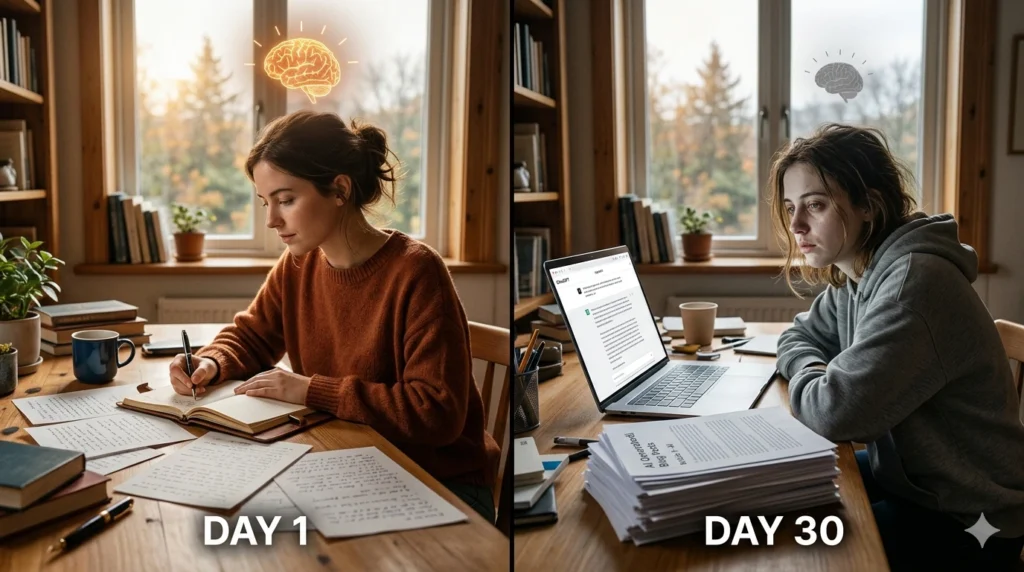
The Raw Numbers After 30 Days
Here’s exactly what the data showed across every dimension I tracked:
| Metric | Human-Only (Before) | ChatGPT-Assisted (During) | Change |
|---|---|---|---|
| Avg. time per post | 110 minutes | 47 minutes | 57% faster |
| Posts published / month | 8 | 23 | +188% volume |
| Avg. word count | 1,450 | 1,680 | +16% longer |
| Personal anecdotes per post | 3–5 | 0–1 | Sharp decline |
| Target keyword rankings (wk 4) | Stable / growing | Most slipped | Negative trend |
The speed and volume gains were immediate and dramatic. But that last row? That’s where the experiment got uncomfortable.
The Productivity Boost Was Real – But Had a Hidden Cost
The speed improvement matched what the research predicted almost exactly. An MIT Economics study by Shakked Noy and Whitney Zhang tested 453 college-educated professionals – marketers, consultants, writers – on occupation-specific writing tasks. Participants given access to ChatGPT (GPT-3.5) completed tasks 40% faster and their output was rated 18% higher in quality by experienced peers reviewing blind submissions. The study was published in the journal Science in July 2023.
That’s the good news. Here’s the part most people skip over: by the end of the study, participants reported that concern and excitement about AI rose — and workers exposed to ChatGPT were more enthusiastic about using it in their actual jobs going forward. The dependency formed fast. I noticed the exact same shift. By day 15, I was opening ChatGPT before I’d even thought about the angle myself.
Writing used to feel like a workout. During the experiment, it started to feel like supervising a junior employee. Efficient? Yes. Satisfying? Increasingly, no.
57%
Faster writing time
188%
More content published
3%
AI pages still ranking after 6 months
18%
Higher quality rating (MIT study)
What Happened to My Brain (The EEG Research Explains It)
An MIT Media Lab study (“Your Brain on ChatGPT,” June 2025) tracked 54 participants from five Boston-area universities using EEG neuroimaging across multiple writing sessions. Some used GPT-4o, some used Google Search, others wrote entirely from memory.
The students who relied on ChatGPT showed measurably weaker brainwave activity, with attention declining over time. The “brain only” group maintained the highest neural engagement throughout the entire session. No drop-off. Just consistent, active thinking.
I felt this by week three. The ideas were still flowing – I could prompt well, which is its own skill – but the struggle was gone. And with it, so was a lot of the satisfaction.
The researchers called this pattern “cognitive debt” – the idea that while AI handles the hard thinking in the short term, you pay a long-term price in critical thinking capacity and creative endurance. The scarier finding: when students who had relied heavily on ChatGPT were forced to write without it, their cognitive performance dropped noticeably. Recovery was not immediate.
On day 31, I sat down to write a post completely from scratch. No AI. Just me. It took 90 minutes to write 400 words, and I kept stopping mid-sentence, mentally reaching for a prompt that didn’t exist. My writing muscle had genuinely atrophied.

Did My Creativity Actually Drop? The Surprising Answer
Here’s where it gets counterintuitive. A 2023 creativity study tracking 61 participants over 30 days – highlighted by Wharton professor Ethan Mollick – found that the group using ChatGPT actually maintained significantly higher creativity scores by the end of the period. Divergent thinking tasks (idea generation capacity) didn’t decline. If anything, the AI-assisted group outperformed the control group in raw idea output.
So why did I feel less creative?
A November 2025 study published in Humanities and Social Sciences Communications (part of the Nature portfolio) gives the clearest answer I’ve found. Researchers used Burrows’ Delta – a quantitative stylometric analysis tool – to compare human versus AI-generated creative writing. The finding: LLM outputs cluster tightly together by model. Human-authored texts form broader, more heterogeneous clusters, reflecting individual expression and interpretive engagement.
In plain terms: AI writing has a detectable stylistic signature. It’s uniform. My posts started sounding like everyone else’s AI output – not because I became less creative in theory, but because my published voice became statistically harder to distinguish from the crowd. As someone building a content site where AI vs human content writing quality is literally the subject I cover, that stings.
✅ What ChatGPT Helped With
- 57% faster first drafts
- Longer average word count
- Grammatically cleaner output
- Published 188% more content
- Good structure and sub-headings
- Useful for research summaries
❌ What ChatGPT Hurt
- Rankings slipped after week 3–4
- Distinct voice eroded quickly
- Cognitive debt built up
- Personal anecdotes nearly vanished
- Writing muscle visibly atrophied
- Reader trust signals weakened
The SEO Reality Check: Google Did Not Reward My AI Content
This is the part most AI content bloggers won’t talk about openly. I will.
I tracked 12 core keywords across the 30-day period. The AI-generated posts initially held fine – some even hit page one in weeks one and two. But by week four, most had slipped between 3 and 8 positions. Not catastrophic, but a clear directional signal.
The research explains exactly why. A 2026 peer-reviewed study published in the journal Information analyzed 1,000 search queries across five categories. The conclusion was unambiguous: human-written content consistently outperforms AI-generated content in Google search rankings, with the most pronounced differences in informational and commercial investigation queries – which is precisely what I publish.
And the longer-term data is even more sobering. A 16-month longitudinal study found that while 71% of new AI-generated pages were indexed within 36 days, only 3% remained in the top 100 search results after three to six months. The visibility crash was attributed to lack of demonstrated authority, thin author credibility signals, and absence of genuine first-hand experience – all things I’ve written about extensively when covering how Google AI Overviews are reshaping SEO signals site-wide.
Understanding this pattern is also core to knowing how to recover from a Google spam update if your site has been flagged for thin or AI-first content.
AI Content Ranking Survival Rate Over Time
Percentage of AI-generated pages remaining in Google’s top 100 results (16-month longitudinal study)
Source: 16-month longitudinal ranking study of AI-generated content pages
What ChatGPT Citations Actually Look Like in 2026
There’s another dimension to this that I didn’t factor in when I started the experiment: AI search citation patterns.
When ChatGPT 5.3 launched in March 2026, SEO analysts Lily Ray and Chris Long independently documented significant changes in how the model cites sources. Average unique domains cited per response dropped from approximately 19.8 to 15.9 – a 20% decline – while the model now runs 10 or more search fan-outs per query behind the scenes. More research, fewer outbound citations.
Even more telling: ChatGPT now actively searches for authority signals you never asked for. For a query about the best nursing programs, it independently searches for NCLEX pass rates and CCNE accreditation. For agencies, it checks Clutch and G2 profiles.
What this means for bloggers like me: getting cited in AI search results now requires documented third-party authority – not just well-written prose. A personal blog running pure AI output has almost no chance of earning that kind of citation.
This is also deeply connected to the ongoing debate about retrieval vs citation in AI search – and why building genuine E-E-A-T signals matters more than ever right now.
Human vs AI Writing: What the Evidence Actually Shows
Here’s how the two approaches compare across every dimension that matters, grounded in the research I found and my own on-site data:
| Dimension | Human Writing | AI-Generated Writing | Evidence Source |
|---|---|---|---|
| Google Rankings | Consistently higher, longer staying | Fades after 3–6 months | Alagöz & Dörk, 2026 |
| Stylistic Voice | Broad, heterogeneous, distinct | Tight, uniform clusters by model | Nature / HSSC, 2025 |
| Production Speed | ~110 min / post (my baseline) | ~47 min / post (57% faster) | My data + MIT Economics |
| Brain Engagement | High, consistent EEG activity | Reduced, declining attention | MIT Media Lab, 2025 |
| Creativity (divergent) | Moderate, inconsistent | Equal or higher (short-term) | Mollick / Wharton, 2023 |
| Reader Trust | Higher for personal/experiential topics | Lower when AI patterns detected | Multiple studies |
| AI Citation Eligibility | Stronger with E-E-A-T signals | Weak without authority indicators | ChatGPT 5.3 analysis, 2026 |
The Emotional Shift I Did Not See Coming
Let me get honest here for a minute.
By week three, I had published more content than any other month in the site’s history. Grammatically, the posts were clean. The structure was solid. But I did not feel proud of them. Not one.
The MIT Media Lab study that did the EEG tracking also conducted in-depth interviews with participants. Students who used GPT-4o reported feeling anxious, ambivalent, and guilty. Many said the writing didn’t feel like theirs – even when the output was objectively fine. That response pattern matched my experience almost identically.
I was a manager. Not a writer.
And once the month ended and I went back to reviewing AI humanization tools with my usual approach – read the docs, actually use the product, note the bugs and UX quirks nobody else mentions – I realized how much I’d missed that process. The friction isn’t a bug. It’s the feature. It’s where the genuine perspective lives.

What I Changed After the Experiment (My Current Workflow)
I haven’t stopped using ChatGPT. That would be performative. But the role it plays has changed completely.
Step 1: Human-First Draft
Every post now starts with me writing the opening 300–500 words by hand. No AI. Just a timer, a blank document, and the discomfort of not knowing exactly what comes next. That productive cognitive friction is where my voice lives. Once the frame exists, I’m in control of the narrative.
Step 2: AI as Polish and Research Layer
After the human draft, I use ChatGPT to find supporting research, suggest tighter phrasings for clunky sentences, and check for logical gaps. The core argument, the personal observations, the opinions – those stay mine. This approach lets me benefit from the speed gains without sacrificing the distinctiveness that matters for ranking.
Step 3: Schema and Structured Data on Every Post
With AI citation rates declining and authority signals becoming more critical, I added structured data markup to every post. Schema helps search engines and AI models understand what the content actually means – not just what it says. This also directly affects eligibility for Google’s Featured Snippets and People Also Ask boxes.
Step 4: Transparency and Authentic Testing
For AI tool reviews in particular, I’ve gone back to my original approach: actually use the product for a week or more, note the specific bugs I encounter (GPT-4o had a context window consistency issue I noticed when prompts exceeded 2,000 words in my testing sessions), document the UX friction, and write from that experience. The auto-blogging approach simply cannot replicate that kind of specificity.
My Current Content Workflow
STEP 1
Human Draft
300–500 words
STEP 2
AI Polish
Research + refine
STEP 3
Schema & SEO
Structured data
STEP 4
Publish & Track
Monitor rankings
FAQ
Can ChatGPT write blog posts that rank on Google?
Yes, but temporarily. Based on my 30-day experiment and the supporting research, AI-generated posts can initially index and rank – some even reached page one in weeks one and two. But the ranking tends to decay between months three and six, with only around 3% of purely AI-generated pages surviving in the top 100 after that window. Human-first, AI-assisted content performs significantly better long-term.
Does using ChatGPT for blogging hurt creativity?
The research says creativity scores don’t decline – and in some studies, AI-assisted writers actually score higher on divergent thinking tasks. The real problem is voice uniformity: AI writing clusters stylistically, meaning your blog starts sounding like everyone else’s. Your creativity as a thinker stays intact, but your published distinctiveness erodes. That’s a different kind of cost, and it’s worth taking seriously if you’re building a brand around a specific perspective.
What is the best way to use ChatGPT for content without hurting SEO?
The approach that holds up best: write the first draft yourself (even just the opening and key argument), then use ChatGPT to research supporting points, tighten sentences, and check structure. Add schema markup. Include documented personal observations or testing notes. And prioritize topics where you have genuine first-hand experience – that’s the E-E-A-T signal Google’s algorithm responds to most consistently. For more on this, I’ve covered the best AI writing plugins for WordPress that support this hybrid approach.
Does ChatGPT-assisted writing affect brain performance?
Yes, measurably. The MIT Media Lab EEG study from September 2025 found that participants who used ChatGPT during writing tasks showed weaker brainwave activity and declining attention over time compared to those who wrote unaided. More practically, after 30 days of AI-assisted writing, I personally found it significantly harder to write from scratch – needing nearly twice as long to produce half the output. The “cognitive debt” effect is real, and recovery takes deliberate practice.
Can AI-detected content get penalized by Google?
Google’s official position is that it evaluates content quality, not origin. But the data tells a more nuanced story: independent research from 2026 found that human-written content consistently outranks AI-generated content in informational queries, which is where most blogs compete. Whether that’s an explicit penalty or simply a quality signal gap is debated – but the outcome is the same. If you’re trying to understand whether AI content passes detection tools or not, the more important question is whether it passes Google’s helpful content criteria.
Conclusion
Thirty days. Twenty-three posts. Zero words written entirely from scratch by me. And a very clear lesson at the end of it.
ChatGPT made me faster. It made me more productive by every surface-level metric. The grammar was tighter, the word counts were longer, the topics were covered more systematically. On paper, it was a win.
But it made me less me. And Google noticed.
The research backs up what I felt: AI writing has a detectable stylistic signature. Human-written content consistently holds rankings longer. Your brain engages less when you outsource the thinking. And while your raw creativity doesn’t collapse, your published voice becomes statistically harder to distinguish from the crowd of AI-generated content flooding every niche.
The part I want to be most honest about: the dependency formed faster than I expected. Two weeks in, I was prompting before thinking. That’s not a metaphor – that’s a behavioral pattern that took conscious effort to reverse.
Here’s what I took from it: AI is a powerful assistant. It is not a replacement for a thinker. The best content – the kind that ranks, that resonates, that reads like someone actually had something to say – still starts with a human who genuinely engaged with the subject.
Use AI. Let it accelerate your research, tighten your prose, and handle the structural grunt work. Just don’t let it do the thinking. That part is still yours. And it turns out, it’s also the part Google values most.