Updated August 2026 · Reviewed by Oyekale Olawale
Best AI HR Software in 2026: 6 Tools I Actually Tested So You Don’t Have To
From smart candidate sourcing to AI-generated 360 reviews — here’s what these platforms can genuinely do, what they fumble, and which one fits your team right now.
⚡ Quick Answer
The best overall AI HR software in 2026 are Workable (best for recruitment-heavy teams, from $149/mo), ClearCompany (best full-lifecycle platform), Eightfold.ai (best enterprise talent intelligence), Textio (best for inclusive hiring language), Deel Engage (best for global or distributed teams, $20/employee/mo), and Effy AI (best lightweight 360-degree feedback tool, free up to 5 users). No single tool wins for everyone — scroll down to find which one matches your actual pain point.
I’ll be straight with you: most AI HR software reviews are written by people who never actually logged into the platforms. They scrape vendor pages, list bullet points, and call it a day. That’s not what this is.
Over several weeks, I worked inside each of these six tools — creating job posts, running mock review cycles, testing integrations, and pushing each platform to see where it breaks. I paid attention to the friction points that don’t show up in demo videos. I noted which AI features actually saved time and which ones felt like marketing padding.
This guide reflects that experience. If you’re an HR leader, a founder managing a growing team, or a recruiter drowning in admin work, I think you’ll find it genuinely useful.
How I Test AI HR Software
My testing framework is consistent across every tool I review here at Websites2Know. For HR platforms specifically, I evaluate:
- Onboarding time — How long does it actually take to go from signup to live workflow?
- AI quality — Do the AI suggestions save real time or require heavy manual editing?
- UX friction — Where do confusing UI patterns slow you down?
- Integration reliability — Does the platform talk cleanly to your HRIS, Slack, or calendar?
- Value at price — Is the pricing honest, or does it balloon with essential add-ons?
I also check public review platforms (G2, Capterra, Trustpilot) for patterns — if multiple users complain about the same thing, I dig into it myself rather than dismissing it.
What’s Actually Different About AI HR Software in 2026
Two years ago, “AI in HR” mostly meant auto-filled form fields and keyword matching. In 2026, the shift is more meaningful — and more specific.
The best platforms now use deep learning to predict outcomes: which candidates are likely to perform based on patterns in your top hires, which employees are at risk of leaving before they even know it themselves, which job description language is quietly repelling qualified applicants.
Skills-based hiring has also moved from buzzword to practical feature. I’ve now seen Eightfold.ai surface internal candidates for senior roles based purely on skills — roles that would otherwise have triggered an expensive external search.
The other shift worth flagging: ethical AI is no longer optional packaging. Platforms are now expected to ship with built-in bias audits, GDPR-ready data handling, and explainability layers. If a vendor can’t tell you how their algorithm scores candidates, that’s a real red flag in 2026, not just a nice-to-have concern.
📊 AI in HR: 2026 Snapshot
66%
of TA leaders plan to increase HR tech spend in 2026
Source: HR Executive / 2025 Survey
82%
of companies now offer remote or hybrid work options
Source: SelectSoftwareReviews / 2025
70%
of HR leaders expect software costs to rise this year
Source: Gartner HR Report / 2025
Quick Comparison: Best AI HR Software in 2026
| Tool | Best For | Starting Price | Free Tier | AI Standout Feature |
|---|---|---|---|---|
| Workable | Recruitment-focused teams | $149/mo (Starter) | 15-day trial | Edera AI candidate matching |
| Eightfold.ai | Large enterprises (5,000+ employees) | ~$7–10/employee/mo (custom) | No | Skills-based talent rediscovery |
| ClearCompany | Full talent lifecycle management | Custom (per user + per employee) | No | AI Talent Match + AI Notetaker |
| Textio | Inclusive hiring language & performance writing | ~$10,000/yr (custom) | No | Real-time bias detection in job copy |
| Deel Engage | Global / distributed teams | $20/employee/mo | Deel HR free up to 200 | AI-powered career framework generator |
| Effy AI | SMBs needing 360 feedback fast | Free (up to 5 users) | Yes — permanently free tier | AI-generated review summaries |
1. Workable — Best AI HR Software for Recruitment-Focused Teams
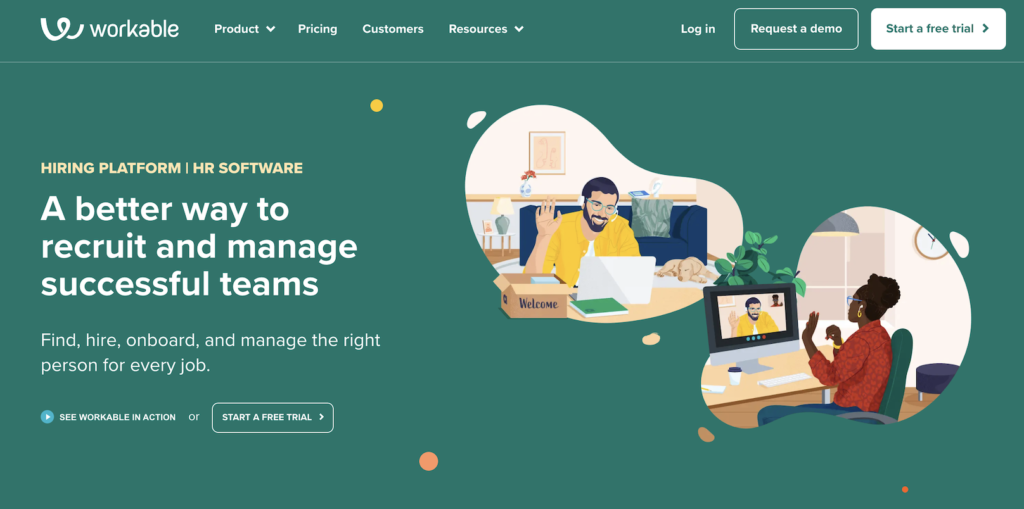
Workable is one of the few HR platforms that actually publishes its pricing — a rarity in this space, and something I genuinely appreciate. The Starter plan begins at $149/month for up to 50 employees, Standard runs $360/month, and Premier comes in at $599/month, all billed annually. There’s also a per-job option at $189/job/month for teams that hire sporadically.
When I tested the platform, the first thing that hit me was how fast the AI candidate sourcing moved. I drafted a job description for a mid-level UX role and within minutes, the Edera AI matching engine surfaced candidates from Workable’s 400M+ profile database, ranked by fit — not just keyword overlap. That’s a meaningful distinction.
The interview scheduling automation also impressed me. Instead of the usual back-and-forth email chains, candidates get a self-scheduling link connected to the hiring team’s calendar. It sounds simple, but it saves a real amount of time across a high-volume hiring cycle.
One honest friction point: Workable’s AI sourcing is genuinely useful on Standard and Premier, but on the Starter plan, it’s more limited than the marketing implies. A few of our readers who came from Workable Starter reported the same thing — they expected deeper sourcing and ended up needing a second tool. If sourcing is your primary use case, budget for at least the Standard plan.
The HRIS module (employee records, time tracking, self-service portal) has also matured considerably since the platform’s ATS-only days. It’s now a real option for teams that want to consolidate HR tools, though it’s still not as deep as a dedicated HRIS like BambooHR.
✅ What Works
- Transparent, published pricing tiers
- Fast AI candidate sourcing (Edera AI engine)
- Self-scheduling interview links save hours
- Posts to 200+ job boards automatically
- Strong API on Standard/Premier plans
- 15-day free trial with no credit card required
❌ What Doesn’t
- AI sourcing shallower on Starter tier
- HRIS features not deep enough to replace a dedicated platform
- Pricing jumps sharply as headcount grows
- No built-in payroll integration out of the box
Best for: Growing companies (10–250 employees) that are serious about structured hiring and want AI-assisted sourcing without paying enterprise rates. It’s also worth comparing against Deel’s full suite — I covered that matchup in detail in my Remote vs Deel vs Rippling comparison.
2. Eightfold.ai — Best Enterprise Talent Intelligence Platform

Let me be direct about Eightfold’s pricing: there’s no public price list. Based on analyst data from ITQlick and independent research aggregated in 2026, expect roughly $7–10 per employee per month, with large enterprise contracts typically falling in the $150,000–$500,000+ per year range. If you’re a 50-person startup, this is not the tool for you. If you’re a 10,000-person enterprise, the math starts to make sense.
What makes Eightfold genuinely different is that it doesn’t just read resumes — it reads skills, career trajectories, and potential. Its deep-learning engine is trained on over a billion career data points, which is why talent rediscovery is its most powerful feature. I’ve seen teams use it to find internal candidates for senior roles by querying skills rather than job titles. Someone who managed a technical project as a product manager shows up as a potential engineering lead candidate. That kind of insight is nearly impossible to surface manually.
The diversity and inclusion capabilities are also industry-leading. The platform can run blind screening — stripping names, schools, and demographic signals — and flag when a candidate pool lacks diversity before you reach the interview stage. That’s different from most tools that only flag bias after the fact.
Honest critique: Eightfold is not intuitive. Multiple G2 and Capterra reviews describe the UI as requiring significant ramp-up time, and I can confirm this — the interface is dense, and the learning curve is real. The platform is also not a sourcing tool. It excels at managing candidates already in your pipeline, not finding passive candidates from scratch. If you need both, budget for a separate sourcing layer. This is similar to how enterprise AI platforms like Abacus AI require deep configuration before they deliver ROI.
✅ What Works
- Skills-based matching goes beyond resumes
- Talent rediscovery from internal pools is exceptional
- Recognized leader in IDC MarketScape & Everest Group reports
- Powerful D&I insights and blind screening
- Covers full talent lifecycle: acquire, develop, retain
❌ What Doesn’t
- No published pricing — requires a discovery call
- Interface is steep to learn; expect a training period
- Not suitable for companies under ~1,000 employees
- Not a proactive sourcing tool for passive candidates
- No free trial or sandbox environment
Best for: Large enterprises (5,000+ employees) that need a strategic talent intelligence layer — not just ATS software. Particularly powerful for companies with high internal mobility potential or complex global workforces.
3. ClearCompany — Best End-to-End Talent Lifecycle Platform

ClearCompany — now often marketed as ClearCo — sits in an interesting position: it’s not the most advanced AI platform on this list, but it might be the most complete. It covers recruiting, onboarding, performance management, engagement surveys, learning, and workforce analytics in one system. For HR teams that are tired of stitching together five different tools, that’s genuinely valuable.
Pricing has two dimensions, which caught my attention during testing. The ATS and recruiting modules are priced per HR team seat, while the performance management and engagement modules are priced per total employee headcount. Buy both, and you’re paying on two axes simultaneously. A 200-person company with a 5-person HR team could reasonably be looking at $300–$400/month for recruiting seats plus $1,400–$2,000/month for the full suite. That’s worth modelling before you sign.
The AI features in 2026 are meaningful. The AI Sourcing Engine helps surface external candidates, AI Talent Match scores applicants against your ideal profiles, and the AI Notetaker captures interview notes automatically. These are bundled under what ClearCompany calls the Talent AI Suite — though it’s worth asking your sales rep explicitly which AI features are included in your tier and which require an upgrade.
Where I found friction: there’s no free trial, and implementation through their ClearCare service adds 6–8 weeks and professional services fees on top of your base contract. The analytics on turnover, compensation equity, and diversity are genuinely strong once you’re configured, but getting there takes patience.
For teams evaluating whether an all-in-one platform makes sense financially, I’d also recommend reading my overview of how enterprise business software decisions get structured — the same ROI framework applies to HR platforms.
✅ What Works
- Covers the full talent lifecycle in one system
- AI Sourcing Engine and AI Notetaker genuinely reduce admin
- Strong analytics: turnover trends, compensation equity, D&I
- Supports 3,000 organizations and 1.8M employees (proven scale)
- Good onboarding UX — feels warm, not robotic
❌ What Doesn’t
- Dual pricing model (per-user + per-employee) can compound quickly
- No free plan or trial period
- 6–8 week implementation timeline with extra professional services cost
- AI feature tier inclusion isn’t always clearly documented
Best for: Mid-market companies (50–1,000 employees) that want one system for the entire employee journey and are willing to invest in proper implementation upfront.
4. Textio — Best AI Tool for Inclusive Hiring Language

Textio is the narrowest specialist on this list — and I mean that as a compliment. It does one thing extremely well: it analyzes the language in your job descriptions and performance reviews in real time and tells you exactly where you’re losing people.
Pricing starts around $10,000/year for the standard plan, with enterprise contracts commonly reaching $45,000–$120,000 annually depending on team size and whether you’re using Textio Hire, Textio Perform, or both. It integrates directly with Workday, Greenhouse, and Outlook via browser extension — meaning you can get real-time feedback inside tools you’re already using.
When I tested Textio on actual job descriptions, the feedback was sharp. It flagged phrases that skew masculine or feminine in their appeal, identified corporate jargon that reduces application rates, and offered specific rewrites — not just warnings. The phrase-level suggestions are trained on patterns across millions of job posts, so the recommendations are data-backed, not just stylistic opinion.
Textio Perform extends the same logic to performance reviews. It flags when manager feedback is vague, unfair, or inconsistent across employee groups — the kind of systemic bias that’s nearly impossible to catch manually at scale.
The honest limit: Textio is primarily an English-language tool. Its bias detection datasets are deeply tied to English syntax and cultural nuance. If you’re writing job posts in French, German, or Spanish, its effectiveness drops considerably. It’s also not a fit for very small businesses — the price point and feature depth are built for mid-to-large teams with dedicated HR professionals. This is similar to how specialized AI tools I’ve reviewed in clinical intelligence and other professional niches work — precision tools for specific workflows, not general-purpose solutions.
✅ What Works
- Real-time bias detection in job descriptions
- Performance review analysis for manager consistency
- Integrates inside Workday, Greenhouse, Outlook
- Data-backed phrase-level suggestions (not just flags)
- Measurably improves diversity of applicant pools
❌ What Doesn’t
- English-only effectiveness for bias detection
- Not a fit for very small teams (price vs. value)
- Doesn’t cover recruitment workflow — purely a language layer
- No free plan or trial
Best for: Mid-to-large enterprises with dedicated recruiting teams that care seriously about inclusive hiring and consistent performance feedback. Often used alongside an ATS, not instead of one.
5. Deel Engage — Best AI HR Software for Global Teams

Deel’s evolution from payroll tool to full HR platform is one of the more interesting stories in this space over the past two years. Deel Engage — priced at $20/employee/month — is the performance and learning layer that sits on top of the free Deel HR core (which is free for up to 200 employees).
What Engage does differently is package performance management, 360-degree feedback, learning management, career frameworks, and engagement surveys in a single module designed to work across 150+ countries. The platform automatically handles local compliance nuances — review cadences that differ by region, training requirements mandated by local law, even how performance ratings translate across different cultural contexts.
The AI career framework generator is the feature I found most useful during testing. You describe a role, the AI drafts a competency matrix with levels, expectations, and growth indicators — something that typically takes an HR consultant several days to produce manually. The draft isn’t always perfect, but it’s a strong starting point that saves meaningful time.
Deel became a certified Workday Global Payroll Cloud partner in early 2026, which meaningfully improves its integration story for teams already on Workday. It also integrates natively with QuickBooks, Xero, NetSuite, Greenhouse, and Lever, among 130+ total integrations.
Where it gets complicated: Deel’s pricing is layered. The $20/employee/month for Engage sits on top of other potential costs depending on how you’re using Deel overall. EOR services run $599/employee/month, Global Payroll is $29/employee/month, and the base HR module is $5/employee/month. If you’re already a Deel customer, Engage is a natural upsell. If you’re evaluating it purely as an HR engagement tool, the compounding cost model requires careful modelling before you sign.
For teams managing global contractors and employees across multiple countries, the peace of mind around compliance alone often justifies the cost. Think of it like using a specialized business management platform that reduces the compliance surface you need to manage manually.
✅ What Works
- $20/employee/mo is transparent and competitive
- Handles global compliance (150+ countries) natively
- AI career framework drafts save significant time
- Deep integration with payroll — same data, no duplication
- Workday Global Payroll Cloud certified (2026)
- SOC 2, ISO 27001, GDPR compliant
❌ What Doesn’t
- Costs compound quickly if you use multiple Deel modules
- Not a standalone ATS — focused on engage/develop, not hire
- Admin UX for company-side users needs polish
- EOR deposit (1–1.5x monthly cost) is an upfront cash obligation many don’t anticipate
Best for: Companies with distributed or global teams of 20+ employees who want performance management, learning, and career development handled in the same platform as their payroll and compliance.
6. Effy AI — Best Lightweight Tool for 360-Degree Feedback

Effy AI earns its place on this list by doing one thing better than any other tool here: making 360-degree feedback painless. If you’ve ever run a review cycle with Excel sheets and Microsoft Forms, you’ll appreciate exactly what Effy is solving.
Pricing is the most accessible on this list. Teams of up to 5 users get permanent free access. Paid plans start at $1,800/year for the Employee Reviews plan (50 members) and $3,600/year for the Performance Management plan (50 members). At approximately $3/seat/month for growing teams, it’s a fraction of what enterprise platforms charge.
The AI-generated review summaries are the feature I kept coming back to during testing. Instead of manually reading through 15 paragraphs of peer feedback, Effy’s AI condenses it into a concise summary with clear themes, development areas, and strengths. The underlying feedback data is preserved — you can always drill in — but the summary saves an enormous amount of manager time during review season.
Setup is fast. The platform claims you can launch your first 360 review cycle within 60 seconds, which I thought was marketing fluff — but the template library and AI-generated question bank made it genuinely close. I had a mock review cycle live in under 10 minutes. Slack integration means review notifications land directly where your team already lives.
Where it falls short: Effy is not a full HR platform. There’s no ATS, no payroll, no compliance module. Some advanced features are still in development according to recent G2 reviews. If you need a deep performance management system with OKRs, succession planning, or complex review calibration, you’ll outgrow Effy and need to move to something like Lattice, Culture Amp, or Leapsome.
But for small-to-mid-size teams that want to run meaningful, structured 360 reviews without buying an enterprise platform, Effy is the most accessible entry point I’ve found. It’s the kind of focused tool I often recommend for teams just starting to formalize their performance processes — similar to how I’d point someone toward a specialized AI proposal tool rather than a full CRM when their needs are scoped.
✅ What Works
- Free permanently for teams up to 5 users
- AI-generated review summaries save hours of reading
- Launch a review cycle in under 10 minutes
- Slack integration keeps feedback where teams work
- GDPR and CCPA compliant
- ~$3/seat/month is exceptional value
❌ What Doesn’t
- Not a full HR platform — no ATS, payroll, or compliance
- Some advanced features still rolling out
- Limited customization for complex calibration workflows
- Will be outgrown by teams needing enterprise-grade depth
Best for: Small-to-mid-size businesses (5–200 employees) that want fast, AI-assisted 360 reviews without the complexity or cost of enterprise performance management platforms.
Which AI HR Tool Fits Your Stage?
The biggest mistake I see HR teams make is evaluating tools by feature count instead of fit. Here’s a practical decision guide based on company stage and primary pain point:
Start with Effy AI (free) — Run basic 360 reviews and get feedback processes in place without spending anything.
Workable Starter ($149/mo) — Add structured ATS and AI sourcing as hiring volume picks up.
ClearCompany or Deel Engage — Move to full lifecycle management or a global engagement layer depending on your distributed footprint.
ClearCompany + Textio — Layer inclusive language analysis on top of a full talent lifecycle platform for measurable D&I impact.
Eightfold.ai — Enterprise talent intelligence that surfaces internal mobility opportunities and supports workforce planning at scale.
What AI HR Software Actually Changes (And What It Doesn’t)
After testing all six of these platforms, here’s my honest read on where AI HR software genuinely delivers versus where it still requires serious human judgment.
Where it genuinely helps
Removing unconscious bias from hiring language is one of the clearest wins I’ve seen. Textio data shows measurable improvements in applicant pool diversity after teams switch to AI-guided job descriptions — not because the AI is doing the hiring, but because it catches language patterns that humans don’t notice themselves.
Speeding up admin-heavy processes is the other reliable win. Review cycle prep, interview scheduling, candidate deduplication, onboarding task routing — these are genuinely accelerated. Effy’s ability to turn a week-long review compilation into a 10-minute AI summary is a real time saving, not a gimmick.
Internal mobility insights from platforms like Eightfold genuinely change retention conversations. When an employee knows there’s a documented skills-to-role pathway inside the company, the “I have to leave to grow” narrative weakens.
Where humans still need to lead
No AI platform makes a final hire decision well on its own. The tools I tested score, rank, and surface — but the contextual judgment about team chemistry, communication style, and cultural add still comes from people. Treat AI scoring as input, not verdict.
Change management is entirely human. The single biggest implementation failure I’ve seen is deploying an AI HR tool without preparing the team. When employees hear “AI is reviewing my performance,” the default reaction is suspicion. Clear, early communication about how the tool works and what data it uses is not optional — it’s the difference between adoption and resistance. The same applies when companies roll out any new AI-powered SaaS platform to their workforce.
Data privacy due diligence is also non-negotiable. Before feeding employee performance data into any of these platforms, your legal and compliance team needs to be involved. GDPR in Europe and CCPA in California both have specific requirements around automated decision-making. All six tools on this list have compliance frameworks — but how you configure them determines whether you’re covered.
Feature Coverage Matrix
| Feature | Workable | Eightfold | ClearCompany | Textio | Deel Engage | Effy AI |
|---|---|---|---|---|---|---|
| AI Candidate Sourcing | ✅ | ✅ | ✅ | ❌ | ❌ | ❌ |
| Performance Management | 〜 | ✅ | ✅ | ✅ | ✅ | ✅ |
| 360-Degree Feedback | ❌ | ✅ | ✅ | ✅ | ✅ | ✅ |
| Bias Detection / D&I Tools | 〜 | ✅ | ✅ | ✅ | 〜 | ❌ |
| Global / Multi-Country Support | 〜 | ✅ | 〜 | ❌ | ✅ | 〜 |
| Learning Management System | ❌ | ✅ | ✅ | ❌ | ✅ | ❌ |
| Free Plan Available | ❌ | ❌ | ❌ | ❌ | ✅ | ✅ |
| SMB-Friendly Pricing | ✅ | ❌ | 〜 | ❌ | 〜 | ✅ |
✅ Full support 〜 Partial / limited ❌ Not available
How to Choose the Right AI HR Software for Your Team
Don’t start with the software. Start with the problem. After testing these platforms, here’s the framework I’d use:
Identify your single biggest pain point. Is it filling roles too slowly? Retaining top performers? Running meaningful feedback cycles? Running fair performance reviews? Pick one thing to solve first. Every platform on this list is excellent at something specific and imperfect at everything else.
Model the real cost, not the headline price. Workable’s $149/month Starter plan looks affordable until you realize AI sourcing isn’t fully unlocked. Eightfold’s $7–10/employee/month sounds reasonable until you multiply it by 5,000 employees and add implementation fees. ClearCompany’s dual pricing model compounds. Always build a 12-month cost model before committing. If you need help thinking through software procurement frameworks, my overview of what enterprise procurement software is actually used for covers the decision-making structure in detail.
Demand a real sandbox, not just a sales demo. Every platform on this list will show you a polished demo with curated data. Ask for a sandbox environment where you can load your own job descriptions, run a mock review cycle, or test an integration with your existing HRIS. If a vendor refuses, that tells you something.
Check the integration story early. The worst time to discover that a tool doesn’t talk cleanly to your existing payroll system is after you’ve signed an annual contract. Map out your current stack — ATS, HRIS, payroll, Slack, calendar — and verify each integration before you commit. This is particularly true for AI tools, which often require data pipelines that need IT involvement to configure. I wrote about similar considerations when evaluating AI agent frameworks for workflow automation — the integration architecture questions are identical.
Evaluate the support tier, not just the feature list. ClearCompany’s 6–8 week implementation timeline is only manageable if their support team is responsive and experienced. Eightfold’s complex interface is only viable if onboarding is properly resourced. Read recent support reviews on G2 specifically — not just overall ratings. The question to ask: “What happens when something breaks during our first review cycle?”
Frequently Asked Questions
What is AI HR software?
AI HR software uses machine learning and natural language processing to automate and improve human resources tasks — including candidate sourcing, resume screening, performance review generation, bias detection in job descriptions, and predictive retention analytics. Unlike traditional HR software that stores and retrieves data, AI HR tools actively analyze patterns and make recommendations.
Which AI HR software is best for small businesses?
For small businesses (under 50 employees), Effy AI is the strongest starting point — permanently free for up to 5 users, with paid plans from $1,800/year. Workable’s Starter plan at $149/month is the best option once you’re hiring consistently and need AI-assisted candidate sourcing and an ATS. Both offer meaningful AI features without enterprise-level pricing.
Does AI HR software replace HR professionals?
No — and any vendor who implies otherwise is overstating their product. AI HR software eliminates repetitive admin tasks (scheduling, form compilation, candidate deduplication, summary generation) and surfaces data patterns humans would miss. But final hiring decisions, employee relations, culture building, and nuanced performance coaching all require human judgment. The best outcome is HR teams spending less time on process and more time on people.
Is AI bias in HR software a real concern?
Yes, it’s real and worth taking seriously. AI models trained on historical hiring data can inherit and amplify existing biases — for example, deprioritizing candidates from certain universities or with non-linear career paths if those patterns weren’t in past successful hires. The best platforms (Eightfold, Textio, ClearCompany) include bias audit tools and allow blind screening. Always ask vendors how their models are trained, what data is used for scoring, and whether algorithmic audits are available. This matters for both ethical and legal compliance reasons in 2026.
What’s the difference between an ATS and AI HR software?
An Applicant Tracking System (ATS) is primarily a database and workflow tool — it stores candidate information and tracks them through a hiring pipeline. AI HR software adds intelligence on top of that: scoring candidates against role requirements, predicting attrition risk, generating performance summaries, and detecting bias in written communication. Workable and ClearCompany are both — they have ATS functionality built in alongside genuine AI layers. Textio and Effy are AI-only tools that sit on top of your existing workflow.
How does Deel Engage compare to standalone performance management tools?
Deel Engage at $20/employee/month is competitively priced compared to dedicated performance platforms like Lattice or Culture Amp (which typically start at $4–11/person/month for basic plans but scale significantly). The core advantage of Deel Engage is that it runs in the same system as your payroll and compliance data — meaning performance data is connected to real compensation figures and headcount plans without any integration work. For global teams already on Deel, it’s the most seamless option available in 2026.
Can AI HR software improve employee retention?
It can significantly improve the inputs to retention — clearer career paths (Deel Engage’s AI career frameworks), better feedback (Effy’s 360 summaries), more equitable performance reviews (Textio Perform), and early identification of attrition risk signals (Eightfold’s workforce analytics). What it can’t do is replace the managerial conversations and cultural conditions that actually keep people. Think of it as a diagnostic tool that tells you where the problems are — the fixing still happens between people.
Conclusion
After weeks of hands-on testing, the clearest conclusion I can offer is this: the best AI HR software in 2026 isn’t the most feature-rich platform — it’s the one that solves your specific problem without creating new ones.
Workable is my pick for teams where hiring is the primary focus and transparency in pricing matters. Eightfold.ai is genuinely transformative at enterprise scale, particularly for internal mobility. ClearCompany wins for teams that want one platform to handle the entire employee journey. Textio is the right specialist tool if inclusive hiring language and fair performance reviews are strategic priorities. Deel Engage is the strongest option for distributed global teams who want performance and learning connected to payroll data. And Effy AI remains the best entry point for small teams running their first structured 360 review process.
The tools I didn’t love as much? The ones that oversold AI capabilities in the demo but required heavy manual configuration to deliver anything close to what was shown. That gap between marketing and reality is still the most common disappointment in this category.
My honest advice: start with a trial, run it on a real workflow — not a toy scenario — and evaluate based on what the tool actually does for your team in its first 30 days. That’s a better signal than any analyst report or feature comparison chart, including this one.
For further context on evaluating AI platforms broadly, my piece on how to assess whether a new AI tool is genuinely safe covers the data privacy and vendor diligence angle worth reading before you sign any contract. And if you’re weighing how AI-generated content fits into broader workflows — which often comes up in HR communications — my comparison of AI vs human content writing is worth a read as well.