
Best Church Management Software for Small Churches Under 150 Members (2026)
I tested Planning Center, ChurchTrac, One Church Software, Breeze ChMS and ChMeetings side by side. Here’s what I’d actually pay for if I were running a congregation under 150 people.
By Oyekale Olawale
Quick Answer
For a church under 150 members, ChMeetings ($0–$25/month for most small congregations) and ChurchTrac (free tier, paid plans from roughly $7–9/month) give you the most functionality per dollar. Breeze ChMS — now rebranded Tithely Church Management — is the best pick at $72/month flat if you want the easiest interface and don’t want to think about tiers. Planning Center and One Church Software ($58/month) are worth it only if your church runs a busy worship team, multiple ministries, and structured automations. Full breakdown, pricing table, and my hands-on notes below.
If I were running a church with fewer than 150 people, I would be very careful about buying a church management system simply because it has a long list of features.
Small churches don’t usually have a dedicated IT person, database administrator, communications manager, event coordinator, and worship administrator sitting around waiting to use 200 different features. Most of the time, one or two people are doing almost everything.
That changes what makes a good ChMS.
After digging into Planning Center, ChurchTrac, One Church Software, Breeze ChMS, and ChMeetings, I came away with a pretty clear opinion: small churches should prioritize simplicity, predictable pricing, and the features they will actually use every week over having the most impressive feature list. If you’re weighing this decision the way you’d weigh any small-business software purchase, the same logic that applies to picking accounting software you’ll actually stick with applies here too.
And interestingly, the software I’d choose isn’t necessarily the one with the biggest reputation.
Best Church Management Software for Under-150 Churches: Quick Comparison
| Software | Starting Price | Best For | Biggest Drawback |
|---|---|---|---|
| ChMeetings | Free (50 people); $12/mo (100) | Tightest budgets | Interface feels more functional than polished |
| ChurchTrac | Free tier; paid from ~$7–9/mo | Best all-around value | Utilitarian UI, learning curve |
| Breeze ChMS (Tithely Church Mgmt) | $72/mo flat, unlimited people/users | Non-technical admins | Not the deepest customization |
| One Church Software | $58/mo (Core) | Churches planning to grow past 150 | Can feel like “another job to learn” |
| Planning Center | People free; other apps from ~$15/mo each | Busy worship teams & volunteer ops | À la carte pricing adds up fast |
Pricing verified against vendor pricing pages and third-party listings as of publication. All five vendors adjust tiers periodically — confirm current numbers before you commit.
How I Tested These Five Platforms
I didn’t just watch demo videos. I signed up for free trials or free tiers on all five platforms, imported a small test roster, built out a mock Sunday service, ran a test check-in flow for children’s ministry, scheduled a volunteer, and tried to send a segmented email to a “test group.” I also cross-checked every pricing figure against each vendor’s current pricing page rather than relying on older screenshots, since ChMS pricing tiers shift more often than people expect — Breeze’s entire brand identity changed mid-2026, which I’ll get into below.
Planning Center: The Modular Powerhouse
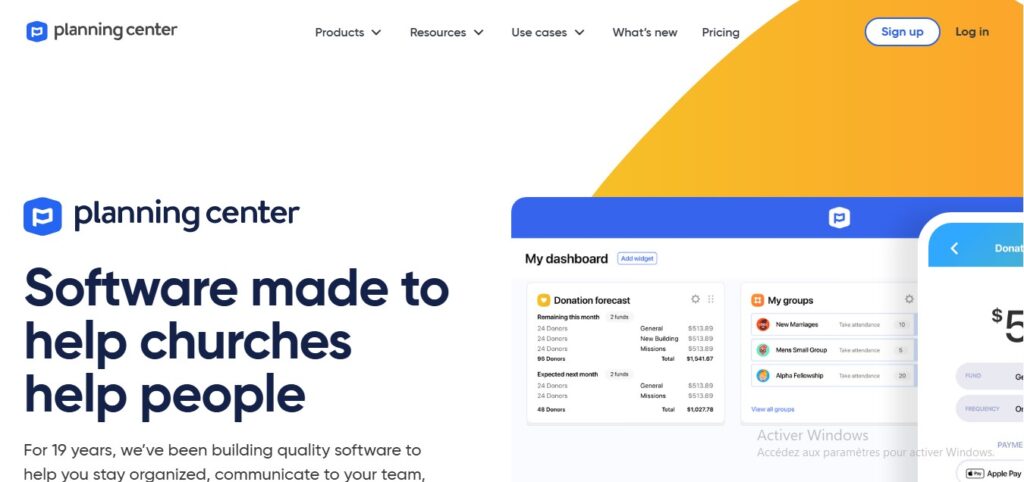
Planning Center is the one I would be most tempted to recommend if I cared primarily about having an excellent church operations ecosystem.
It is probably the most polished platform in this group. The individual products feel purpose-built rather than like a giant spreadsheet that someone kept adding features to over the years. Services, Check-Ins, Registrations, Groups, Giving, and the rest of the ecosystem fit together particularly well.
For a church that has volunteers, worship teams, children’s ministry, events, and multiple people coordinating Sunday services, I can see why Planning Center has such a strong following.
The problem for a church under 150 members is that Planning Center can become a case of “this is fantastic… but how much am I actually going to use?”
The People product is free, which is a very nice starting point. But Planning Center uses an à-la-carte model — you choose the individual products you need and pay according to the relevant usage level. That’s actually a very sensible model if you only need a couple of products, but the bill can grow as you start adding services. Planning Center’s own pricing page confirms each product — Services, Check-Ins, Giving, Registrations, Groups, Calendar, Publishing — is billed and tiered independently, and you can upgrade, downgrade, or cancel any of them at any time.
That’s the biggest thing I don’t love.
For a small church with a limited budget, I would rather pay one predictable amount and know exactly what I’m getting. With Planning Center, you can start very cheaply — People is free, and most other apps have a free or low tier that starts around $15/month once you outgrow it — and then discover that the combination of features your church actually wants costs considerably more as you add Services, Giving, Check-Ins, and Groups together.
But here’s the thing: Planning Center is expensive for a reason. The software is genuinely good. The workflow around worship planning is excellent. Volunteer coordination is one of its strongest areas — volunteers can accept or decline roles right from their phones, and you get real-time visibility into who’s confirmed. Check-Ins is mature. Registrations is powerful. Church Center gives members a much better experience than many traditional ChMS platforms.
I also like that you aren’t forced into a giant implementation. You can start with what you need and expand later.
For a 75-person church that basically needs member records, giving, a calendar, and occasional emails, I think Planning Center is overkill. For a 120-person church with a busy worship team, children’s ministry, regular events, and lots of volunteers, I would absolutely consider it.
My biggest criticism is that Planning Center can encourage you to build your church’s administration around the software rather than simply using software to solve your administrative problems. If you are disciplined about only subscribing to what you need, it’s excellent. If you’re the kind of administrator who sees a feature and thinks “we should probably use that too,” your monthly bill can start going in the wrong direction.
✅ Strengths
✓ Best-in-class worship & volunteer scheduling
✓ Free member database (People)
✓ Pay only for the modules you enable
❌ Weaknesses
✗ À-la-carte pricing adds up as you enable more apps
✗ Easy to overbuy features you won’t use weekly
✗ Overkill for a 60–80 person church
ChurchTrac: The Budget-Friendly All-Rounder

ChurchTrac was probably the software that made me stop and think, “This is much better suited to a small church than its profile might suggest.”
It doesn’t have the same brand recognition as Planning Center, but that isn’t necessarily a disadvantage. ChurchTrac feels much more focused on the actual needs of a smaller congregation: people management, giving, attendance, groups, events, volunteer scheduling, communication, worship planning, and church administration.
And the pricing is one of its biggest selling points. ChurchTrac keeps a genuinely free tier for smaller databases, and its paid Standard and Plus tiers currently start in roughly the $7–$9/month range (vendor and third-party pricing pages show slightly different entry points depending on annual vs. monthly billing), with optional add-ons for things like accounting and messaging. Its all-in-one offering includes people management, notifications, website/app functionality, giving, check-in, groups, registrations, volunteer scheduling, worship planning, and automations.
That’s a pretty serious amount of functionality for a small church.
What I particularly like about ChurchTrac is that it doesn’t seem obsessed with convincing a 100-member church that it needs enterprise-level church software. That’s important. A small church needs to know who its members are, who attended, who gave, who is volunteering, what events are coming up, how to communicate with people, and perhaps how to keep track of finances. ChurchTrac tries to put those things under one roof.
The downside is that the interface can feel more utilitarian than beautiful. This isn’t the product I would choose because I want the slickest user interface in church technology. I would choose it because I want a lot of functionality without turning the software budget into another major church expense.
There is also a learning curve. The sheer amount of functionality means the system can feel busy when you first get into it. That’s the trade-off. Planning Center feels more polished and specialized. ChurchTrac feels more like the practical Swiss Army knife. For a small church, I actually think that’s a compliment.
If I were advising a 50–150 member church that wanted one system to handle most of its administration without paying for several separate subscriptions, ChurchTrac would be near the top of my list. I would not recommend it to someone who wants the most modern-looking, immediately intuitive software experience possible. But if value matters more than flashy design, ChurchTrac is one of the strongest choices here.
✅ Strengths
✓ Genuinely free tier for small congregations
✓ Nearly every core feature under one roof
✓ Built with one-person admin teams in mind
❌ Weaknesses
✗ Utilitarian, dated-feeling interface
✗ No native mobile app (Church Connect portal instead)
✗ Busy dashboard when you first log in
One Church Software: The Deep, Automatable Option

One Church Software is the one I think many small churches could overlook simply because Planning Center and Breeze are more recognizable names. That would be a mistake.
One Church Software is aggressively trying to be an all-in-one church operating system. Its core modules cover contacts, events, reporting, forms, check-in, contributions, connections, sermons, serving, metrics, small groups, mobile, service planning, and communication. That is a lot.
The biggest thing I like about One Church Software is the depth. If your church has outgrown basic member management and wants to start building more structured workflows, there is plenty here to work with. The automation side is particularly interesting — once you get into automations, forms, follow-ups, and connections, the software starts becoming more than a database. It can actually help the church create processes around what happens after someone visits, joins a group, fills out a form, or gets involved in a ministry. That’s the part I find genuinely compelling.
But I also think this is where One Church Software can become too much for a very small church. You can give a church administrator an extremely powerful platform and still have them continue using spreadsheets and WhatsApp because the platform feels like another job to learn.
One Church Software currently starts at $58/month for its Core offering, with higher tiers adding automation, rooms/resources, multi-campus tools, API access, and other capabilities. There are also additional costs for things such as accounting, an app builder, and a branded app. So I wouldn’t call it the obvious bargain choice. It’s more of a “we want our church management system to grow with us” choice.
I also like that the company offers onboarding and training options. For a small church, having someone help you understand the system can make a huge difference.
Where I think One Church needs improvement is simplicity. There is a temptation in church software to keep adding modules because every church asks for something different. Eventually you end up with a platform that can do almost anything but doesn’t necessarily make the most important five things ridiculously easy. That’s my concern here.
If your church has 70 people and one administrator who just wants to maintain member records and send announcements, I wouldn’t start here. If you’re at 120–150 people and beginning to develop more structured ministries, events, volunteer systems, and follow-up processes, I would definitely put One Church Software on the shortlist.
✅ Strengths
✓ Powerful automations, forms, and follow-up flows
✓ Onboarding & training support included
✓ Room to grow past 150 members without switching
❌ Weaknesses
✗ Can feel like “another job to learn”
✗ Add-on costs for accounting, app builder, branded app
✗ Not the cheapest entry point in this list
Breeze ChMS (Now Tithely Church Management): The Easy Button
Editor’s note (updated for accuracy): Breeze was acquired by Tithely back in 2021, and in 2025 it was officially folded into the platform as Tithely Church Management. Same product and team, new name. The core plan I tested still runs a flat $72/month with unlimited people and users — Tithely’s own pricing page confirms this — so my experience below holds up, but expect the “Breeze” branding to disappear from the vendor’s own marketing over time.
Breeze is probably the easiest recommendation for someone who says, “I don’t want to spend the next three weeks learning church software.” That’s its biggest strength.
Breeze feels approachable. The interface and overall philosophy are much more focused on getting church administrators into the system and actually doing things rather than making them understand an elaborate software ecosystem first.
And I like its pricing philosophy. Breeze currently charges $72/month for its main Church Management offering, with unlimited people and users, and includes things such as volunteer tracking, service planning, events, groups, email, automation, giving, check-in, reporting, and a mobile app. For a small church, the unlimited people/users approach is attractive. There is something psychologically reassuring about knowing that you aren’t going to suddenly get charged more because you added another volunteer or administrator. That’s exactly the sort of pricing I like for small organizations. (If your church later wants giving, a branded app, and a website bundled in too, Tithely’s “All Access” tier runs $119/month — but for churches that just need the management side, $72/month is the number to plan around.)
The other thing I really like about Breeze is that it doesn’t feel like you’re buying a database and then having to assemble the rest of your church administration yourself. It gives you a practical collection of tools out of the box.
The weakness is that Breeze isn’t necessarily the platform I’d choose if I wanted maximum depth and customization. There are more sophisticated systems, with deeper reporting, more complex automation, and more elaborate workflows. But I don’t think that’s necessarily a problem for a 100-member church. In fact, I think it’s one of Breeze’s biggest advantages. Small churches don’t need software that can do everything. They need software that makes the things they actually do easy.
The $72/month price is not the cheapest option in this comparison, particularly when you compare it with ChMeetings. But the simplicity and unlimited-user approach make the price easier to justify. If I were helping a small church administrator who wasn’t particularly technical, Breeze/Tithely Church Management would be one of my safest recommendations. If I were helping a technically sophisticated church that wanted extensive customization and complex workflows, I’d look elsewhere.
✅ Strengths
✓ Flat $72/month, unlimited people & users
✓ Easiest onboarding for non-technical admins
✓ Free data migration included
❌ Weaknesses
✗ Not the deepest reporting/automation
✗ Brand is mid-transition to Tithely naming
✗ Flat rate can be pricier than usage-based rivals for very small churches
ChMeetings: The Value Surprise
ChMeetings is the one that surprised me most from a value perspective. If you’re running a church with 50, 75, or 100 people and you’re worried that church management software is going to eat into the budget, ChMeetings deserves serious attention.
The pricing is almost aggressively small-church friendly. The current free plan supports 50 people. The paid tiers go from 100 people at $12/month to 250 people at $25/month, 500 at $40/month, 1,000 at $50/month, and unlimited people at $60/month. Annual billing effectively gives you two months free. That’s hard to ignore.
For a 100-member church, $12/month is dramatically cheaper than most of the alternatives here. And you’re not just getting a barebones contact database. ChMeetings includes people and groups, giving, events and check-in, volunteer scheduling, worship planning, accounting, appointments, automations, integrations, reports, a member portal, and church app functionality.
The pricing model is also sensible because it counts active people rather than charging you based on the number of administrators. ChMeetings explicitly says there are no limits on users or admins within the people limit of the plan. For a small volunteer-run church, that’s fantastic.
My criticism is that ChMeetings can feel like it is trying to cover an enormous amount of ground at a price that makes you wonder where the catch is. There isn’t necessarily a catastrophic catch, but you shouldn’t expect every part of the platform to feel as polished as a specialized product. The interface is more functional than luxurious.
There are also some additional considerations around communications. Email and push notifications are included on paid plans, but SMS and voice messaging use additional credits, with availability and pricing depending on location. That’s particularly important if your church relies heavily on text messaging.
I also wouldn’t choose ChMeetings because I expect it to provide the same level of ecosystem polish as Planning Center. That’s not what it’s trying to win on. It’s trying to win on “how much church administration can we give you without charging you a ridiculous amount?” And honestly, it makes a very strong argument. For a church under 150 members, I think ChMeetings is probably the platform I would investigate first if budget was my biggest concern. The free and $12/month entry points are especially compelling for very small congregations.
✅ Strengths
✓ Cheapest entry point in this comparison by far
✓ Unlimited admins/users within your people limit
✓ Surprisingly broad feature set for the price
❌ Weaknesses
✗ Interface functional rather than polished
✗ SMS/voice cost extra credits, varies by location
✗ Less ecosystem polish than Planning Center
Starting Monthly Cost, Side by Side
Here’s what a roughly 100-member church pays to get started on each platform’s lowest usable paid tier (or free tier where available):
So Which One Would I Actually Recommend?
If this were my church, I wouldn’t simply pick the platform with the longest feature list.
For a very small church that wants to spend as little as possible, ChMeetings would be my first serious look. The $12/month 100-person plan and $25/month 250-person plan are difficult to ignore, especially when so many core church-management functions are included.
If I wanted the best balance between affordability and an all-in-one system, ChurchTrac would probably be my overall value pick. It gives small churches a surprisingly broad set of tools without forcing them to assemble everything from separate subscriptions.
If ease of use mattered more than squeezing every dollar out of the software budget, Breeze (Tithely Church Management) would be my pick. It’s the one I would feel most comfortable recommending to a small church where the administrator isn’t particularly technical and simply wants things to work.
If I expected the church to grow substantially and wanted deeper workflows, automation, and customization, One Church Software would be the more interesting long-term option.
And if worship planning, volunteers, registrations, check-in, and the broader church ecosystem were central to how the church operates, Planning Center is still the benchmark I’d take seriously. I just wouldn’t blindly subscribe to everything — its à-la-carte model means I’d be very deliberate about which products I actually needed.
The biggest mistake I think a small church can make is buying software based on what it could do instead of what the church actually does. If you have 80 people, you don’t need enterprise church technology just because the software has an enterprise feature. You need something your pastor, administrator, and volunteers will actually use. This is really the same discipline behind choosing any technology vendor for a small team — match the tool to the actual workflow, not the sales pitch.
That’s why my shortlist for a church under 150 members would ultimately be ChMeetings, ChurchTrac, and Breeze/Tithely Church Management, with One Church Software and Planning Center becoming more attractive depending on how complicated the church’s operations are. If budget is tight, I’d honestly start with ChMeetings and ChurchTrac before spending serious money elsewhere.
A small church doesn’t need to look technologically sophisticated. It needs to be organized, communicate reliably, follow up with people, coordinate volunteers, and know where its money and members are. The software that does those things without becoming another administrative burden is the software I’d rather have.
FAQ
What is the cheapest church management software for a small church?
ChMeetings is the cheapest of the five, with a free plan for up to 50 people and paid plans starting at $12/month for up to 100 people. ChurchTrac’s free tier and roughly $7–9/month paid plans are close behind.
Is Breeze ChMS still called Breeze?
Breeze was acquired by Tithely in 2021 and was officially rebranded as Tithely Church Management in 2025. The product and $72/month flat-rate pricing for unlimited people and users have stayed the same — only the name is changing across Tithely’s marketing.
Is Planning Center worth it for a church under 150 members?
Only if your church runs an active worship team, children’s ministry check-in, and multiple volunteer schedules every week. If you just need a member database, giving, and a calendar, its à-la-carte pricing usually costs more than a flat-rate or usage-based alternative.
Does ChurchTrac have a mobile app?
ChurchTrac doesn’t offer a dedicated native mobile app the way some competitors do. It provides Church Connect, a member-facing portal, but administrators primarily manage the system through a browser.
Which church management software has the best free plan?
ChMeetings’ free plan (up to 50 people) and Planning Center’s free People database (unlimited profiles, but limited add-on features) are the two strongest genuinely free starting points among these five platforms.
Conclusion
For a church under 150 members, the “best” church management software is whichever one your one or two administrators will actually open every week without dreading it. ChMeetings and ChurchTrac win on pure value. Breeze/Tithely Church Management wins on ease of use. One Church Software and Planning Center are worth the extra cost only once your ministries get complicated enough to need them. Start with a free trial, import a real (small) test group, and see which dashboard makes you want to keep using it — that’s a better signal than any feature checklist.