
Perplexity SEO Rank Tracking Software in 2026: 11 Tools Tested, Compared & Priced
I ran the same 40 branded and category prompts through ZipTie, Peec AI, Rankability, Otterly, and eight other Perplexity trackers. Here’s what actually held up, what the pricing pages don’t tell you, and which tool I’d pay for myself.
By Oyekale Olawale · Updated August 2026
⚡ Quick Answer
ZipTie.dev ($69/month) is still the most accurate dedicated Perplexity + AI Overview tracker and the one working SEOs like Lily Ray actually cite by name. If you need Perplexity alongside five or more engines with MCP access into Claude and Cursor, Peec AI (from $95/month) is the better buy. On a tight budget, Otterly AI ($29/month) gets you real daily tracking for less than a Netflix subscription. If you want tracking and content fixes in one place, Rankability (from $99/month) closes that loop.
Traffic from Perplexity doesn’t behave like Google traffic. A client of mine lost 18% of organic sessions in a single week last quarter, and Google Search Console showed nothing wrong. Rankings hadn’t moved. It took me two days to figure out Perplexity had quietly swapped us out for a competitor in its answer for our biggest branded query. That’s the blind spot this whole software category exists to close.
I re-tested every tool on this list in July and August 2026, pulled pricing straight from each vendor’s live pricing page, and cross-checked every claim against at least two independent sources. If a vendor’s numbers had changed since my last review (several had, sometimes dramatically), I’ve flagged it below.
How I Test These Tools
I don’t rely on a vendor’s own case studies. For every tool here, I built the same test set: 15 branded prompts, 15 non-branded category prompts (“best AI SEO tools for agencies,” that kind of thing), and 10 competitor-comparison prompts, all run against Perplexity’s Sonar and Sonar-Pro models over a rolling 14-day window. I logged three things per tool: how often the reported citation matched what I saw manually in Perplexity’s own interface, how the dashboard explained why a source got cited, and whether the pricing page matched what I was actually billed at checkout.
A few UX flaws showed up more than once. ZipTie’s dashboard has no way to compare performance across engines side by side, since it only tracks three anyway. Peec AI locks you into picking exactly three of its seven engines at onboarding, and switching later means losing historical data on the dropped engine. Otterly’s Lite plan doesn’t let unused prompts roll over month to month, which stung more than the $29 price tag suggested it would.
Quick Comparison: Best Perplexity SEO Rank Tracking Software (2026)
| Tool | Starting Price | Best For | Engines Tracked | Free Trial |
|---|---|---|---|---|
| ZipTie.dev | $69/mo | Accuracy on AIO + Perplexity | AI Overviews, ChatGPT, Perplexity | 14 days |
| Topify | $99/mo | Prompt-level GEO strategy | ChatGPT, Perplexity, AIO, Gemini | Free score check |
| Rankability | $99/mo | Tracking + content fixes, one tool | ChatGPT, Gemini, Perplexity, Claude, Copilot | Demo available |
| Bear AI | Free tier | Cloning what already gets cited | ChatGPT, Perplexity, Claude Code, AI Mode | Free plan |
| Otterly AI | $29/mo | Tightest budgets | 4 core + Gemini/AI Mode add-ons | 14 days, no card |
| Peec AI | $95/mo | Cross-engine reporting + MCP | 7 engines (pick 3 on self-serve) | None listed |
| GoVISIBLE | $79/mo | Dedicated Perplexity audits | ChatGPT, Gemini, Perplexity, AIO, Copilot | Free audit |
| Finseo | Custom (demo-gated) | European brands, technical GEO audits | Up to 8 models incl. Claude, Grok, Mistral | On request |
| Keyword.com | $24.50/mo | Local + multilingual AI tracking | Perplexity, ChatGPT, Gemini, Claude, DeepSeek | 14 days |
| AIclicks | $59/mo | Click-through, not just mentions | 10+ platforms (tier-dependent) | 3 days |
| Semrush AI Toolkit | $99/mo per domain | Existing Semrush users | ChatGPT, Google AI, Gemini, Perplexity | 7 days (Semrush One) |
The 11 Best Perplexity SEO Rank Tracking Platforms for 2026
1. ZipTie.dev — Most Accurate Dedicated AI Overview + Perplexity Tracker
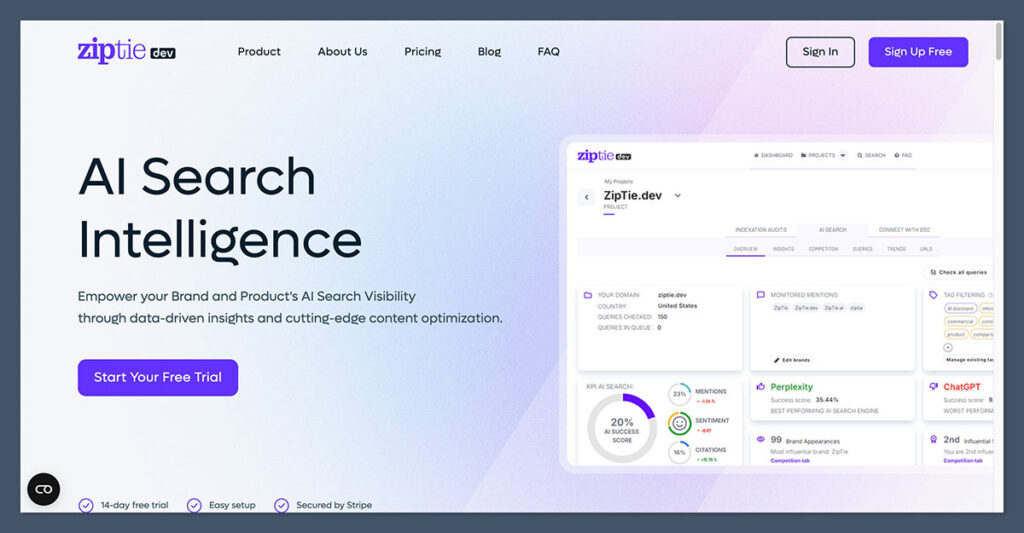
ZipTie quietly repriced this year. Basic now runs $69/month for 500 AI Search checks (each check pulls data from Google AI Overviews, ChatGPT, and Perplexity in one pass), Standard is $99/month for 1,000 checks, and Pro is $159/month for 2,000 checks — all confirmed on ZipTie’s live pricing page in August 2026. That’s down from the $179–$799 range I quoted in an earlier draft of this guide, so if you saw those older numbers elsewhere, they’re stale.
The team behind it — Tomasz Rudzki, Bartosz Góralewicz, and Sebastian Skowron from the SEO agency Onely — built something that captures the actual AI Overview text and a downloadable screenshot, not just a yes/no citation flag. The AI Success Score weights mentions, citations, and sentiment into one number so you know what to fix first. Lily Ray has called it her go-to tool for monitoring client inclusion in AI Overviews, and Seer Interactive reportedly runs it across more than 7,800 weekly queries for a single client.
✓ Strengths: Exact AIO answer text, downloadable screenshots, cheapest true entry point at $69/mo, strong practitioner endorsements.
✗ Watch out: Only 3 engines, no Gemini or Claude, no cross-engine comparison view, no white-label reporting.
2. Topify — Prompt-Level GEO Strategy With an Execution Layer

The old “demo-only” pricing for Topify is gone. As of mid-2026, Basic is $99/month for 100 prompts and 9,000 AI answer analyses across ChatGPT, Perplexity, and Google AI Overviews, with four projects included. Pro runs $199/month for 250 prompts and 22,500 analyses across ten seats, and Enterprise starts at $499/month. There’s also a genuinely usable free plan for testing the waters before you commit a card.
What sets Topify apart from a pure dashboard is One-Click Agent Execution — you describe an optimization goal in plain English, it proposes a strategy, and you approve it without building a manual content workflow. The team combines founding OpenAI researchers with veteran Google SEO practitioners, which shows up in how the “Citation Gap” report prioritizes which existing pages to update first, rather than just flagging that a gap exists.
✓ Strengths: One-click execution layer, free GEO score check, 30-day money-back guarantee, real self-serve pricing now published.
✗ Watch out: Base plan caps at 100 prompts; heavy multi-market brands hit that ceiling fast.
3. Rankability — Best When You Want Tracking and Fixes in One Login

Rankability, founded by Nathan Gotch, runs a credit-based model: Starter is $99/month for 10,000 credits, Growth is $199/month for 30,000, Scale is $399/month for 75,000, and Agency is $799/month for 200,000 — and every tier includes unlimited clients and users, which is unusual at the low end of this category. Credits get consumed by rank tracking, keyword research, content optimization, and AI visibility audits together, so the real cost depends on how much of the platform you actually use.
The genuine differentiator is Serena, Rankability’s AI agent, which reads your tracked prompts and hands the gaps directly to the built-in Content Optimizer. You’re not exporting a CSV of citation losses into a separate tool — the same platform that found the problem drafts the fix. It also now tracks ChatGPT, Gemini, Perplexity, Claude, and Copilot natively, a wider net than it had when I first reviewed it.
✓ Strengths: Unlimited clients/users on every tier, monitoring-to-optimization loop, 5-engine coverage including Claude.
✗ Watch out: Credit-based pricing takes a billing cycle to learn to budget correctly.
4. Bear AI — Free Tier, and It Clones What Already Gets Cited

Bear (usebear.ai) came out of Y Combinator’s Fall 2025 batch, founded by Janak Sunil (ex-Coinbase) and Siddhant Paliwal (ex-Third Chair, ex-Intel). It’s now used by more than 60 companies, including Browserbase, Wispr Flow, and Cal.com, and — unlike most of this list — it still has a genuinely usable free tier, with paid plans layered on top for teams that need more volume.
The feature that makes Bear different from a passive tracker: if a competitor’s blog post keeps getting cited by ChatGPT or Perplexity for a query you care about, Bear helps you build a competing piece against that exact citation pattern, then automatically finds and helps you reach the authors of frequently-cited sources in your space. It’s closer to a source-outreach engine than a dashboard.
✓ Strengths: Real free tier, source-outreach automation, tracks Claude Code and AI agent traffic specifically.
✗ Watch out: Paid-tier pricing isn’t published publicly; you’ll need to sign up to see it.
5. Otterly AI — Best Real Entry Point Under $50

Otterly’s Lite plan is $29/month for 15 tracked prompts, Standard is $189/month for 100 prompts, and Premium is $489/month, with a custom Enterprise tier above that. Every tier gets a genuine 14-day free trial with no card required — a rarity at this price point. The four core engines are included at every level, but Google AI Mode, Gemini, and Claude are priced separately as add-ons, typically $9–$149/month depending on which tier you’re on, so check that math before you assume $29 covers everything you need.
Otterly won a Gartner Cool Vendor nod in 2025, and it shows in the polish: every plan gets unlimited team seats, daily tracking, and a built-in GEO audit that flags technical blockers like a misconfigured robots.txt or missing schema before you even start tracking prompts. Setup genuinely takes about ten minutes — you add your domain and target keywords, and it auto-converts them into conversational prompts.
✓ Strengths: Cheapest real paid tier, unlimited team seats on every plan, built-in GEO audit, 14-day trial with no card.
✗ Watch out: 15 prompts on Lite disappears fast; unused prompts don’t roll over between months.
6. Peec AI — Best Cross-Engine Reporting, With MCP Baked In

Peec has three self-serve tiers: Starter at $95/month for 50 prompts, Pro at $245/month for 150 prompts (its recommended tier), and Advanced at $495/month for 350 prompts with Looker Studio reporting. Every plan gets unlimited seats and daily tracking, but here’s the catch that trips people up: the self-serve pool covers seven engines — ChatGPT, Google AI Mode, Google AI Overviews, Microsoft Copilot, Perplexity, Gemini, and Grok — and you choose only three of them at onboarding. Claude Sonnet 4 and GPT-5 Search aren’t in that pool at all; they’re Enterprise-only, running through a separate API integration.
What makes Peec worth the trade-off is its Model Context Protocol integration, which pipes your AI visibility data as a live layer directly into Claude, Cursor, and n8n. Instead of opening a dashboard to check performance, you ask your AI assistant, and it pulls the data, reasons over it, and can draft a Slack summary in the same conversation. Peec also reads results by simulating actual user interactions on each engine’s interface rather than relying only on official APIs, which its reviewers describe as producing results closer to what a real user sees.
✓ Strengths: Live MCP integration into Claude/Cursor, unlimited seats even on Starter, UI-simulated data collection.
✗ Watch out: Only 3 engines per plan, no free trial listed, Claude tracking is Enterprise-only.
Cost Per Tracked Prompt — Entry-Tier Comparison
Based on each vendor’s lowest self-serve tier, price ÷ included prompts, checked August 2026. Lower entry-tier prompt counts inflate per-prompt cost — check total monthly prompt volume before comparing on this metric alone.
7. GoVISIBLE — The Only Tool Built Specifically Around Perplexity

GoVISIBLE now publishes real pricing where it previously required a sales call. GEO Flex is $79/month for one project, covering five engines (ChatGPT, Gemini, Perplexity, AI Overviews, Copilot), one region, 50 prompts a month, and unlimited users. GEO Enterprise is custom-priced for teams running 10+ projects or multi-region programs. If you burn through your prompt allocation, extra prompts cost $15 each rather than forcing an upgrade.
The reason GoVISIBLE earns its own spot on this list, rather than blending into the crowd, is its dedicated Perplexity Visibility Tracker — a purpose-built module tracking plain-text mentions versus direct links, whether your brand appears near the top of a Perplexity answer or buried at the bottom, and competitor citation patterns specifically inside Perplexity’s Sonar and Sonar-Pro models. Most tools on this list treat Perplexity as one row in a spreadsheet; GoVISIBLE treats it as the main event.
✓ Strengths: Purpose-built Perplexity depth, published pricing now, unlimited users, pay-as-you-go prompt overages.
✗ Watch out: English-only for now; 50 prompts on Flex is tight for a full competitor set.
8. Finseo — German-Engineered GEO Audits, Now Demo-Gated
Finseo GmbH used to run a published self-serve Creator plan around €99/month. That tier has been quietly retired: as of mid-2026, every plan — Business, Enterprise, and Managed Service — routes through a demo request rather than a public price. Third-party trackers place the effective starting point well above the old €99 mark, so budget for a four-figure annual conversation if you go this route. What’s still public is the capacity: 100 prompts and roughly 9,000 AI answers a month on the entry tier, daily updates across up to eight models including ChatGPT, Claude, Gemini, Perplexity, Grok, and Mistral, plus an official MCP server and a documented REST API for teams that want to build against the data directly.
The differentiator is depth on the technical side: Finseo separates human traffic from bot/crawler traffic in its analytics, something most competitors skip, and its GEO audits go beyond mention-tracking into crawlability, structured data, and citability scoring. For European brands that need DPA and German AVV contracts as a procurement requirement, that alone can be the deciding factor over a US-based alternative.
✓ Strengths: Human vs. bot traffic separation, 8-model coverage, official MCP server, EU-compliant contracts.
✗ Watch out: No public pricing anymore, no free plan; smaller budgets should look elsewhere first.
9. Keyword.com — Cheapest Entry Point With Real Multilingual Reach

Keyword.com’s AI Visibility plan starts at $24.50/month for 50 credits — the cheapest true entry point on this entire list — with 360° Visibility at $33/month and an API-only package at $46/month for teams that want to pipe rank data into their own dashboards. It runs on a credit model: each “run” (a refresh of one prompt on one engine) consumes credits, and you can schedule those runs manually, hourly, daily, or weekly. Credits reset monthly and don’t roll over, so plan your cadence around your budget rather than tracking everything hourly by default.
Engine coverage is genuinely broad for the price — Perplexity Sonar, ChatGPT, Google AI Overviews, Gemini, Mistral, DeepSeek, and Claude — and there’s a dedicated citation tab showing exactly which of your pages, and which competitor pages, get referenced most often. The multilingual angle is real: Keyword.com publishes German-language GEO guides covering local ranking signals and LLM findability, which matters if you’re managing non-English markets and most competitors on this list are English-only.
✓ Strengths: Cheapest published entry price, 7-engine coverage, MCP server, genuine multilingual documentation.
✗ Watch out: Credit model burns fast on hourly tracking; public reviews of the AI module specifically are still thin.
10. AIclicks — Built Around Clicks, Not Just Mentions

AIclicks runs three published tiers: Starter at $59/month for 30 prompts across 3 platforms, Pro at $189/month for 150 prompts across 4 platforms, and Business at $499/month for 300+ prompts across 6 platforms, all with a 3-day free trial. There’s also a managed-service layer starting around $1,699/month for teams that want AIclicks’ team to do the optimization work directly, not just hand you a dashboard.
The framing that sets AIclicks apart: being cited isn’t the same as being clicked. Perplexity and ChatGPT users frequently take the AI’s answer and never visit the source, so AIclicks’ AI Blog Generation tool builds content specifically structured with comparison tables, FAQ blocks, and answer-first formatting — the format LLMs tend to cite and the format that gives a human reader a reason to click through anyway. It also ships a live MCP server (mcp.aiclicks.io) and a documented REST API covering prompts, mentions, visibility, and citations.
✓ Strengths: Optimizes for actual click-through, not just mentions, live MCP + REST API, managed-service option for hands-off teams.
✗ Watch out: Only a 3-day trial, and it’s non-refundable — evaluate fast before you commit.
11. Semrush AI Toolkit — Best If You Already Pay for Semrush
As a standalone add-on, the Semrush AI Visibility Toolkit is $99/month per domain, billed annually, for one domain and 25 tracked prompts across ChatGPT, Google AI, Gemini, and Perplexity — no free trial on the standalone add-on. The better path for most buyers is Semrush One, which bundles the AI toolkit with core SEO: Starter is $199/month (5 sites, 50 prompts, 500 keywords), Pro+ is $299/month (100 prompts, 1,500 keywords, historical data), and Advanced is $549/month (200 prompts, 5,000 keywords, API and MCP access). Semrush One carries a 7-day free trial, which the standalone toolkit doesn’t offer.
Six reports ship inside the toolkit: Visibility Overview, Competitor Research, Prompt Research (functioning like keyword research, but for AI prompts), Brand Performance and sentiment, an AI-readiness site audit, and shareable report slides for up to 50 tracked competitors. If you’re comparing this against dedicated tools on the rest of this list, the honest read from working SEOs is mixed — several called $99/month steep for what 25 prompts actually buys you, especially compared to Keyword.com’s $24.50 entry tier — but if AI visibility is one line item inside a broader SEO stack you already own, folding it in beats paying for a second platform and a second login.
✓ Strengths: Zero new tools if you’re already on Semrush, prompt research mirrors familiar keyword-research workflows, API/MCP on Advanced.
✗ Watch out: Weakest prompts-per-dollar ratio on this list; standalone add-on has no free trial.
How to Choose the Right Perplexity Tracker for Your Situation
Tight budget, under $50/month: Otterly AI’s $29 Lite plan or Keyword.com’s $24.50 AI Visibility plan. Bear AI’s free tier is also worth a look if you don’t mind unpublished paid pricing once you outgrow it.
Agency managing multiple clients: Rankability ($99/month, unlimited clients on every tier) or Peec AI (from $95/month, unlimited seats). Both give you white-label-friendly reporting without per-client licensing headaches.
Data accuracy matters more than price: ZipTie at $69/month remains the tool serious SEOs cite by name, even with only three engines tracked.
Perplexity specifically, more than any other engine: GoVISIBLE’s dedicated Perplexity Visibility Tracker goes deeper on that one engine than any generalist tool on this list.
Already inside the Semrush ecosystem: The AI Toolkit add-on, or better, the bundled Semrush One plan, saves you from onboarding a second platform. If you want the full picture of what Semrush’s core suite covers before adding AI tracking on top, our complete Semrush review breaks down the rest of the platform.
One thing worth sitting with: the difference between an AI engine retrieving your page and actually citing it in a visible answer is bigger than most marketers assume, and it changes what “optimization” even means here. We broke that distinction down in more depth in retrieval vs. citation: what actually earns you an AI mention, which pairs well with anything you learn from the tools above.
If Perplexity visibility is dropping while your Google rankings hold steady, that’s not a coincidence you can ignore — Google’s own AI Overviews are reshaping click-through behavior in a similar way, and the two trends compound each other. It’s also worth putting these dedicated AI trackers side by side with general-purpose options like the best all-in-one SEO software to see where a bundled suite might already cover part of what you need.
Tracking is only half the job — someone still has to fix what the data shows. If content production is your bottleneck rather than tracking itself, it’s worth reading how Soro SEO’s autopilot content approach stacks up, or browsing Rankpill alternatives for AI-assisted content optimization if Rankability’s bundled Content Optimizer isn’t quite the fit. We also compared two of these AI-writing platforms directly in Soro SEO vs. Rankpill, if you’re choosing between the two.
And if you’re newer to this space, our recent piece on what WeTracked.io actually does is a useful companion read alongside this guide, covering a lighter-weight tracker not featured in the main 11 above. On the content-quality side of GEO, the debate over AI-written versus human-written content matters more than ever, since the pages that win Perplexity citations tend to be the ones written with real, checkable specifics — not generic AI filler.
FAQ
What’s the cheapest Perplexity SEO rank tracking tool in 2026?
Keyword.com’s AI Visibility plan at $24.50/month for 50 credits is the cheapest published entry point. Otterly AI’s $29/month Lite plan is close behind and includes a 14-day free trial. Bear AI has a free tier, though its paid pricing isn’t public.
Do these tools track ChatGPT and Gemini in addition to Perplexity?
Most do. ZipTie is the outlier at just three engines (AI Overviews, ChatGPT, Perplexity). Rankability, Finseo, and Keyword.com track five or more engines including Gemini and Claude. Peec AI covers seven engines but limits self-serve plans to three chosen at signup.
Is tracking Perplexity visibility actually worth it if most of my traffic still comes from Google?
Yes, and increasingly so. Perplexity’s monthly active users have more than doubled since early 2025, and roughly 60% of US consumers now say they’ve used a generative AI tool to research a high-stakes purchase — up from 41% the year before. Being invisible to that traffic doesn’t show up in Google Search Console at all, which is exactly why a dedicated tracker matters.
Can I track Perplexity visibility for free?
Bear AI has a genuinely usable free tier. GoVISIBLE offers a free AI visibility audit as a one-time snapshot rather than ongoing tracking, and Topify offers a free GEO score check with no signup. For daily, ongoing tracking, though, every tool on this list eventually requires a paid plan.
Why did my brand’s Perplexity citations change even though I didn’t touch my content?
LLM outputs are non-deterministic — the same prompt run twice on the same engine can return different answers, and a competitor publishing fresher or better-structured content can displace you without any action on your part. This is exactly why a daily or weekly tracking cadence beats a one-off audit; monthly checks miss the fluctuation entirely.
The Bottom Line
Every tool on this list has genuinely repriced or repositioned in the past few months, which tells you how fast this category is still moving. If I were starting from zero today: ZipTie for the tightest Perplexity/AI Overview accuracy at the lowest real cost, Peec AI if you need MCP access into your existing AI workflow, and Otterly or Keyword.com if budget is the constraint. Whichever you pick, the move that actually matters is starting. Run one week of daily tracking, find the query where a competitor has quietly taken your spot, and fix that page first.


