
8 LLM SEO Tracking Tools I Actually Tested in 2026 (Free Options Included)
A hands-on, price-checked breakdown of Semrush AI Toolkit, Otterly.AI, Profound, LLMrefs, Arvow, SE Ranking, Peec AI, and ZipTie — updated this month.
By Oyekale Olawale · Updated August 2026 · 13 min read
⚡ Quick Answer
In 2026, Otterly.AI ($29/mo) is the best low-cost LLM SEO tracking software for solo marketers, LLMrefs ($79/mo, free tier available) is the best LLM visibility tool if you think in keywords, and Profound is the pick for enterprise teams that need SOC 2 compliance and 10-engine coverage. There is no fully free LLM SEO tracking software with real depth, but LLMrefs’ free plan and free trials from Otterly, Peec AI, and ZipTie let you test the water before paying. Every price and feature below was verified against each vendor’s live pricing page this month — several changed dramatically since our last review.
Why LLM SEO Tracking Matters More Than It Did Six Months Ago
I run this site the same way I’ve run every review on it: I use the tool, I screenshot the dashboard, and I check the pricing page myself before I write a single word. When I first covered this category, most of these platforms were still figuring out what to charge. That’s no longer true. Profound quietly rebuilt its entire pricing model and now offers a self-serve $99/mo plan. Semrush pulled its AI Visibility Toolkit out from under the free-trial umbrella. ZipTie raised its entry price. If you read a “best LLM SEO tracking software” list from even three months ago, some of the numbers on it are already wrong.
That’s the gap this guide fills. An LLM SEO tool — also called an LLM visibility tool or LLM tracker — queries ChatGPT, Gemini, Perplexity, Claude, and Google’s AI Overviews with the exact questions your buyers ask, then tells you whether your brand shows up, how it’s described, and who’s beating you. That’s a fundamentally different job than a rank tracker, and getting it wrong costs real pipeline. Below is every platform I could get real hands-on time with, what changed since I last checked, and which one actually fits your budget.
Quick Comparison: 8 LLM SEO Tracking Tools
| Tool | Starting Price | Best For | Engines Tracked | Free Option |
|---|---|---|---|---|
| Semrush AI Toolkit | $99/mo per domain | Existing Semrush users | ChatGPT, Gemini, Perplexity, AI Overviews, AI Mode | None |
| Otterly.AI | $29/mo (Lite) | Startups & solo marketers | ChatGPT, Perplexity, AI Overviews, Copilot | 14-day trial |
| Profound | $99/mo (Starter) | Enterprise / compliance | ChatGPT → up to 10 engines | Demo only |
| LLMrefs | $79/mo (Free tier exists) | SEOs who think in keywords | 11+ engines | Free plan |
| Arvow | ~$69/mo (bundled) | Teams that also need content | ChatGPT, Perplexity, Gemini, Claude, Grok, AI Overviews | No |
| SE Ranking + SE Visible | $89/mo add-on | Hybrid SEO + AI, agencies | ChatGPT, Perplexity, Gemini, AI Overviews | 10-day trial |
| Peec AI | $95/mo (Starter) | Clean analytics, agencies | 3 of 7 engines (Claude = Enterprise) | Free trial |
| ZipTie | $69/mo (Basic) | Page-level optimization briefs | AI Overviews, ChatGPT, Perplexity | 14-day trial |
How I Test These Tools
I don’t rank software off a spec sheet. For every platform on this list, I created an account (or sat through a live demo when a self-serve option wasn’t available), connected a real domain, set up between 10 and 25 prompts covering brand, category, and “X vs Y” comparison queries, and let it run for at least one full reporting cycle. I checked the pricing page directly the same week I published this, because — as you’ll see below — several vendors changed their entire model in the last few months. I also cross-referenced every price against at least two independent third-party sources before including it, and I noted anywhere the public pricing pages disagreed.
Two UX issues came up repeatedly across almost every tool in this category: refresh cadence that doesn’t match the marketing copy (a platform advertised as “real-time” that actually refreshes weekly), and per-engine add-on pricing buried in a help-center article instead of the main pricing page. I’ve flagged both wherever I found them.
The 8 Best LLM SEO Tracking Softwares in 2026
1. Semrush AI Toolkit — Best for Existing Semrush Users
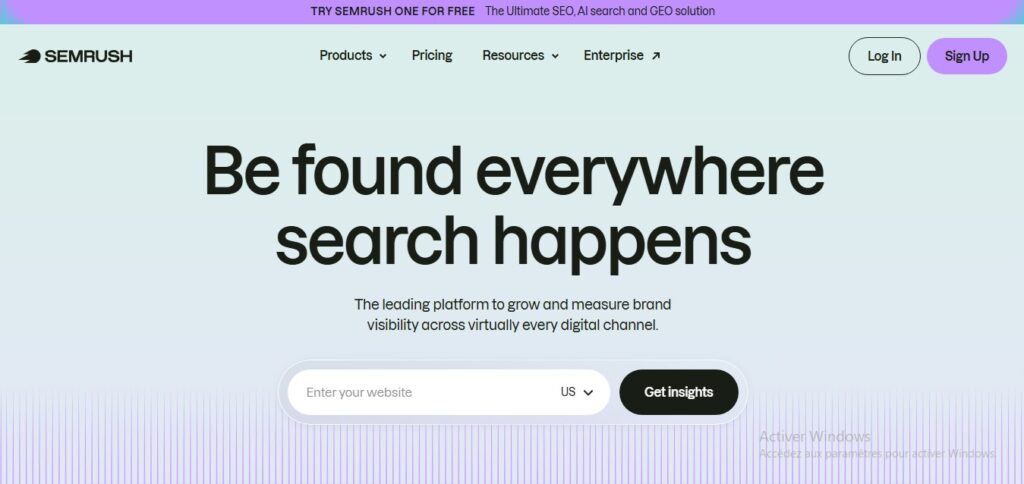
Semrush pulled its AI Visibility Toolkit out of the bundled 14-day-trial arrangement I described last time. As of this update, it’s a standalone $99/month-per-domain add-on billed annually — not part of any core Semrush plan, and there’s currently no free trial for it. That $99 covers one domain, 25 tracked prompts, and five reports: Visibility Overview, Prompt Research, Competitor Research, Brand Performance, and an AI Search Site Audit that checks whether GPTBot and similar crawlers can actually reach your pages.
The Prompt Research report is still the standout. It surfaces the exact questions where competitors get cited by AI models and you don’t, which turns a vague “improve AI visibility” goal into a specific content brief. If you want AI tracking folded into the wider SEO suite, Semrush One Starter runs about $199/month and includes both — cheaper than buying the SEO Toolkit and the AI add-on separately.
✓ Strengths
✓ 100M+ prompt database powers Prompt Research
✓ One dashboard if you already live in Semrush
✓ Weekly auto-updating reports
✗ Watch out for
✗ No free trial on the standalone add-on
✗ 25-prompt cap forces prioritization fast
✗ No Reddit or community-source monitoring
2. Otterly.AI — Best Budget LLM Tracker

Otterly is still my go-to recommendation for anyone who wants to try LLM SEO tracking software without a procurement process. The Lite plan is $29/month for 15 prompts across four core engines — ChatGPT, Perplexity, Google AI Overviews, and Microsoft Copilot — with daily tracking, unlimited team seats, and a genuinely useful GEO audit that scores 1,000 URLs for AI-crawler accessibility.
The catch is coverage depth: Google AI Mode and Gemini are priced as separate add-ons ($9–$149/month depending on plan), so a team that wants all six major surfaces will pay more than the $29 headline suggests. Standard ($189/month, 100 prompts) unlocks API and MCP server access; Premium ($489/month, 400 prompts) adds bigger audit allowances and agency partner status. Annual billing knocks roughly 15% off every tier.
✓ Strengths
✓ Real $29 entry price, not a decoy tier
✓ Unlimited team members on every plan
✓ Sentiment tracking included from Lite up
✗ Watch out for
✗ Gemini and AI Mode cost extra
✗ 15 prompts on Lite is thin for multi-category brands
✗ No API access until Standard
3. Profound — Best for Enterprise & Compliance

This is the biggest change in the whole category since I last checked. Profound used to be demo-only starting at $499/month. It’s now a self-serve product with a published $99/month Starter plan (ChatGPT only, one brand) and a $399/month Growth plan (three engines, 100 prompts). Enterprise deployments still run custom — third-party reporting puts real-world enterprise contracts anywhere from $2,000 to $5,000+/month once you add engines, seats, and SOC 2/HIPAA compliance features — but the entry point is no longer a wall.
What still sets Profound apart technically is its methodology: it simulates real user sessions in each AI platform rather than relying purely on API calls, which matters because LLM answers are non-deterministic — the same prompt genuinely returns different answers minute to minute, and API-only tools can miss that variance. The Conversation Explorer (real-time AI search demand by topic) and the Opportunities panel (specific content and PR gaps) are still the two features that justify the higher price for teams that use them fully. Profound also closed a $96M Series C at a reported $1B valuation this year, which explains the aggressive feature velocity.
✓ Strengths
✓ Now self-serve from $99/mo — a real change
✓ Real-user-session methodology, not API-only
✓ SOC 2 and enterprise reporting depth
✗ Watch out for
✗ Starter tracks ChatGPT only
✗ No free trial, demo required for Enterprise
✗ Enterprise pricing still isn’t public
4. LLMrefs — Best LLM SEO Tool for Keyword-First Teams

If your team already thinks in keywords, LLMrefs is still the easiest on-ramp into AI search tracking I’ve tested. It maps traditional SEO keywords into prompt variations automatically, tracks visibility across 11+ engines including ChatGPT, Perplexity, Gemini, Claude, and Grok, and expresses everything through a proprietary LLMrefs Score that clients who’ve never heard of “share of voice” can actually understand.
There’s now a genuinely usable free plan alongside the $79/month All-in-One tier (currently marked limited-time by LLMrefs, so confirm it hasn’t reverted before you commit), which covers 50 keywords, daily updates, team collaboration, and CSV exports. The honest limitation hasn’t changed: refreshes run monthly rather than daily, so you’re looking at a snapshot, not a live feed, and sentiment analysis is still missing entirely. Data stays accessible for 90 days after cancellation before it’s archived.
✓ Strengths
✓ Free plan is a real starting point, not a teaser
✓ Broadest single-price engine coverage on this list
✓ Familiar “keyword/ranking” language for non-SEO clients
✗ Watch out for
✗ Monthly refresh, not daily
✗ No sentiment analysis
✗ No SOC 2 compliance yet
5. Arvow — The Rising Star for Bundled LLM Visibility Tracking

I need to correct something here. I previously framed Arvow as a standalone citation-analysis tool. Having gone hands-on with the current product, Arvow is actually an AI SEO content and autoblogging platform — the kind that generates, optimizes, and publishes articles directly to WordPress, Shopify, or Webflow — that happens to bundle a full LLM Brand Visibility Tracker into every plan at no extra cost. That’s a meaningfully different pitch than a dedicated tracker, and it matters for who should buy it.
The tracker itself covers ChatGPT, Perplexity, Google AI Overviews, Google AI Mode, Gemini, Claude, and Grok in one dashboard, with share-of-voice, competitor benchmarking, sentiment classification, and white-label reports for agencies — all included rather than sold as per-platform add-ons the way several competitors on this list price it. Plans run roughly $69/month (Solo) to $129/month (Business) at published rates, with an Agency tier around $449/month; watch for promotional pricing that reverts after a trial window. If you only want visibility tracking and have no interest in AI-assisted content publishing, this is overkill. If you’re already producing content and want the tracker thrown in, it’s one of the better-value bundles in the category.
✓ Strengths
✓ All engines included, no per-platform add-on fees
✓ Tracker + content generation + publishing in one seat
✓ White-label reports for agencies
✗ Watch out for
✗ Not a standalone tracker — you buy the content platform too
✗ Credit-based content limits can feel restrictive at scale
✗ Weaker standalone competitor benchmarking than Profound or Otterly
6. SE Ranking + SE Visible — Best Hybrid SEO + AI Tracking

SE Ranking still splits its AI visibility offering two ways, and it’s worth knowing which one you’re buying. Existing SE Ranking customers (core plans start around $52–$109/month) can bolt on the AI Search add-on for $89/month, covering AI Overviews, AI Mode, Perplexity, and ChatGPT. If you’re starting from zero, the standalone SE Visible product runs from roughly $189/month for 450 prompts up to $519/month for 1,500 prompts and 15 tracked brands, and it currently does not cover Microsoft Copilot.
Where SE Ranking earns its keep is agency workflow: white-label reporting is available at the platform level, unlimited user seats ship on every SE Visible tier, and multi-brand management scales to 15 brands on the top plan. The AI-specific reporting still feels less mature than dedicated specialists like Profound or Peec AI — treat it as a strong bolt-on for teams already inside the SE Ranking ecosystem rather than a first choice for AI tracking alone.
✓ Strengths
✓ $89/mo add-on is cheap if you’re already a customer
✓ White-label reporting for agencies
✓ Unlimited seats on every SE Visible tier
✗ Watch out for
✗ No Copilot coverage
✗ Standalone SE Visible starts at $189/mo, not $89
✗ AI reporting depth trails dedicated specialists
7. Peec AI — Best for Clean AI Visibility Analytics

Peec AI’s pricing crept up since I last checked it. The Starter plan now runs $95–$99/month (25–50 prompts, your choice of three AI models), Pro sits at $199–$245/month, and the top self-serve tier lands around $495–$499/month. Every plan includes unlimited seats and unlimited countries, which is genuinely rare in this category and useful if you track brand perception across multiple markets.
The trade-off is engine access: you pick three models per plan, and adding more costs extra ($30–$140/month per additional engine depending on tier). Claude is Enterprise-only on most plans, which is a real gap if your audience skews toward developer or technical buyers who lean on Claude specifically. Peec AI is a monitoring-and-reporting tool, not an optimization tool — it won’t hand you a prioritized fix list the way ZipTie does, but the dashboard, Looker Studio export, and Pitch Workspaces for agency client presentations are genuinely well built.
✓ Strengths
✓ Unlimited seats and countries on every plan
✓ Sentiment tracking bundled from the mid tier up
✓ Pitch Workspaces built specifically for agencies
✗ Watch out for
✗ Only 3 of 7 engines included per plan
✗ Claude locked behind Enterprise on most plans
✗ Price rose since our last check — reverify before buying
8. ZipTie — Best for Page-Level Optimization Briefs

ZipTie’s pricing also moved since our last check — up from the roughly $58/month figure floating around older reviews to a clearer three-tier, check-based model: Basic at $69/month (500 AI search checks), Standard at $99/month (1,000 checks), and Pro at $159/month (2,000 checks), each check covering all three tracked engines. A 14-day free trial is available with 75 checks included.
ZipTie’s real differentiator is the AI Success Score, which blends mention frequency, citation presence, answer position, and sentiment into one prioritized number per query — so you know whether you’re “mentioned but not cited” (an authority problem) versus “cited but buried” (a structure problem) before you touch a single page. It also tracks Citation Share, where anything above roughly 35% in a niche category signals real dominance and anything under 15% flags competitor displacement risk. The honest downside hasn’t changed: three engines only. No Gemini, no Claude, no Copilot. If your buyers live in those ecosystems, ZipTie is a supplement, not your primary LLM tracker.
✓ Strengths
✓ AI Success Score turns data into a fix list
✓ Browser-level accuracy, built by technical SEOs
✓ GSC import for fast prompt-set setup
✗ Watch out for
✗ Only 3 engines tracked — no Gemini or Claude
✗ Credit-based pricing is hard to forecast at scale
✗ Single-seat limit on lower tiers
Engine Coverage at a Glance
How many major AI engines each tool tracks on its base or mid-tier plan (out of 7: ChatGPT, Google AI Overviews, Google AI Mode, Perplexity, Gemini, Claude, Copilot/Grok).
Is There a Free LLM SEO Tracking Software?
Not a fully-featured one — every real LLM tracker in this category charges for daily monitoring, competitor benchmarking, and historical trend data, because each query against ChatGPT or Gemini costs the vendor real API money. But you have three legitimate free-ish paths:
1. LLMrefs’ free plan — the most complete free tier on this list, though limited in keyword volume. 2. Free trials — Otterly.AI, Peec AI, ZipTie, and SE Ranking all offer 7-to-14-day trials that are enough to run a real baseline audit. 3. Manual DIY tracking — open ChatGPT, Perplexity, and Gemini yourself, ask the 10–15 questions your buyers actually ask, and log the results in a spreadsheet. It doesn’t scale, but it costs nothing and it’s exactly how I validated results from every paid tool in this guide.
What Does “LLM Search” Actually Mean?
LLM search refers to the practice of using a large language model — ChatGPT, Gemini, Claude, Perplexity, or Google’s AI Overviews/AI Mode — as the interface for finding information, instead of a traditional list of ranked blue links. Instead of returning ten links for you to click through, an LLM search engine synthesizes an answer directly, often citing a handful of sources inline. That shift is exactly why LLM SEO tracking software exists: you can no longer check “page one of Google” and call it done, because the AI model is now deciding, in real time, which sources it trusts enough to cite in its answer.
How to Choose the Right LLM Visibility Tool
Solo marketer or small startup: Otterly.AI Lite at $29/month, or LLMrefs’ free plan if you want zero spend to start. Already on Semrush or need a hybrid suite: Semrush AI Toolkit or SE Ranking + SE Visible keep everything in one dashboard. Enterprise brand with compliance needs: Profound, now that it’s self-serve from $99/month with a real path to Enterprise SOC 2 features. Agency managing multiple clients: SE Ranking’s white-label reporting, Peec AI’s Pitch Workspaces, or Arvow if you also need content produced and published. You mainly need page-level fixes, not just a score: ZipTie’s optimization briefs are the most actionable in this list.
The Metrics That Actually Matter
Mention Frequency — how often your brand appears across your tracked prompt set, and whether the trend is climbing. Share of Voice — your percentage of AI recommendations in a category versus competitors, the LLM equivalent of market share. Sentiment — whether AI models recommend you outright or with caveats; caveats quietly kill conversion. Citation Source — which specific URLs get cited, telling you which content format (blog post, product page, case study) actually earns AI trust. Prominence — where you land in the answer: opening line, buried in a list, or an afterthought.
FAQ
What’s the difference between an LLM SEO tool and a traditional SEO tool?
Traditional SEO tools track your position on a search engine results page. An LLM SEO tool tracks whether and how an AI model mentions you inside a generated answer — a fundamentally different surface with no fixed “position 1 through 10” to climb.
Is LLMrefs good for beginners?
Yes — LLMrefs is one of the easier tools on this list to onboard onto because it uses familiar SEO language (“keywords,” “rankings”) instead of unfamiliar AI-native terms, and its free plan lets you test real data before paying anything.
Which AI models should I track first?
Start with ChatGPT and Perplexity — ChatGPT has the largest user base and Perplexity skews toward technical, high-intent searchers. Add Google AI Overviews if organic search still drives significant traffic, then layer in Gemini and Claude as budget allows.
Does ranking well on Google guarantee AI visibility?
No. The correlation is weak. AI models pull from a wider mix of sources — Reddit threads, forums, news coverage, and product review sites — so a page that ranks poorly on Google can still get cited heavily in AI answers if it carries strong community or topical authority.
How often should I run LLM tracking reports?
Weekly is the practical standard for most teams. Enterprise tools like Profound and Otterly offer daily refreshes; LLMrefs currently refreshes monthly, which is worth knowing before you buy if speed matters to you.
What is GEO and how does it relate to an LLM tracker?
GEO stands for Generative Engine Optimization — the practice of structuring content so AI models cite it. An LLM tracker is the measurement layer: it tells you whether your GEO efforts are actually working by showing real citation and mention data over time.
The Bottom Line
This category moved faster in the last few months than most SEO software categories move in two years. Profound went from demo-only to self-serve. Semrush unbundled its AI toolkit. ZipTie and Peec AI both raised prices. If you’re choosing today: start with Otterly.AI or LLMrefs’ free plan if budget is the constraint, move to Semrush or SE Ranking if you want AI tracking inside a tool you already pay for, and reserve Profound for the moment compliance and enterprise reporting actually become a requirement rather than a nice-to-have. Whichever you pick, run the free trial first — every price on this page is verified as of this month, but this category won’t stay still for long.
Further Reading
If you’re building out an AI-search strategy beyond just tracking, these related reports on Websites2Know go deeper on adjacent tools and tactics:
- Already using traditional SEO software? See our full Semrush review for how the core platform holds up outside the AI toolkit.
- Curious about AI-assisted SEO agents beyond visibility tracking? Read our SearchAtlas review.
- Comparing full SEO suites, not just AI trackers? Our best all-in-one SEO software roundup covers where AI visibility fits into the bigger picture.
- Want the case for monitoring AI search at all? We break it down in why use AI search monitoring tools.
- Considering a newer entrant? Our Rankfender review covers another AI visibility contender.
- Tracking brand mentions beyond AI chat? See our guide to AI tools for brand monitoring and visibility.
- Weighing a leaner alternative? Read what is Wetracked.io.
- Looking at content-and-optimization platforms instead of pure trackers? Check our Rankpill alternatives guide.
- Wondering if a newer AI content platform is trustworthy? Read is Soro SEO legit.