
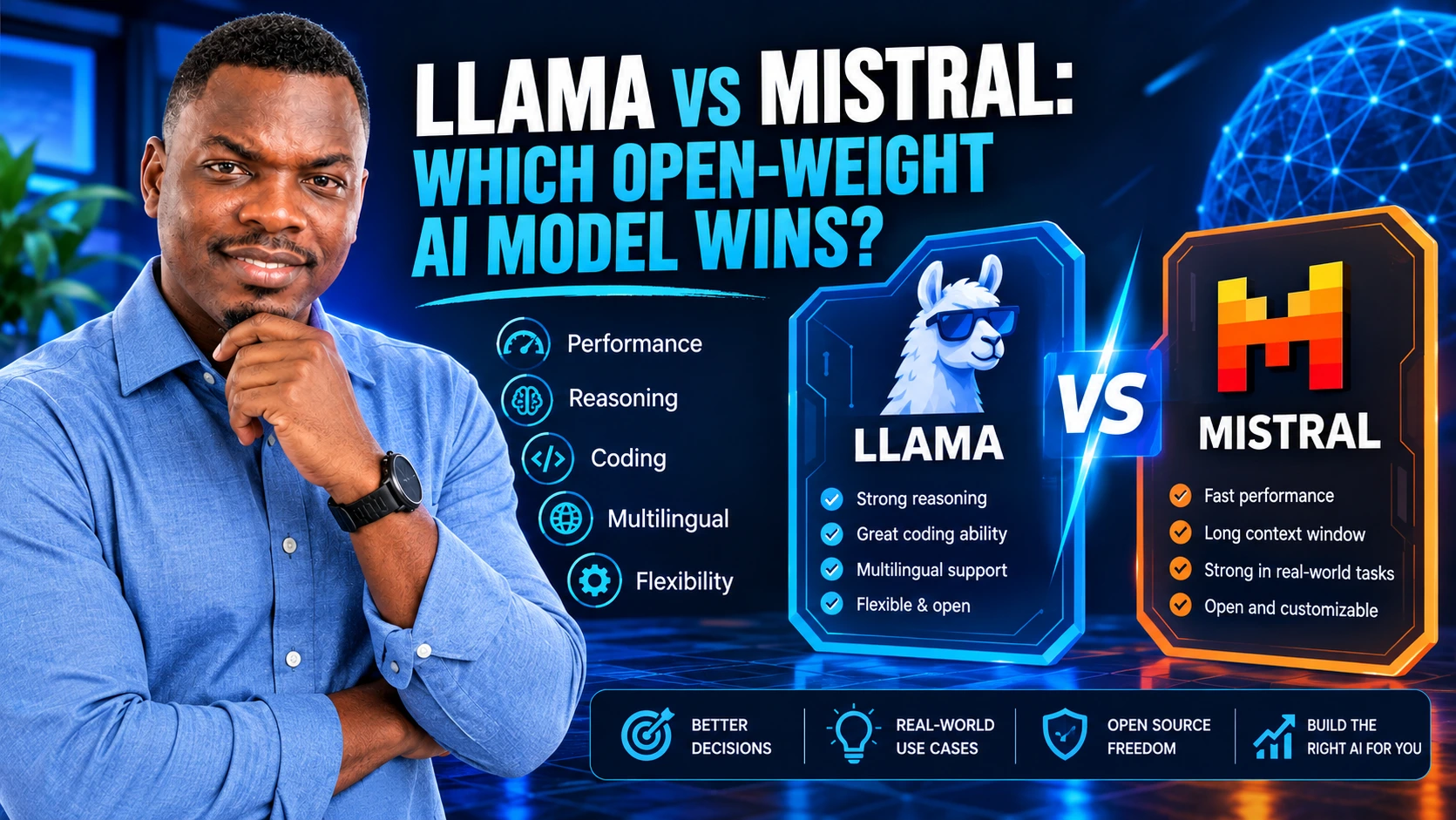
Llama vs Mistral: Which Open-Weight AI Model Should You Choose?
A practical, fact-checked comparison of Meta’s Llama and Mistral AI’s open-weight models — licensing, parameters, context windows, and which one actually fits your project.
By Oyekale Olawale
Quick Answer
If you want the largest ecosystem and the most community fine-tunes, go with Llama 4 (Scout or Maverick) — but check Meta’s Llama 4 Community License first, since it caps free commercial use at 700 million monthly active users and restricts multimodal use for EU-domiciled licensees. If you want a fully permissive Apache 2.0 license with no user caps, better inference efficiency, and native European multilingual strength, go with Mistral Large 3 or the smaller Mistral Small 4. Neither model “wins” outright — the right pick depends on your licensing tolerance, hardware budget, and language requirements.
If I were picking an open-weight model for a new build today, I would not start with a benchmark leaderboard. I would start with three boring questions: what does the license actually let me do, how much compute does the model need, and how much community support exists when something breaks.
That is the lens I am using here. Meta’s Llama and Mistral AI’s Mistral come from two very different companies with two very different philosophies, and after digging through the current model cards, license text, and independent trackers, I do not think this is a “one model beats the other” situation. It is a trade-off, and I will show you exactly where each side wins.
Llama vs Mistral at a Glance
| Factor | Llama 4 (Scout / Maverick) | Mistral 3 (Large 3 / Small 4) |
|---|---|---|
| Release date | April 5, 2025 | Large 3: Dec 2, 2025 · Small 4: Mar 16, 2026 |
| Architecture | Sparse MoE | Sparse MoE |
| Parameters | Scout: 109B total / 17B active · Maverick: ~400B total / 17B active | Large 3: 675B total / 41B active · Small 4: 119B total / ~6B active |
| Context window | Scout: 10M tokens · Maverick: 1M tokens | Both: 256K tokens (262,144) |
| License | Llama 4 Community License (source-available) | Apache 2.0 (fully open source) |
| Commercial cap | Free under 700M MAU; separate license required above that | No user-count cap |
| Multimodal (vision) | Yes, but excluded for EU-domiciled licensees | Yes, no regional carve-out |
| Hosted API pricing (approx.) | Varies by third-party provider | Large 3: $0.50 / $1.50 per 1M tokens · Small 4: $0.15 / $0.60 per 1M tokens |
1. Two Very Different AI Companies
Before comparing specs, I want to be clear about where these models come from, because it explains almost everything else in this article.
Meta is one of the largest technology companies on the planet, with the compute and the developer reach to make Llama the default open-weight family for years. Millions of people have fine-tuned it, written tools around it, and built entire products on top of it.
Mistral AI is a much younger, much smaller company. It was founded in 2023 by researchers who previously worked at Meta and Google DeepMind, and it has built its entire identity around one bet: that efficient, well-engineered models can compete with far larger ones. Mistral has since raised significant financing to expand its own European GPU infrastructure, which tells me the company is not just shipping research demos — it is trying to become the sovereign AI backbone for European enterprises.
Here is something worth flagging that I have not seen covered clearly elsewhere: Meta’s most recent frontier release, an April 2026 model internally called Muse Spark, was not released as open weights. It shipped closed, API-only. Meta also quietly shelved its planned 2-trillion-parameter Llama Behemoth model — it was previewed in 2025 but never shipped. As of today, Llama 4 (Scout and Maverick) remains Meta’s most recent open-weight release. That is a meaningful signal: Meta’s frontier ambitions and its open-weight strategy have started to diverge, while Mistral has kept shipping openly licensed flagship models on a roughly quarterly cadence.
2. Model Sizes, Context Windows, and Efficiency
Parameter count is not a vanity metric to me — it is a direct line item on my infrastructure bill. Both families now use sparse Mixture-of-Experts architecture, which means the total parameter count and the “active” parameter count (the part that actually fires per token) are two very different numbers.
Active parameters per forward pass (billions)
Llama 4 Scout/Maverick
17B
Mistral Small 4
~6B
Mistral Large 3
41B
Llama 4 Scout has 109 billion total parameters but only 17 billion active per token, spread across 16 experts, and Meta advertises an enormous 10-million-token context window. Maverick scales up to roughly 400 billion total parameters across 128 experts while keeping the same 17 billion active parameters, with a 1-million-token context window. In practice, I would treat Meta’s marketed context length as a ceiling, not a guarantee of quality — long-context recall degrades well before you hit the stated maximum on almost every model I have researched, and Meta’s own documentation does not claim otherwise.
Mistral Large 3 is the more direct competitor to Maverick: 675 billion total parameters, 41 billion active, trained on 3,000 Nvidia H200 GPUs, with a 256K-token context window. Mistral Small 4 is the one I find genuinely interesting for cost-conscious teams — 119 billion total parameters but only around 6 billion active, unifying what used to be four separate specialist models (chat, reasoning, vision, and agentic coding) into a single checkpoint with a toggleable reasoning-effort setting. That consolidation alone can simplify a deployment stack that would otherwise need to juggle Magistral, Devstral, and Pixtral separately.
If I were choosing based purely on cost-per-token efficiency for a mid-size workload, I would lean toward Mistral Small 4. It activates a fraction of the parameters Llama 4 does per token, and its listed API pricing is meaningfully cheaper than most Llama-hosting providers charge for comparable throughput.
3. Licensing — the Part Most Developers Skip
This is the section I would read twice before writing a single line of production code, because “open” does not mean the same thing for these two companies.
Llama 4 ships under the Llama 4 Community License, which is source-available rather than a true open-source license under the OSI definition. It grants a broad right to use, reproduce, and create derivative works, but it comes with two conditions that actually matter in the real world. First, if your product reaches more than 700 million monthly active users (as measured at the time the license took effect), you need a separate commercial license directly from Meta — most startups will never hit that, but any company with ambitions of platform-scale reach should not treat it as a footnote. Second, and this one surprised me: Meta’s current Llama 4 terms exclude multimodal (vision) capability for EU-domiciled licensees. If you are in the EU and need image input, Llama 4’s vision features are off the table under the license as written, and you would need to look at Mistral, Qwen, or a hosted proprietary model instead.
Mistral takes the opposite approach. Mistral Large 3, Small 4, and the Ministral 3 family (3B, 8B, and 14B dense models for edge deployment) all ship under the Apache 2.0 license — no user-count threshold, no regional carve-outs, and no requirement to request permission from Mistral once you are past a certain scale. That said, I would not assume every single Mistral release carries the same terms: Voxtral TTS, Mistral’s text-to-speech model, is licensed under CC BY-NC 4.0, which is non-commercial only, and OCR 4 is a paid, non-open offering. The lesson here applies to both companies equally — check the license attached to the specific model file you are downloading, not the company’s general reputation for openness.
✅ Where Llama 4 wins
Largest ecosystem of fine-tunes, quantizations, and tutorials · Longest advertised context windows · Deep third-party hosting support
❌ Where Llama 4 falls short
Source-available, not true open source · 700M MAU commercial ceiling · Vision excluded for EU licensees
✅ Where Mistral wins
Genuine Apache 2.0 across its main text/vision models · No user-count cap · Strong efficiency-to-performance ratio · Hosted enterprise platform (Forge)
❌ Where Mistral falls short
Smaller community and fewer third-party fine-tunes · Not every specialty model (Voxtral TTS, OCR 4) is open · Younger company with a shorter production track record
4. Multilingual Capabilities
Language coverage is where I would slow down and actually test rather than trust a spec sheet. Meta’s own FAQ states that Llama 4 officially supports 12 languages for text-to-text tasks out of the box, though developers can fine-tune it for others under the applicable license. That is a real jump from Llama 3.1, 3.2, and 3.3, which supported 8 languages.
Mistral’s model cards list support across dozens of languages, including English, French, Spanish, German, Italian, Portuguese, Dutch, Chinese, Japanese, Korean, and Arabic. Given Mistral’s French roots and its explicit push to become Europe’s sovereign AI layer, I would expect its models to have a stronger baseline in continental European languages specifically — but “expect” is doing a lot of work in that sentence, and I would not commit to a language-critical product without running my own evaluation set in the exact languages, dialects, and domain terminology my users actually type.
5. Ecosystem, Tooling, and Fine-Tuning Support
This is Llama’s strongest card, and I do not think it is close. Because Llama has been the default open-weight family since 2023, there is a massive volume of quantized builds, GGUF conversions, Ollama images, LoRA adapters, deployment guides, and framework integrations already circulating. If something goes wrong with your Llama deployment, there is a very good chance someone has already hit the same wall and posted the fix.
I would still be cautious about downloading random community fine-tunes without checking their training data, license inheritance, and evaluation methodology — popularity is not the same as quality control.
Mistral’s ecosystem is smaller but growing quickly, and it is far from a ghost town. Community GGUF conversions and Ollama-ready builds for Mistral’s releases typically show up within days of launch. Mistral also joined the NVIDIA Nemotron Coalition as a founding member and ships Small 4 as a day-zero NVIDIA NIM container, which tells me enterprise deployment friction is a real priority for the company, not an afterthought. If your team already has infrastructure built around vLLM, TensorRT-LLM, or similar serving frameworks, swapping between Llama and Mistral checkpoints is usually a config change rather than a rebuild — which is exactly why I would recommend running your own side-by-side benchmark before committing to either family long-term.
If you are trying to build good judgment about which open-weight models are worth trusting in general, it is worth reading my first impressions of Kimi K3’s open weights alongside this piece — Chinese open-weight labs are now a genuine third force in this market, not a footnote.
6. Hosted APIs vs Self-Hosting
There is a decision buried under all of this that I think gets skipped too often: do you actually want to run the infrastructure yourself?
Mistral has a clear structural advantage here. It operates its own hosted platform, La Plateforme, plus an enterprise offering called Forge that goes beyond fine-tuning — it supports full pre-training and reinforcement learning on a company’s internal data, with adopters reportedly including Ericsson, the European Space Agency, and ASML. That is a genuine alternative to self-hosting for teams that would rather not manage GPU fleets.
Meta does not operate an equivalent first-party hosted API for Llama. Instead, the model weights are distributed for developers to self-host or to deploy through third-party infrastructure providers, cloud marketplaces, and inference platforms. That gives you more provider choice and potentially better pricing competition, but it also means you are responsible for vetting whichever host you pick.
How I Evaluate These Models
I want to be straight with you about methodology, because I think it matters more than most comparison articles let on. I did not run a private GPU cluster to benchmark Llama 4 Maverick against Mistral Large 3 head-to-head for this piece. What I did instead was cross-reference the official Meta and Mistral model cards and license documents against independent trackers — LLM Stats, DataLearner, and OpenRouter — to confirm parameter counts, context windows, and pricing were consistent across sources rather than relying on a single vendor’s marketing page.
Where a benchmark number came only from the vendor itself, I have flagged it as directional rather than independently verified, because self-reported benchmarks are exactly that — self-reported. If you are making a real deployment decision, do not skip your own evaluation on your own workload. A model that wins on MMLU or HumanEval can still underperform on your actual customer support transcripts or your actual codebase.
7. A Step-by-Step Way to Actually Decide
If you want a repeatable process instead of just picking whichever name you have heard more often, here is the sequence I would follow.
Step 1 — Check the license against your actual scale. If you expect to stay under roughly 700 million monthly active users and you do not need vision features in the EU, Llama 4’s license is workable. If you want zero ambiguity or you are building an EU-facing multimodal product, Mistral’s Apache 2.0 models remove the question entirely.
Step 2 — Match model size to your hardware budget. If you need to run something on a single high-end GPU or an edge device, look at Mistral Small 4 or the Ministral 3 line before you look at a 400-billion-parameter Llama variant.
Step 3 — Test your actual languages and domain terms. Do not trust the “supports 12 languages” or “supports dozens of languages” claims at face value — run your real prompts, in your real target languages, through both.
Step 4 — Decide who manages the infrastructure. If you want a first-party hosted platform with enterprise support, Mistral’s La Plateforme and Forge are built for that. If you want maximum provider choice and the largest self-hosting ecosystem, Llama’s third-party hosting landscape is deeper.
Step 5 — Run a real workload comparison. Deploy both on the same task — the same support tickets, the same codebase, the same documents — and measure tokens per dollar, latency, and actual output quality before you commit.
If you are weighing an open-weight model against a closed one for the same project, it is also worth reading my breakdown of the Claude Opus 5 pricing and benchmark numbers and my hallucination-rate comparison between Claude and ChatGPT — the trade-offs against a closed frontier model are different from the trade-offs between two open-weight families, and it helps to see both sides before you lock in an architecture.
Who Should Choose Llama, and Who Should Choose Mistral
I would lean toward Llama 4 if I already had a team experienced with it, needed the largest possible library of existing fine-tunes and tutorials, or was building something firmly under the 700 million MAU threshold with no EU multimodal requirement.
I would lean toward Mistral if licensing certainty mattered more than ecosystem size, if I needed a model that runs efficiently on modest hardware, if my users were concentrated in Europe, or if I wanted a first-party hosted enterprise platform instead of stitching one together myself.
Neither answer is permanent. This space moves fast — Alibaba’s Qwen and DeepSeek’s newer releases are already pulling developer attention away from the Llama-versus-Mistral framing that dominated 2024 and 2025, and I would keep an eye on where Meta’s next open-weight release lands now that its frontier work has split toward closed models like Muse Spark. If you are curious how another well-funded open-weight competitor is shaping up right now, my comparison of how Kimi K3 stacks up against Claude Fable 5 and a 7-day readiness checklist for open-weight rollouts are both worth a read before you finalize a stack.
FAQ
Is Llama 4 or Mistral Large 3 better for coding tasks?
Both perform competitively on public coding benchmarks, and vendor-reported scores should be treated as directional rather than proven. I would not decide based on a leaderboard number alone — run both against your actual repository and your actual test suite, since real codebases expose gaps that synthetic benchmarks do not.
Is Mistral actually more “open” than Llama?
By the strict, OSI-recognized definition of open source, yes. Mistral’s Large 3, Small 4, and Ministral 3 models ship under Apache 2.0, with no user-count threshold. Llama 4 ships under Meta’s own Community License, which is source-available with a 700-million-MAU commercial ceiling and additional terms, including a multimodal restriction for EU-domiciled licensees.
Can I run either model on a single GPU?
Not the flagship models at full precision. Mistral Small 4 and the Ministral 3 line (3B, 8B, 14B) are the more realistic single-GPU or edge options. Quantized builds of both Llama and Mistral’s larger models exist through the community, but you should expect a real quality trade-off compared to running full precision.
Did Meta release a Llama 5?
Not as of this writing. Llama 4 (Scout and Maverick), released April 5, 2025, remains Meta’s most recent open-weight release. Meta’s planned Behemoth model was previewed but never publicly shipped, and Meta’s newer frontier model, Muse Spark, launched in April 2026 as a closed, API-only system rather than open weights.
Which model should I use for a multilingual European product?
Mistral’s European origins and its explicit multilingual model cards make it the natural starting point to test first, especially if vision features matter and you are domiciled in the EU. That said, “natural starting point” is not the same as “guaranteed winner” — test your exact target languages before committing.
Comparing More Than Just Open-Weight Models?
See how a coding-focused agent stacks up in my Gemini Code Assist Standard vs Enterprise breakdown.
Conclusion
After going through the license text, the model cards, and the independent trackers line by line, my honest take is that this is not a contest with a single winner. Llama 4 still has the deepest ecosystem in open-weight AI, and if your team already knows it, that familiarity is worth something real. But its license is more restrictive than most developers realize until they actually read it, and Meta’s own strategic shift toward closed frontier models is a signal worth watching.
Mistral, on the other hand, has quietly built one of the cleanest, most permissively licensed model families in the industry, backed by real infrastructure investment and a hosted enterprise platform that removes a lot of the operational burden. It is not the safe default choice the way Llama has been for the past two years — but for a growing number of use cases, especially in Europe or on constrained hardware, I think it is the smarter one.
My advice stays the same regardless of which name is more familiar to you: read the actual license for the exact model file you plan to ship, size the model to your hardware budget rather than the biggest number on the spec sheet, and test both on your real workload before you write a single line of production code around either one.


