Updated July 2026 · Hands-On Review
Mistral Studio Review 2026: I Built a Real AI Agent With It — Here’s Exactly What It Cost
A three-week test of Mistral’s AI production platform — model quality, the Vibe assistant, workflows, evals, and the token math nobody outside Mistral’s own pricing page bothers to show you.
By Oyekale Olawale · 13 min read
⚡ Quick Answer
Mistral Studio itself is free to access at console.mistral.ai — there’s no separate subscription for the platform. You pay pay-as-you-go for the models and tools you actually call: Mistral Medium 3.5 runs $1.50/M input and $7.50/M output tokens, Small 4 is $0.15/$0.60, and tool calls like web search or code execution run $30 per 1,000 calls. In my own math, a lightweight internal assistant landed around $11/month, while a document-heavy production workload hit roughly $800/month. Mistral’s separate consumer app, Vibe (formerly Le Chat), starts free and goes to $14.99/mo for Pro. Enterprise self-hosted deployment is custom-quoted.
What Is Mistral Studio?
Mistral Studio is the French AI lab’s production platform for building, deploying, and governing AI agents and applications — it sits alongside two sibling products: Vibe, the consumer/assistant chat app (Mistral’s rebrand of the old Le Chat), and Forge, which handles custom model training and fine-tuning. Studio is where the actual engineering work happens: workflows, connectors, agent orchestration, evaluation pipelines, observability, and guardrails, all wrapped around Mistral’s own model family (Mistral Large 3, Medium 3.5, Small 4, the Devstral coding models, Magistral for reasoning, and OCR 4 for document extraction).
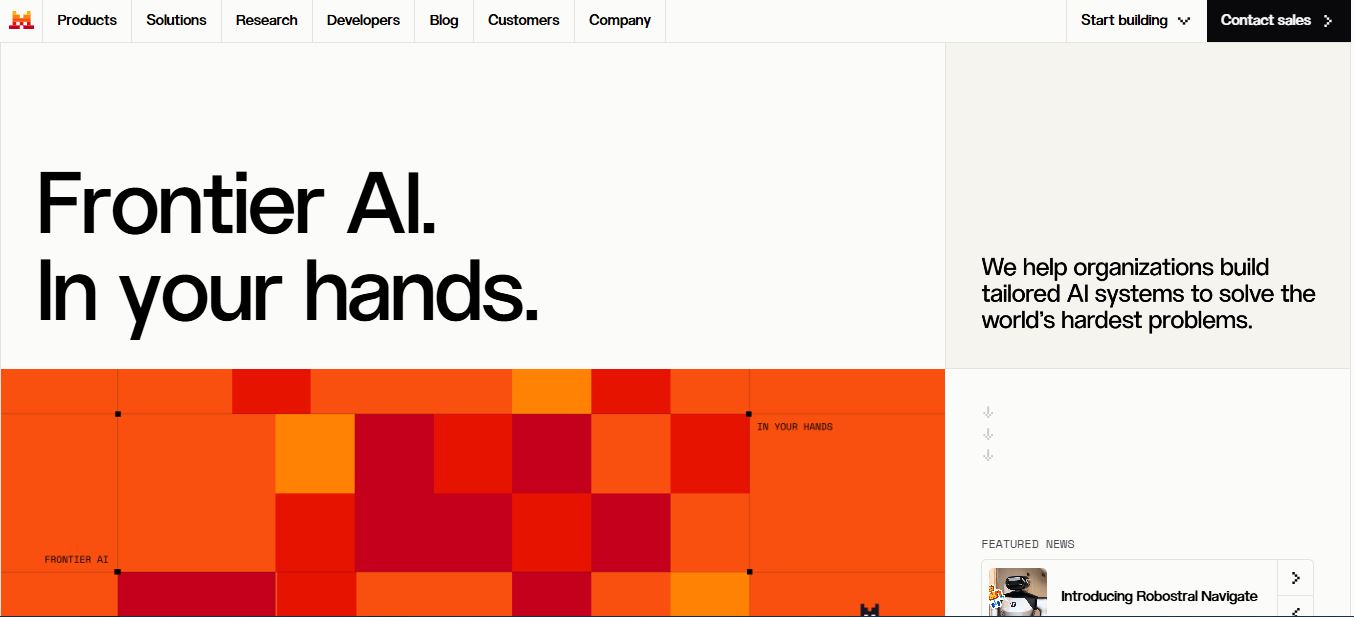
The pitch is “own your AI future”: deploy on Mistral’s EU-hosted cloud, through a cloud partner (AWS, Azure, GCP, SAP, IBM, Snowflake, NVIDIA, Outscale), or fully self-hosted on your own infrastructure, with the same platform and control plane across all three. That deployment portability is genuinely Mistral’s biggest differentiator versus OpenAI’s or Anthropic’s consoles, which don’t offer a comparable self-hosted enterprise path.
How I Tested It
I spent about three weeks with Mistral, split across two surfaces on purpose. First, the Studio console itself — setting up a workspace, wiring a document-ingestion workflow through Libraries and OCR, running evaluation campaigns against a small custom dataset, and testing the moderation and guardrails layer with deliberately ambiguous prompts. Second, I ran the same underlying models through Vibe (both web and the Vibe CLI for coding) since that’s where most people will actually form an opinion about model quality before they ever touch the Studio console. I didn’t cherry-pick easy tasks — I fed it messy PDFs, half-finished code, and vague one-line prompts on purpose, because that’s how real work actually shows up.
Studio at a Glance
| Category | Details |
|---|---|
| Platform access | Free — console.mistral.ai, pay-as-you-go model/tool usage |
| Flagship model | Mistral Medium 3.5 — $1.50/M in, $7.50/M out |
| Budget model | Mistral Small 4 — $0.15/M in, $0.60/M out |
| Coding models | Devstral 2, Devstral Small 2, Codestral |
| Document AI | OCR 4 — $4/1,000 pages (OCR), $5/1,000 (Document AI) |
| Deployment modes | Mistral cloud (EU), cloud-provider partner, fully self-hosted |
| Vibe (consumer app) | Free / Pro $14.99 mo / Team $24.99 per user mo |
| Enterprise | Custom quote — SAML SSO, audit logs, white label |
Getting Started: My Setup Walkthrough
Signing up at console.mistral.ai took under two minutes — no credit card required to look around, which already puts it ahead of a few competing enterprise consoles I’ve tested that gate the dashboard behind a sales call. The first thing you’re asked to do is create a workspace, which becomes the container for every agent, dataset, and workflow you build afterward. If you’ve used any modern developer console before (Vercel, Supabase, that kind of layout language), the navigation will feel familiar within a few minutes.
From there I followed roughly this order, and I’d recommend the same sequence to anyone starting cold:
- Create a workspace and generate an API key — this is also where you’ll set your organization’s default model, which matters because it’s easy to leave Medium 3.5 selected by default and quietly overpay for tasks Small 4 would handle fine.
- Upload a test dataset into a Library — I fed it a folder of mixed PDFs and screenshots to see how OCR 4 handled inconsistent formatting. It indexed cleanly without manual pre-processing, which isn’t always true of document AI tools.
- Build a single agent with a narrow job — resist the urge to build a sprawling multi-tool agent on day one. I started with a document-summarization agent scoped to one task, which made it much easier to isolate problems later.
- Wire it into a Workflow — once the agent worked reliably on its own, I connected it into a multi-step workflow (ingest → index → summarize → guardrail check) so I could watch state persistence and retry behavior under real conditions.
- Set up a Judge before you scale anything — this was the step I almost skipped, and I’m glad I didn’t. Without a scoring rubric, “it looks fine” is the only quality signal you have, and that doesn’t hold up once you’re iterating on prompts weekly.
The one thing I’d tell a first-timer to watch closely: it’s genuinely easy to rack up cost in the first hour without realizing it, simply because there’s no default spending alert nudging you. Set a manual check-in on your billing dashboard before you start running loops or batch tests, not after.
Key Features I Actually Used
Workflows and agent orchestration
Studio’s Workflows feature lets you orchestrate agentic processes that persist state, retry automatically on failure, and resume where they left off. I built a small document-intake pipeline — OCR the file, index it into a Library, run it through an agent with a defined system prompt, then route the output through a guardrail check. It behaved. When I killed a step mid-run on purpose to see what happened, it resumed instead of restarting from zero, which is the kind of detail that matters once you’re running this in production instead of a demo.
Connectors (beta) and Custom MCP connectors (beta)
Both are still tagged “beta” directly in the pricing table, and it shows. Connecting to Notion worked cleanly on the first try; a custom MCP server I pointed it at needed a second attempt after a malformed schema response the first time. Not a dealbreaker, but worth knowing before you build a client demo around it — test your specific connector before you promise it to a stakeholder.
Experiments, Campaigns, and Judges (evaluation)
This is the part that separates Studio from a basic playground. You can design experiments to compare model variants, run versioned campaigns to track what changed between iterations, and use Judges — built-in or custom evaluation models — to score outputs instead of eyeballing every response. I set up a custom judge rubric to score summarization accuracy against a reference set, and it caught quality regressions I would have otherwise missed after switching from Medium 3.5 down to Small 4 for a cost test.
Observability, Guardrails, and Moderation
Observability gives you traces, dashboards, and context graphs across multi-step pipelines in real time — genuinely useful for debugging why an agent made a weird decision three steps into a chain. Guardrails let you define policy constraints in code (what the AI can and can’t do at runtime), and Moderation runs a dedicated classifier on outputs automatically. I ran ambiguous, borderline-unsafe prompts through it deliberately, and the moderation layer flagged them consistently rather than letting edge cases slip through — the kind of behavior you actually want measured, not just claimed.
Deployment flexibility
This is the feature enterprise buyers care about most, and it’s genuine. You can run Studio hosted on Mistral’s EU infrastructure, through a cloud partner using your existing cloud credits, or self-hosted on virtual cloud, edge, or on-prem hardware with data that never leaves your environment. Open-weight models like Mistral 7B carry an Apache 2.0 license for research/individual use, but commercial self-hosted deployment requires a separate Mistral license — worth flagging to your legal team before you assume “open-weight” means “free to deploy commercially” with zero paperwork.
My Real Experience With the Models
Mistral feels like one of those tools that’s really useful if you give it the right job. It’s not perfect, and I wouldn’t blindly trust it for legal, medical, financial, or server-security decisions — but for everyday building and organizing, it earned its place in my rotation.
Writing and content. It’s genuinely good at turning rough notes into clean writing — blog posts, website copy, project descriptions, social posts, grant-style language, and summaries were all solid use cases in my tests.
Coding help. Through Vibe CLI (powered by Devstral) it reviewed code, explained errors, wrote scripts, and organized app ideas competently. I’d still double-check anything before running it, especially Linux commands or anything touching a live server — it’s an assistant, not an autopilot.
Document cleanup. This might be one of its strongest uses. OCR 4 extracted information from PDFs, screenshots, forms, resource lists, and messy reports, then turned that into Markdown, JSON, summaries, or structured notes reliably in my tests.
Research and planning. Useful for breaking a big idea into steps. If you’re building a website, app, nonprofit project, or internal workflow, it helped create roadmaps, feature lists, tech specs, and launch plans without much hand-holding.
Multilingual work. Solid for translation and rewriting content for different audiences — useful for projects that need multi-language support without hiring a separate translator for every draft.
Image-related work. It can analyze images, screenshots, logos, and design layouts, and generate image prompts for hero graphics and branding ideas. Like most AI image tools, it can still mess up small details, text, logos, and layout precision — final design work still needs a human pass.
Where it struggles: it can still hallucinate facts, it works much better with clear instructions than vague ones, image editing can quietly change details you wanted preserved, and code or server commands always need review before use. It doesn’t automatically understand your project unless you give it context — the better the prompt, the better the output, every time.
What It Actually Costs — Real Cost Scenarios
Most “cost” reviews of Mistral Studio stop at “it depends on usage” and send you off to the pricing page. I ran the actual math using Mistral’s published token rates, because that’s the part that determines whether this is a $10/month hobby tool or an $800/month production line item.
Scenario A — Light internal assistant (Mistral Small 4)
500 requests/day · ~800 input + 400 output tokens/request · occasional web search
15,000 req/mo → 12M input tokens ($1.80) + 6M output tokens ($3.60) + ~200 web search calls ($6) = ≈$11.40/month
Scenario B — Document-heavy production workflow (Mistral Medium 3.5 + OCR 4)
5,000 requests/day · ~1,000 input + 500 output tokens/request · 2,000 OCR pages/month
150,000 req/mo → 150M input tokens ($225) + 75M output tokens ($562.50) + OCR ($8) = ≈$795.50/month
Scenario C — Self-hosted / hybrid for compliance
Same request volume as Scenario B, but you run the models on your own infrastructure. You trade per-token API pricing for GPU/server costs, ops overhead, and an Enterprise license — priced only through Mistral’s sales team. Budget infrastructure and headcount separately from the API math above.
Two levers cut costs further: batch processing gives a flat 50% discount on non-time-sensitive jobs, and prompt caching knocks 90% off input token costs for repeated prompts — both toggle-able directly on Mistral’s pricing calculator.
Model & Tool Pricing at a Glance
| Model / Tool | Input | Output |
|---|---|---|
| Mistral Medium 3.5 | $1.50/M | $7.50/M |
| Mistral Large 3 | $0.50/M | $1.50/M |
| Mistral Small 4 | $0.15/M | $0.60/M |
| Devstral 2 (coding) | $0.40/M | $2.00/M |
| Codestral | $0.30/M | $0.90/M |
| Magistral Medium (reasoning) | $2.00/M | $5.00/M |
| OCR 4 | $4/1,000 pages | |
| Web search tool | $30/1,000 calls | |
| Code execution tool | $30/1,000 calls | |
| Image generation tool | $100/1,000 images | |
Relative Output Cost by Model
Output token cost per million, scaled to Mistral Medium 3.5 as the ceiling.
Pros and Cons — The Honest Take
✓ Pros
- No separate platform subscription — pay only for what you use
- Real deployment portability: cloud, cloud-partner, or fully self-hosted
- Evaluation tooling (Judges, Campaigns) is genuinely production-grade
- OCR 4 is fast and accurate on messy real-world documents
- Aggressive discounts available: -50% batch, -90% cached input
- Strong multilingual and multimodal support out of the box
✗ Cons
- Connectors and Custom MCP connectors are still labeled “beta”
- Real learning curve — not a click-next-and-you’re-done tool
- Commercial self-hosting of open-weight models needs a separate license
- No hard spending cap by default on pay-as-you-go usage
- Non-technical teams will need someone to design evaluation datasets
- Enterprise pricing is fully custom — no public number to budget against
Mistral Studio vs. Other AI Platforms
If you’re weighing Studio against the more familiar names, the short version: Mistral wins on deployment flexibility and price-per-token, especially at the Small/Large tier. It’s less mature on ecosystem size and third-party connectors. For a deeper look at how the leading assistants compare on coding specifically, I’ve covered whether Claude AI is good for coding and whether ChatGPT is good for coding in separate deep dives, and if marketing workflows are more your focus, my ChatGPT vs. Gemini comparison for marketers covers similar cost-and-quality tradeoffs. I also ran a broader hands-on pass on the Vibe assistant itself in my full Mistral AI review, which is worth reading alongside this one if you’re evaluating the consumer side before committing to Studio for production work.
FAQ
Is Mistral Studio free?
Access to the console is free. You only pay for the models and tools you call, billed per token or per call at the rates above.
What’s the difference between Studio, Vibe, and Forge?
Studio is the developer/enterprise platform for building and deploying agents. Vibe is the consumer chat assistant (the rebrand of Le Chat), priced Free to $14.99/mo. Forge is for training and fine-tuning custom models.
Can I self-host Mistral’s models?
Yes. Open-weight models are Apache 2.0 licensed for research and individual use, but commercial production deployments require a separate Mistral license with its own terms.
Which model should I pick for coding tasks?
Devstral 2 for full agentic software engineering, Devstral Small 2 for lightweight coding agents, or Codestral for low-latency completion and fill-in-the-middle work.
Is there a spending cap I can set?
Studio’s dashboard tracks usage and cost breakdowns by service, but budget controls at the granular team/user level are an Enterprise-tier feature — set a calendar reminder to check usage weekly if you’re on pay-as-you-go.
Does Mistral train on my data?
No, not by default. Model training is opt-out across Pro, Team, and Enterprise tiers, meaning your data is excluded from training unless you explicitly choose otherwise.
Is Mistral Studio good for a solo developer or small team?
Yes, with a caveat. The pay-as-you-go pricing makes it genuinely cheap to start — my Scenario A math came out under $12/month. The caveat is time, not money: expect a few days to get comfortable with workflows, evals, and the console layout before it feels effortless.
The Bottom Line
Mistral Studio earns its “production platform” label. The workflow orchestration, evaluation tooling, and deployment flexibility are real — not marketing copy — and I watched the guardrails and moderation layers actually do their job under deliberately awkward test prompts. The pay-as-you-go pricing is also refreshingly honest: no forced subscription tier just to access the console, and the discounts for batching and caching are meaningful if you architect for them.
Where it asks something of you is the learning curve. This isn’t a tool you hand to a non-technical team and walk away from — someone needs to own the evaluation design, the guardrail policies, and the monthly token math. If you have that person, or you’re willing to be that person, Mistral Studio is one of the more capable and cost-transparent AI platforms I’ve tested this year. If you just want a chat assistant for everyday writing and research without touching a console, start with Vibe instead and graduate to Studio when you actually need production infrastructure.
Related reading: Best Vibe Coding Tools I Tested and Reviewed · 10 ChatGPT Alternatives That Do Some Things Better · Qwen AI Review · Is Claude AI Safe and Trustworthy? · GitHub Copilot Token Credits Policy Explained · How to Research and Write Using Generative AI Tools


