Updated July 20, 2026 · 7 Days To Go
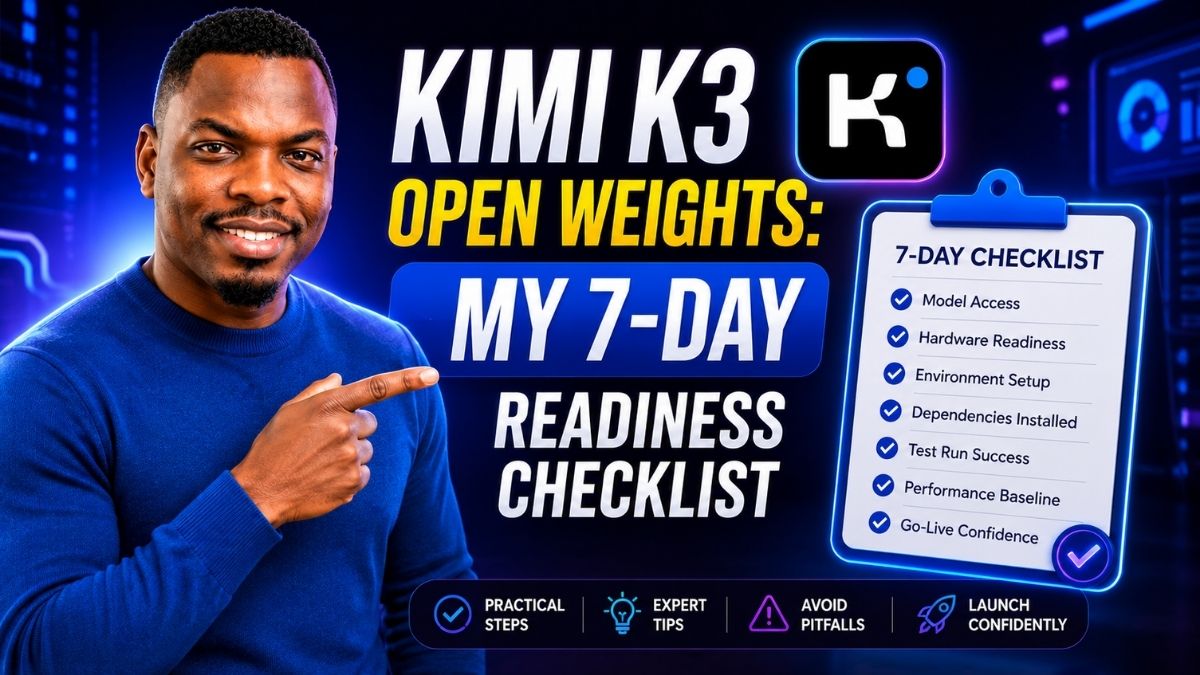
Kimi K3 Open Weights: My 7-Day Readiness Checklist Before July 27
Moonshot promised full weights for its 2.8T-parameter flagship by July 27 — I’ve spent the last three days actually running the hosted API, reading the license precedent, and pressure-testing what “readiness” really means with a week left on the clock.
By Oyekale Olawale · 11 min read
⚡ Quick Answer
As of today, no Kimi K3 weights, LICENSE file, or deploy guide exist. Moonshot’s own blog still says “the full model weights will be released by July 27, 2026” — a promise, not a shipped fact. With 7 days left, the useful work is: qualify against the hosted kimi-k3 API today, size out that a 2.8T model at MXFP4 needs 64+ accelerators (not a home rig), and template your license review off K2.7-Code’s Modified MIT clause. None of that depends on the drop actually landing on schedule.
7 days
Jul 20 → Jul 27
2.8T
total parameters
64+
accelerators recommended
Unconfirmed
license terms
What’s Actually Confirmed vs. What’s Just Promised
Moonshot launched Kimi K3 on July 16, 2026 — live on Kimi.com, Kimi Work, Kimi Code, and the Kimi API, all hosted, none downloadable. The open-weights line appears in the launch blog and it hasn’t been walked back or clarified since: “The full model weights will be released by July 27, 2026.” That’s it. No repository link, no LICENSE file, no deploy guide. I checked Moonshot’s Hugging Face org myself this morning — the newest thing sitting there is still K2.7-Code from June. K3’s folder doesn’t exist yet.
If you’re weighing K3 against a closed alternative before committing engineering time either way, I broke down the vendor benchmark gap and the pricing math in Kimi K3 vs. Claude Fable 5 — it’s worth reading before you decide whether the open-weight bet is even the right one for your workload.
Moonshot’s track record cuts in its favor here — K2.7-Code shipped its weights and code openly in June exactly as stated. But a stated target isn’t a shipped artifact, and every checklist item below is built to survive the date slipping.
The Actionable Readiness Matrix
Here’s what I’d actually be doing with the API right now, ranked by what breaks first if you skip it.
| Task | Do This Today? | Why It Matters |
|---|---|---|
Wire kimi-k3 into your eval harness |
✅ Yes | OpenAI-SDK compatible today; carries over unchanged once self-hosting exists |
| Inventory which workloads justify self-hosting | ✅ Yes | 64+ accelerators kills most hardware conversations before they start |
| Pre-brief a managed inference provider | ✅ Yes | DeepSeek V4’s drop day showed hosts move within hours, not days |
| Draft license checklist off K2.7-Code’s clause | ✅ Yes | Same attribution-clause structure is the pattern to expect |
| Buy or reserve supernode-class hardware | ❌ Not yet | No confirmed LICENSE file or deploy guide to size against |
Hosting Reality: 2.8T at MXFP4 Isn’t a Homelab Project
The number that actually matters here isn’t a benchmark score, it’s the serving footprint. K3 ships weights in MXFP4 with MXFP8 activations, applied through quantization-aware training from the SFT stage forward. Even with that efficiency work, Moonshot’s own guidance recommends serving on supernode configurations with 64 or more accelerators. Compare that to K2.7-Code, which Moonshot documents running on a single H200 node at tensor parallelism 8 — or even a budget rig of 8× L20 GPUs paired with two Xeon CPUs through KTransformers. That’s roughly an 8x jump in accelerator count between the coding specialist and the flagship.
Kimi K3 (vendor guidance) — 64+ accelerators
K2.7-Code — H200 node, TP8 — 8 accelerators
Source: Moonshot K3 deploy guidance; Kimi-K2.7-Code deploy_guidance.md
Practically, that means “open weights” for K3 will mean “someone in the inference market runs this for you” far more often than “I run this in my own rack.” I’ve been through this exact sizing exercise before with smaller open-weight coding models — if you’re weighing hardware against a lighter model class, my vibe coding tools breakdown covers what’s realistic on consumer-adjacent setups, which K3 is simply not.
License Watch: No File Yet, But a Specific Precedent
K3’s launch material contains zero licensing language for the forthcoming weights. What it does have is a strong precedent to work from. K2.7-Code shipped in June under a “Modified MIT License” — standard MIT plus one attribution clause that kicks in once a commercial product built on it crosses 100 million monthly active users or $20M in monthly revenue. DeepSeek uses the identical clause structure on its MIT-licensed V3 and V4 weights, so this isn’t a one-off Moonshot quirk — it’s becoming the house style across major Chinese open-weight labs.
✓ What the precedent tells you to check
- Base license family (MIT-derived vs. bespoke)
- MAU / revenue attribution thresholds
- Whether derivative works and quantized variants are covered
✗ What you can’t assume
- K3’s clause will match K2.7-Code’s exactly
- Weights and code will ship under one unified license
- “Open weight” means unrestricted commercial use
If your team is already running K3 through the CLI rather than raw API calls, the plan-gating rules matter here too — I covered the cache-invalidation behavior and plan minimums in my Kimi Code K3 setup guide, and the fuller walkthrough of the interface itself is in the Kimi Code K3 guide.
How I Tested the Kimi K3 API This Week
I ran the hosted kimi-k3 model ID through the OpenAI-compatible endpoint for three days on a mix of long-context summarization and multi-step coding prompts, mostly to see what the harness would actually surface before the weights show up. A few things stood out that vendor charts don’t tell you:
reasoning_effortis locked to max at launch — there’s no low or high tier yet, so every number I recorded is a max-effort number, and my cost estimates ran higher than I’d budgeted because of it.- Sampling is fixed at temperature 1.0 / top_p 0.95. I tried overriding it in a request payload and the API silently ignored the parameter rather than erroring, which cost me twenty minutes debugging output variance I thought was a prompt problem.
- Pricing really is flat across the whole 1M-token window — $3.00/M input, $0.30/M on a cache hit, $15.00/M output — no tiering by context length, which made cost modeling genuinely simpler than I expected going in.
- On one long-context run pushing close to the advertised ceiling, a request with heavy cached content returned a context-length error well before the full 1M budget was used, which suggests the effective usable window with caching enabled is narrower than the headline number in practice.
Moonshot itself flags thinking-history sensitivity and excessive proactiveness as known rough edges versus closed frontier models — worth testing against your own tasks rather than trusting a benchmark chart, since that’s exactly the kind of gap vendor evals don’t surface. If you’re deciding whether Claude’s coding workflow is a safer bet while K3 stabilizes, I go deep on that in Is Claude AI Good for Coding?
The 7-Day Countdown From Here
| Window | Action | Cost of Skipping |
|---|---|---|
| Jul 20–22 | Finish harness baselines on kimi-k3 against your own task suite |
You start qualifying on Jul 27 instead of finishing |
| Jul 22–24 | Pre-brief a managed inference provider for K3-class capacity | You queue behind teams who called earlier |
| Jul 24–26 | Finalize the license checklist template from the K2.7-Code clause | Legal review starts cold the day the file appears |
| Jul 27+ | Verify the actual LICENSE, artifact format, and deploy guide before adopting | You build on terms you never checked |
Pick Your Posture Before the Drop
Most teams running multi-vendor AI stacks now default to a primary-plus-secondary split specifically to avoid single-vendor dependency risk. An open-weights drop is what turns “trust the vendor’s uptime” into “worst case, the artifact exists outside them.” Where you land depends on how much that risk actually costs you. For a broader look at open-weight coding options if K3 turns out to be more than you need, my Verdent alternatives roundup and ChatGPT alternatives guide both cover adjacent tools worth benchmarking against.
FAQ
Is Kimi K3 open source right now?
No. K3 is live as a hosted model through Kimi’s apps and API, but the downloadable weights are promised for July 27, 2026, not shipped yet.
Can I self-host Kimi K3 on a normal GPU server?
Realistically, no. Moonshot’s own guidance points to supernode configurations with 64 or more accelerators for the 2.8T model — this is managed-inference or large-cluster territory, not a single-node setup.
What license will K3 use?
Unconfirmed as of today. The strongest signal is K2.7-Code’s Modified MIT license, which adds an attribution requirement once a product crosses 100M monthly active users or $20M in monthly revenue.
Can I evaluate K3 before July 27?
Yes — the API is live now under model ID kimi-k3, OpenAI-SDK compatible, and any eval harness you build against it carries over once self-hosted or third-party endpoints exist.
Bottom Line
With 7 days left, treat July 27 as a date to plan around, not a date to wait for. Everything worth doing — harness qualification, hosting conversations, license prep — is doable against the API today and loses nothing if Moonshot’s timeline slips. The two things I’d actually verify the moment the weights land: the real LICENSE file against the K2.7-Code precedent, and every benchmark number in circulation, since all of it is vendor-reported at max effort until you re-run it yourself.


