Open Source vs Open Weight AI Models: The Real Difference Explained
A plain-English breakdown of what Llama, DeepSeek, Qwen, and GPT-OSS actually release — and why the license matters more than the label.
By Oyekale Olawale
Quick Answer
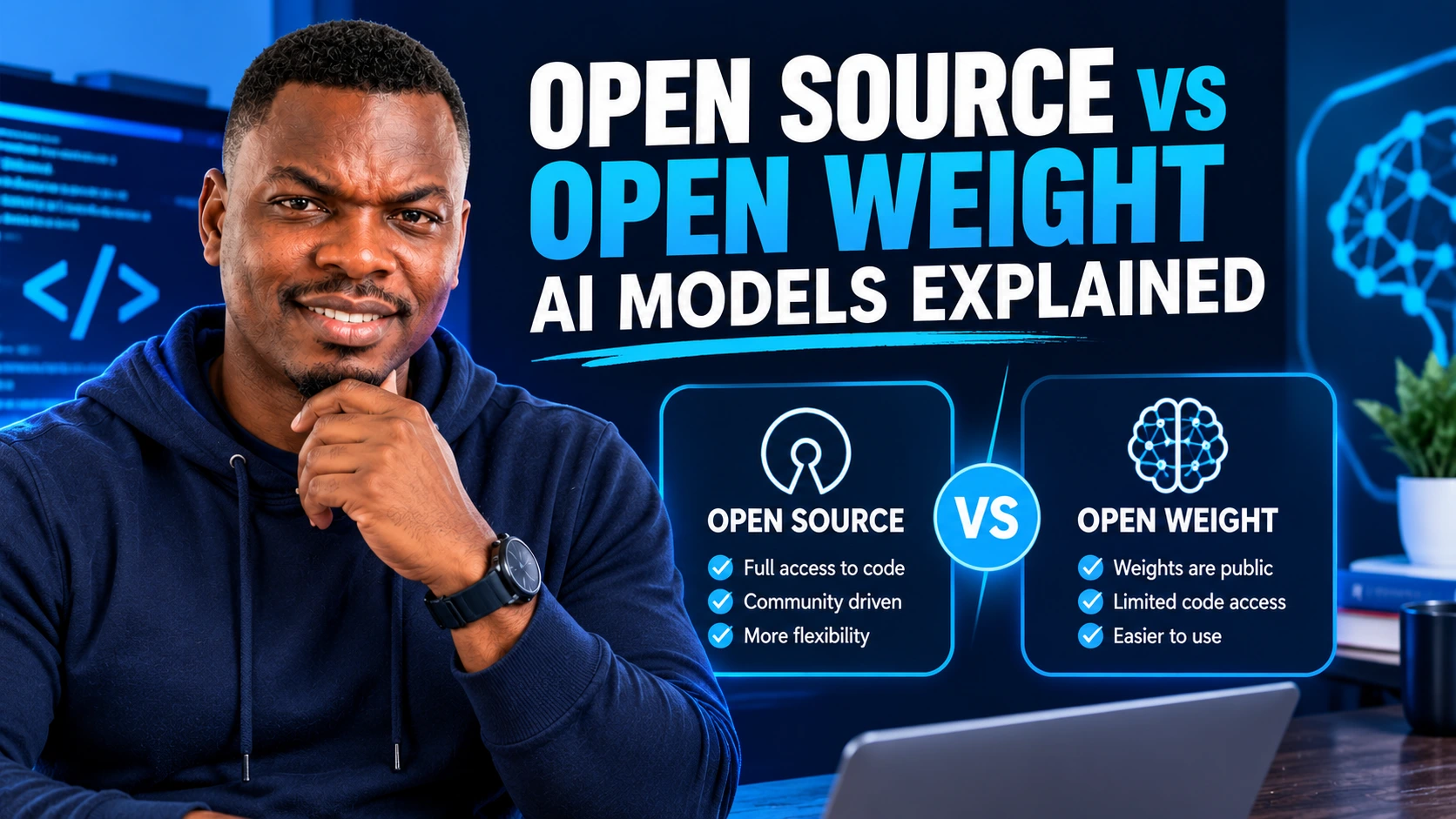
Open source vs open weight AI models comes down to this: open weight means you can download a model’s trained parameters and run them yourself, but the training code, the training data, and the full development process usually stay private. Open source AI, under the Open Source Initiative’s 2024 definition, requires enough of the code, data information, and documentation for someone to actually study, modify, and rebuild the system — not just run it. Almost every model people call “open source” in 2026 — Llama, DeepSeek, Qwen, Mistral, GPT-OSS — is technically open weight. The handful that genuinely clear the open source bar, like AI2’s OLMo 2, are the exception, not the rule.
Open source vs open weight AI models sounds like a technicality until you’re the one signing off on a production deployment. I’ve spent the past few months cross-referencing model cards, license texts, and independent trackers for Websites2Know’s AI coverage, and the terminology gap causes real problems — teams assume “open source” means they can inspect and rebuild a model, when in most cases they’ve only been handed a finished file they’re allowed to run.
This guide walks through what each term actually means, verifies the current license terms and specs for the models people cite most (Llama 4, DeepSeek V3.2/V4, Qwen3, Mistral Large 3, GPT-OSS), and gives you a checklist for evaluating any model’s openness before you build on it.
What “Open Source” Actually Means in AI
In traditional software, open source has a settled meaning: the source code is available under a license that lets anyone inspect, modify, and redistribute it. Projects like Kubernetes and Apache Spark fit that mold cleanly.
AI models break that clean picture. A model isn’t just code — it’s code plus weights (the learned parameters), plus the training data, plus the training methodology, plus documentation. Releasing the code alone tells you almost nothing about how the model actually came to behave the way it does.
The Open Source Initiative (OSI), the same nonprofit that maintains the canonical Open Source Definition for software, published its Open Source AI Definition (OSAID) 1.0 in October 2024 specifically to close this gap. Under OSAID, a genuinely open source AI system has to grant four freedoms:
- Use — for any purpose, without asking permission
- Study — how the system works and why it produces the outputs it does
- Modify — the system for any purpose, including changing its behavior
- Share — the system, modified or not, with anyone
Exercising those freedoms in practice requires access to the “preferred form for making modifications” — which OSI interprets as training code, sufficient information about the training data (or the data itself, when legally possible), and the model parameters, all under terms that don’t restrict use, study, modification, or redistribution.
What Are AI Model Weights?
Before “open weight” makes sense, it helps to know what a weight actually is. A neural network is, structurally, a huge collection of numerical parameters. During training, those numbers get adjusted — over trillions of tokens — until the model reliably turns an input into a useful output.
Those learned numbers are the weights. They’re distinct from hyperparameters, which are settings you choose before training starts (learning rate, batch size, number of layers). Weights are discovered through training; hyperparameters are decided by the people running it.
When a lab releases a model’s weights, developers can download those parameter files (usually as safetensors or GGUF checkpoints) and run the model on their own hardware — no API call, no per-token bill, no dependency on the vendor staying online.
Open Weight vs Open Source: The Core Difference
Here’s the distinction stripped down to one line each:
Open weight: you get the trained parameters, under whatever terms the license sets. Open source AI: you get the parameters plus the training code and enough data transparency to actually reproduce, audit, or meaningfully modify the system.
The gap almost always comes down to training data. A lab can hand you a 600-billion-parameter checkpoint and still tell you nothing about what it was trained on. Without that, you can’t audit it for bias, verify licensing compliance in the data, or reproduce the training run even if you had the compute budget to try.
The Openness Spectrum
Feature Comparison: Open Source AI vs Open Weight
| Component | Open Weight | Open Source AI (OSAID) |
|---|---|---|
| Model weights | Released | Released |
| Training code | Not shared | Shared |
| Training dataset / data info | Not disclosed | Released or fully described* |
| Intermediate checkpoints | Withheld | Often included |
| Commercial use | Depends on license | Permitted by definition |
| Self-hosting | Usually possible | Possible |
| Full reproducibility | No | Yes |
*When legally possible; otherwise, comprehensive documentation of sources, cleaning, and balancing methods.
2026 Model Licensing Table: What’s Actually Verified
I cross-checked each of these against the model’s own card on Hugging Face, the vendor’s license file, and independent trackers (LLM Stats, OpenRouter, Artificial Analysis) as of September 2026. Parameter counts and context windows shift with point releases, so treat this as a snapshot, not a permanent reference.
| Model | Parameters | Context | License | Openness class |
|---|---|---|---|---|
| Llama 4 Scout | 109B total / 17B active (MoE) | 10M tokens | Llama Community License | Restricted weights |
| Llama 4 Maverick | 400B total / 17B active (MoE) | 1M tokens | Llama Community License | Restricted weights |
| DeepSeek V3.2 | 685B total / 37B active (MoE) | ~128K–163K tokens | MIT | Open weight |
| DeepSeek V4 (preview) | Pro: 1.6T/49B active · Flash: 284B/13B active | 1M tokens | MIT | Open weight |
| Qwen3-235B-A22B | 235B total / 22B active (MoE) | 262K tokens | Apache 2.0 | Open weight |
| Mistral Large 3 | 675B total / 41B active (MoE) | 256K tokens | Apache 2.0 | Open weight |
| GPT-OSS-120B | 117B total / 5.1B active (MoE) | 131K tokens | Apache 2.0 | Open weight |
| OLMo 2 (7B/13B) | 7B or 13B (dense) | 4K–32K tokens | Apache 2.0 (weights, code, checkpoints); ODC-BY (Dolma data) | Open source AI (OSAID-aligned) |
Two things jump out from that table. First, only Llama carries a hard usage restriction — companies above 700 million monthly active users need a separate commercial agreement, and Meta requires “Built with Llama” attribution. Second, every other model here uses a genuinely permissive license (MIT or Apache 2.0) for the weights — but not one of them, except OLMo 2, publishes the training data or training code alongside it.
If you’ve been evaluating agentic frameworks recently, this same “what’s actually included” question comes up outside model licensing too — we ran into a version of it while comparing Kimi K3’s open-weight release against a closed model like Claude Fable 5, where the practical trade-offs (control vs. convenience) mattered more than which one scored higher on a benchmark.
Why Almost Nobody Releases Training Data
This is the real bottleneck behind the “open source” label, and it’s worth understanding rather than just accepting.
Frontier models train on trillions of tokens scraped from text, code, images, and audio across the open web. A meaningful slice of that material carries copyright restrictions, contractual limits, or privacy concerns that make wholesale redistribution legally risky. Publishing the full dataset isn’t just an engineering task — it’s a legal exposure the lab has to accept.
There’s a competitive angle too. Data curation — sourcing, filtering, deduplication, quality scoring — is a huge part of what separates a mediocre model from a frontier one. A lab can afford to give away the weights (which are hard to reverse-engineer usefully) while keeping the data pipeline that produced them as a trade secret.
The Models That Actually Pass the Open Source Bar
Most roundups stop at Llama and DeepSeek and call it a day. But if you’re looking for a model that genuinely satisfies OSAID rather than just wearing the label, the Allen Institute for AI’s OLMo 2 family is the clearest current example. Alongside the 7B and 13B weights, AI2 released the full Dolma training corpus, the training code, evaluation frameworks, and hundreds of intermediate checkpoints — everything a researcher would need to actually reproduce the training run, not just run the finished model.
✓ What “truly open” gets you
- Full reproducibility of training
- Independent bias and safety audits
- No hidden data-sourcing liability
- Community can improve the whole pipeline, not just fine-tune the output
✗ The trade-off
- Truly open models lag frontier benchmarks (7B–13B vs. 600B+ MoE flagships)
- Smaller ecosystem of hosting providers and fine-tunes
- Fewer specialized variants (coding, vision, agentic)
Other historically “fully open” efforts worth knowing — EleutherAI’s Pythia and BigScience’s BLOOM — set the precedent OLMo built on, but neither is actively competitive on 2026 benchmarks. OLMo is currently the most capable model that clears the OSAID bar without asterisks.
Why Llama and DeepSeek Get Called “Open Source” Anyway
Meta’s Llama family and DeepSeek’s models are the ones people reach for as “the open source AI models” — but neither one clears OSAID once you look closely.
Llama’s license is the more obviously restricted of the two: it disallows use by companies above 700 million monthly active users without a separate agreement from Meta, and it requires “Built with Llama” attribution on derivative products. OSI has explicitly stated that these terms disqualify Llama from the open source category, regardless of how open its weights feel in practice.
DeepSeek’s situation is different but lands in the same place. Its weights and inference code ship under the genuinely permissive MIT license — no usage cap, no attribution requirement, full commercial rights. But DeepSeek has never published its training dataset or the full data-curation pipeline, so there’s no way to independently verify what went into the model or reproduce the training run. MIT-licensed code plus an undisclosed dataset is open weight, not open source, no matter how permissive the code license is.
The License Matters More Than the Weights
This is the mistake I see most often: people check whether the weights are downloadable and stop there, without reading what the license actually permits. Two models can both ship downloadable weights while giving you very different rights.
Before building a product on any open-weight model, check whether the license lets you:
- Use the model commercially, at your actual scale
- Fine-tune it on proprietary data
- Redistribute the model or a fine-tuned derivative
- Combine it with other software under different licenses
- Skip mandatory attribution or “powered by” notices
Downloadable does not mean unrestricted. A startup that fine-tunes an open-weight model and builds a product around it can still run into licensing conditions on distribution or scale that only show up if someone actually reads the license text — not just the marketing page.
How Closed AI Models Compare
At the opposite end of the spectrum sit fully closed models — Claude, GPT-5.x, Gemini — where you interact through an app or API and never receive the weights or training materials. The trade-off is convenience for control: no hosting, no maintenance, no GPU procurement, but no ability to run the model without the vendor’s infrastructure or inspect why it produced a given output.
Data handling is the other variable that shifts constantly between vendors, tiers, and even policy updates within the same company — consumer accounts and enterprise/API accounts are frequently governed by different rules on whether your prompts get used for training and how long they’re retained. Rather than repeat a specific retention window here that could be outdated by the time you read this, check the current privacy documentation for the exact product and tier you’re using before sending anything sensitive through a closed model’s consumer interface. If you’re weighing closed models against each other rather than against an open one, our breakdowns of hallucination rates between Claude and ChatGPT and Claude Opus 5’s pricing and benchmarks go deeper on that comparison.
Pricing Reality: Self-Hosting vs API Access
“Free weights” doesn’t mean free to run. Here’s the honest cost comparison for a mid-size workload (roughly 50M input + 10M output tokens a month):
| Approach | Upfront cost | Ongoing cost | Who it fits |
|---|---|---|---|
| Self-host open weight model (own GPUs) | High (GPU purchase or reserved cloud instances) | Power, ops, and DevOps headcount; no per-token fee | High, steady, predictable volume |
| Open weight model via hosted inference (Together, Groq, DeepInfra, OpenRouter) | None | $0.02–$0.60 per million tokens, model-dependent | Variable volume, no infra team |
| Closed frontier model via API | None | Typically several dollars per million tokens for top-tier models | Maximum capability, minimum ops burden |
The practical read: hosted inference on an open-weight model (rather than full self-hosting) is usually the sweet spot for teams that want the licensing flexibility of open weights without buying GPUs — you still don’t get the training data or code, but you skip the infrastructure bill.
How to Evaluate Any Model’s Openness: Step by Step
- Find the actual license file, not the marketing page. Look on Hugging Face or the model’s GitHub repo for LICENSE.md.
- Check for usage caps or attribution clauses — user-count thresholds, “Built with X” requirements, or field-of-use restrictions.
- Search the model card for training data disclosure. Does it name specific datasets, or just say “a diverse mixture of publicly available data”?
- Look for training code or a technical report detailed enough to reproduce the architecture and training recipe.
- Confirm commercial rights explicitly for your use case and scale — don’t assume “downloadable” means “commercially unrestricted.”
- Cross-check the license against an OSI-approved list if OSAID compliance actually matters for your compliance or procurement process.
This same due-diligence habit — reading past the label to the actual terms — is one we apply across every open-weight model we cover, including our first-look review of Kimi K3’s open-weight release and the 7-day readiness checklist we built before deploying it.
Which Type Should You Actually Use?
Solo devs & researchers
An open-weight model (Qwen3, GPT-OSS) for full control over deployment, cost, and fine-tuning — or OLMo 2 specifically if reproducibility matters more than raw capability.
Small businesses
A hosted closed model via API — no infrastructure to manage, and the capability gap over self-hosted options is usually still real for general-purpose tasks.
Commercial products at scale
Read the license line by line before committing. A usage cap or redistribution clause you missed at prototype stage becomes a legal problem at scale.
If you’re weighing a self-hosted open-weight model against a managed coding assistant for engineering work specifically, it’s worth reading how licensing and usage terms play out in practice elsewhere in the AI tooling stack — our coverage of Gemini Code Assist Standard vs Enterprise and Claude Fable 5 vs ChatGPT 5.5 both run into the same “what does the tier actually include” question.
Where Most Guides on This Topic Get It Wrong
A few patterns show up repeatedly in other write-ups on this exact topic, and they’re worth flagging directly rather than quietly avoiding.
First, several treat “open” as a binary — a model is either open source or it’s closed, full stop. It isn’t. The spectrum above has at least four meaningful tiers, and a model can move between them release to release: Meta’s own Llama 1 was research-only, Llama 2 introduced the Community License, and Llama 4 kept that structure while adding the 700-million-user carve-out. Same family, shifting openness.
Second, most roundups list Llama, DeepSeek, Qwen, and Mistral as “the open source models” and stop there — none of them mention OLMo, Pythia, or BLOOM, the models that were actually built to satisfy the transparency standard everyone’s citing. That’s an odd omission for a topic that’s fundamentally about definitional precision.
Third, context-window and parameter figures get copied forward from launch-day press releases and never updated. DeepSeek’s active parameter count, Qwen’s context ceiling, and Llama’s exact license thresholds have all shifted since their original announcements — which is exactly why this piece cites current model cards and trackers rather than repeating numbers from a 2025 launch post.
FAQ
Is Llama open source?
No, not by the Open Source Initiative’s definition. Llama’s Community License caps free use at 700 million monthly active users and requires “Built with Llama” attribution, both of which conflict with OSAID’s requirement of unrestricted use. It’s open weight.
Is DeepSeek open source?
DeepSeek’s code and weights are released under the MIT license, which is fully permissive for commercial use. But DeepSeek has not published its training dataset or complete training pipeline, so it doesn’t meet OSAID’s data-transparency requirement. It’s open weight with a very permissive code license — not open source AI.
What’s the most “truly open” AI model available in 2026?
AI2’s OLMo 2 family is the clearest current example that satisfies OSAID: weights, training code, the Dolma training corpus, and intermediate checkpoints are all public under Apache 2.0 (ODC-BY for the dataset).
Can I use an open-weight model commercially?
Usually yes, but check the specific license. Apache 2.0 and MIT-licensed models (Qwen3, Mistral Large 3, GPT-OSS, DeepSeek) permit commercial use with no restrictions. Llama’s license permits commercial use except for organizations above the 700-million-user threshold.
Does open weight mean I can retrain the model from scratch?
No. Open weight gives you the finished, trained parameters — you can run and fine-tune them, but without the training code and dataset, you can’t reproduce the original training run.
Why does the OSI definition matter if most people ignore it?
Because procurement, compliance, and regulatory frameworks increasingly reference “open source” as a formal term with legal weight — not a marketing adjective. Misclassifying a model can create real compliance gaps, particularly under frameworks that reference AI openness explicitly.
Conclusion
Stop treating “open source,” “open weight,” and “closed” as interchangeable marketing words. They describe genuinely different things, and the difference has real consequences for compliance, reproducibility, and what you’re legally allowed to build.
When I evaluate a new model now, I don’t stop at whether the word “open source” appears on the landing page. I check whether the weights are actually downloadable, what’s disclosed about training data, what the license permits at my specific scale, and whether an independent tracker corroborates the vendor’s own claims. That four-step habit is the entire difference between picking a model that fits your project and discovering a licensing problem after you’ve already shipped.