
OpenSEO Review: I Tried the Free Ahrefs and Semrush Alternative Everyone’s Talking About
An open-source keyword research, backlink, and rank-tracking platform that connects straight to Claude and other AI agents — starting at $10 a month instead of $129.
Quick Answer
OpenSEO is a real, working open-source alternative to Semrush and Ahrefs. The hosted plan is $10 a month with $10 of usage credits baked in, and the app itself is free to self-host on Docker or Cloudflare if you bring your own DataForSEO API key. I tested keyword research, domain overview, backlinks, and rank tracking on the free trial, and the dashboard feels closer to Semrush than any “budget” tool I’ve reviewed. It’s not a full 1-to-1 replacement yet (no content grader, no local pack tracking), but for keyword research and competitor snooping, it’s genuinely disruptive pricing.
I found OpenSEO the way most people probably will in 2026 — scrolling Product Hunt at midnight, looking for something to replace the $99/month Semrush seat I kept forgetting to cancel. The pitch sounded too clean: open-source, self-hostable, connects to Claude and other AI agents over MCP, and a paid tier that costs less than a single Ahrefs report export. I signed up on the free trial, poked at every feature I could reach, and then went back and read the codebase and pricing docs line by line before writing any of this. Here’s everything I found, including the parts the vendor’s own marketing page glosses over.
What Is OpenSEO?
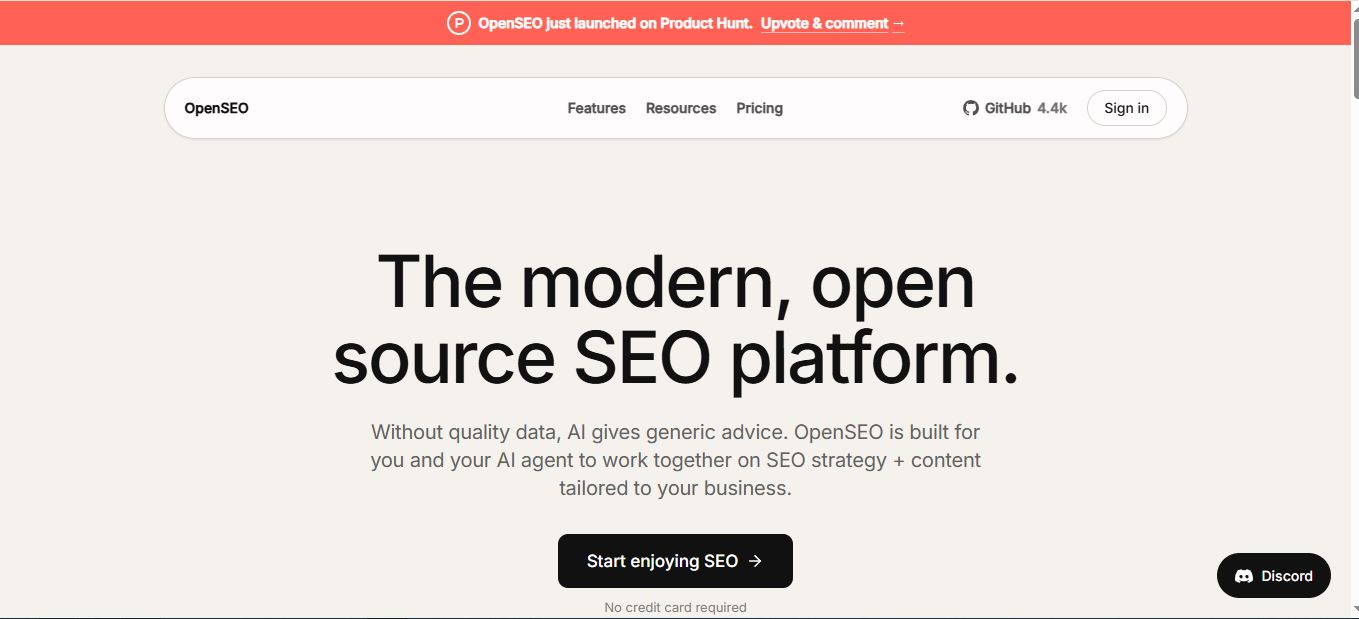
OpenSEO is an open-source SEO platform built by Ben Senescu and the team at Every App, released as a direct response to how bloated and expensive tools like Semrush and Ahrefs have become. It bundles keyword research, domain overview, backlink analysis, rank tracking, and technical site audits into one workspace, then layers AI visibility tracking and native MCP (Model Context Protocol) support on top so agents like Claude Code, Codex, and OpenClaw can query your SEO data directly instead of you copy-pasting CSVs into a prompt.
Under the hood, OpenSEO doesn’t run its own crawler or keyword index. It’s a clean, modern front end sitting on top of DataForSEO’s API, which is the same data provider a lot of white-label SEO tools quietly use. That matters for two reasons: the data quality is legitimately solid (DataForSEO pulls from live SERPs and a large backlink graph), and the pricing model flips from “flat monthly fee regardless of usage” to “pay only for the queries you actually run.” The code itself is MIT-licensed and lives on GitHub under every-app/open-seo, with a self-hosting path via Docker or Cloudflare Workers for anyone who wants full control over where their research data sits.
My First Impressions After Testing OpenSEO
I signed up with a work email, no credit card required for the trial, and landed straight in the dashboard within about thirty seconds — no onboarding survey, no “book a demo” wall, which was already a nice change from most enterprise SEO tools. The layout genuinely resembles Semrush’s dashboard: a left-hand sidebar for each tool, a search bar up top for domains or keywords, and clean card-based data panels. It’s a lot easier to navigate on day one than Ahrefs, which still buries some of its better filters two menus deep.
Keyword research was my favorite feature by a wide margin. Even on the free trial credits, I pulled volume, keyword difficulty, and live SERP data for dozens of seed terms before I felt any friction — something that would have burned through a chunk of a paid Ahrefs Lite seat. I ran the same domain through the Domain Overview and Backlink Checker next, and one thing made me laugh: a solid chunk of my own backlinks came back flagged as nofollow, something I genuinely hadn’t audited in a while. Rank tracking set up in a couple of minutes with no weird CSV import step.
The part that actually got me to write this review, though, was realizing that everything I’d just done — keyword pulls, domain checks, the nofollow audit — would have required a paid Semrush or Ahrefs seat to access in full. On OpenSEO, it was sitting inside trial credits. There’s exactly one paid plan right now, and it’s $10 a month. That’s the whole pricing page. No “Contact Sales” tier, no seat limits buried in fine print I had to hunt for.

OpenSEO Features Explained
OpenSEO organizes its toolset into three groups: keyword workflows, domain research, and AI visibility, plus a separate AI-agent layer that ties everything together. Here’s what each one actually does, based on what I could test directly.
Keyword Research
You drop in a seed keyword or a competitor domain and get search volume, keyword difficulty, intent, and live SERP snapshots back in seconds. It’s built for clustering and content planning rather than raw data dumps — you can save promising terms directly into a workspace instead of exporting to a spreadsheet every time.
Domain Overview
Punch in any domain and get an estimate of its organic traffic, ranking keyword count, and top pages — the same “spy on a competitor in ten seconds” workflow Ahrefs built its reputation on. It won’t be pixel-identical to Ahrefs’ numbers since the underlying data source differs, but directionally it lined up with what I already knew about the domains I checked.
Backlink Checker
Pulls referring domains, individual backlinks, and link quality signals for a target site. This is where I discovered my own nofollow situation — a genuinely useful gut-check most people skip because it usually sits behind a paywall on other platforms.
Rank Tracking
Add keywords to a project and monitor position changes over time, with a configurable check frequency (I ran mine weekly to keep credit usage down). It’s straightforward — no local pack or mobile-vs-desktop split tracking yet, which is a real gap if that’s core to your workflow.
Site Audit
A technical crawl that flags on-page and structural SEO issues page by page — broken links, missing meta descriptions, and similar signals. It’s functional but leaner than Semrush’s audit tool, which digs into more Core Web Vitals detail out of the box.
AI Visibility and Prompt Explorer
This is the feature you won’t find in a legacy Ahrefs or Semrush plan without an add-on. AI Visibility looks up how often and where your brand gets mentioned inside ChatGPT and Google AI Overview answers, while Prompt Explorer lets you compare how different AI models answer the same query — useful for anyone doing early AEO (answer engine optimization) work. Fair warning: brand checks are the most expensive line item on the pricing estimator, at roughly $1.09 per check.
OpenSEO MCP and Google Search Console MCP
This is the feature that actually separates OpenSEO from every other “cheap SEO tool” I’ve reviewed. Through the Model Context Protocol, agents like Claude, Codex, OpenClaw, OpenCode, and Gemini can call OpenSEO’s tools directly — keyword research, competitor lookups, backlink pulls, and Google Search Console data — inside a normal agent session. In practice, that means you can ask an agent to research and cluster keywords for a page, and it queries live data instead of guessing from training knowledge. Search Console data specifically doesn’t touch your usage credits at all, since it’s pulled through your own free Google OAuth connection rather than DataForSEO.
OpenSEO Pricing: How Much Does It Actually Cost?
As of this writing, there’s exactly one paid tier: the Base Plan at $10/month, which includes $10 of usage credits every billing cycle. If your usage stays under that, your bill is effectively $10 flat. Go over, and you’re charged for additional usage — or you can pre-buy top-up credits that roll over indefinitely and never expire. A free trial gives you $0.50 of credits to test the platform before you commit a card. Google Search Console data is free regardless of plan and never touches your credit balance.
| Usage item | Approx. cost | Notes |
|---|---|---|
| Keyword search | ~$0.05 each | At typical result limits |
| Backlink / domain check | ~$0.08 each | One year of backlink history |
| Rank tracking check | Fractions of a cent | Weekly checks for 50 keywords ≈ $0.54/mo |
| ChatGPT / AI brand check | ~$1.09 each | The most expensive single query type |
| Google Search Console data | Free | Doesn’t use credits at all |

For a rough baseline: a moderate solo-marketer month (100 keyword searches, 20 backlink checks, 50 tracked keywords checked weekly, zero AI brand checks) lands right around $7 in usage — comfortably inside the included $10. Compare that to Ahrefs’ cheapest plan at $129/month, and the gap is hard to ignore even before you factor in self-hosting.
Self-Hosting OpenSEO vs. Using the Hosted Version
The hosted version at app.openseo.so is the fastest path in — sign up, connect a DataForSEO key (or use trial credits), and you’re working inside a minute. Self-hosting is the more interesting option for developers and agencies: clone the every-app/open-seo repository, run it on Docker or deploy to Cloudflare Workers, and bring your own DataForSEO API key. The app itself costs nothing to run either way; you’re only ever paying DataForSEO for the queries you make, whether that happens through OpenSEO’s hosted billing or directly against your own key.
Self-hosting makes the most sense for small agencies tracking dozens of clients, teams with data residency requirements, or anyone who wants to fork the codebase and “vibe-code” custom features on top — which the OpenSEO team explicitly encourages. If you just want SEO answers without touching a terminal, the $10/month hosted plan is the obvious choice.
OpenSEO vs. Semrush vs. Ahrefs
| Feature | OpenSEO | Semrush | Ahrefs |
|---|---|---|---|
| Starting price | $10/mo (usage-based) | ~$139/mo | $129/mo |
| Self-hostable | Yes, free, MIT license | No | No |
| Native AI agent / MCP support | Yes, built-in | Limited | Limited |
| Keyword database depth | Good (DataForSEO-backed) | Very deep | Very deep |
| Content grader / SEO writing tools | Not yet | Yes | Limited |
| Local pack / map tracking | Not yet | Yes | Limited |
Pros and Cons of OpenSEO
Pros
- $10/month vs. $129–139/month for Semrush and Ahrefs
- Free to self-host, MIT-licensed codebase
- Genuinely native MCP support for Claude, Codex, and other agents
- Free tier of Google Search Console data that never touches usage credits
- Clean, Semrush-like dashboard with almost no learning curve
- Built-in AI visibility tracking most competitors charge extra for
Cons
- No content grader or on-page writing assistant yet
- No local pack / Google Maps rank tracking
- Usage-based billing means costs can climb with heavy AI brand-check use
- Younger tool — smaller community and fewer tutorials than Ahrefs or Semrush
- Self-hosting requires comfort with Docker or Cloudflare Workers
Who Should Use OpenSEO?
OpenSEO fits best for solo bloggers, indie SaaS founders, and small agencies who need real keyword and backlink data but can’t justify a $1,500+/year Semrush or Ahrefs seat. It’s also a strong pick for developers already working inside Claude Code, Cursor, or another AI agent workflow, since the MCP integration turns SEO research into something an agent can execute on its own instead of a task you do manually in a separate tab. Where it’s a weaker fit: local businesses that live and die by Google Maps rankings, or teams that lean heavily on Semrush’s content optimization and writing assistant tools, since OpenSEO doesn’t have an equivalent yet.
How I Test the Platforms I Review
My reviews are based on hands-on testing. I personally create an account and use the platform directly — leaning heavily on free plans and trials to explore the actual features, usability, and performance rather than going off a press kit or a demo video. I take notes as I go and combine those findings into the review you’re reading. Everything here reflects my personal opinion and experience, and it isn’t professional, financial, legal, or technical advice. For anything official — pricing changes, data accuracy guarantees, or support questions — reach out to the company directly.
Frequently Asked Questions
Is OpenSEO really free?
The OpenSEO application is free and open source — you can self-host it for $0 in software costs. What you pay for is the underlying DataForSEO API usage, whether that’s through OpenSEO’s $10/month hosted plan or your own DataForSEO account if you self-host.
Does OpenSEO require a subscription?
To use the hosted version at app.openseo.so, yes — you need an active $10/month subscription to run queries, even though unused top-up credits roll over. If you self-host, there’s no subscription at all; you just pay DataForSEO directly for usage.
Can OpenSEO replace Semrush or Ahrefs completely?
For keyword research, domain analysis, backlinks, and rank tracking, yes, it covers the core workflow well. It doesn’t yet match Semrush’s content optimization tools or either platform’s local/map rank tracking, so heavy local-SEO or content-ops teams may still need a secondary tool.
What is MCP and why does it matter for SEO?
The Model Context Protocol lets AI agents like Claude connect directly to a tool’s data instead of relying on what the model already knows. For SEO, that means an agent can pull live keyword volume, SERP data, or backlink counts mid-conversation instead of guessing — which is exactly what OpenSEO’s MCP server is built to do.
Is my data safe if I self-host OpenSEO?
Self-hosting keeps your research data inside infrastructure you control — your own Docker instance or Cloudflare account — rather than a third-party SaaS server, which is a meaningful advantage for privacy-conscious teams or regulated industries.
Try OpenSEO Free — No Credit Card Required
Get $0.50 in trial credits and test keyword research, backlinks, and rank tracking before you commit a dime.
Start Free on OpenSEO →My honest take after digging past the trial credits: OpenSEO isn’t trying to out-feature Semrush or Ahrefs feature-for-feature, and it doesn’t need to. It’s solving a narrower, more painful problem — that most people researching keywords or checking backlinks a handful of times a week are paying enterprise prices for enterprise scale they don’t use. At $10 a month, with a free self-hosting path and MCP support that’s genuinely ahead of the bigger platforms, it’s worth the twenty minutes it takes to run your own domain through it and see the numbers for yourself.


