
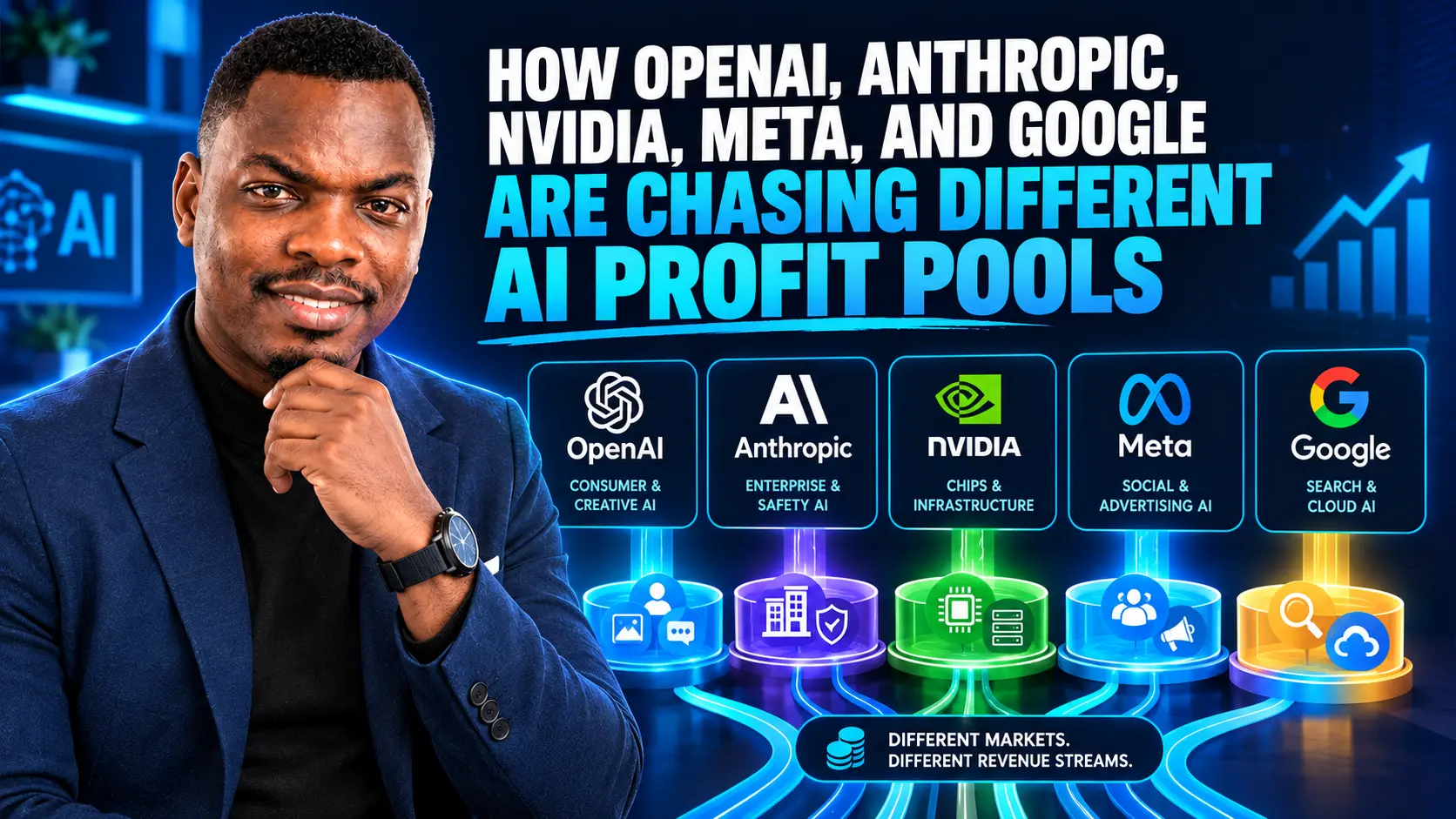
How OpenAI, Anthropic, NVIDIA, Meta, and Google Are Chasing Different AI Profit Pools
Same $2.59 trillion AI market. Five completely different bets on where the money actually lands.
By Oyekale Olawale · Independent Reviewer, Websites2Know
Quick Answer
AI profit pools have split into five distinct bets, and no single company is chasing all of them. NVIDIA is the only one already posting AI-driven profit at real scale ($59.7 billion net income in a single quarter). Anthropic is betting on enterprise agents and expects to break even well before OpenAI. OpenAI is burning cash on ubiquity, reportedly running a −122% operating margin on $5.7 billion of Q1 2026 revenue. Meta is giving its models away to commoditize the layer beneath its ad business. Google is the only one that owns its own chips, models, and distribution end to end. Here’s how each one actually makes (or loses) money, with the current pricing, licensing, and financials to back it up.
I’ve spent the past few weeks pulling apart earnings calls, model cards, and pricing pages for this one, because “AI is unprofitable” and “AI is wildly profitable” are both being said about the same industry in the same week — and both are technically true, depending on which layer of the stack you’re looking at. That’s the whole story here. There isn’t one AI business. There are five, stacked on top of each other, and the company you think of as “winning” depends entirely on which layer you’re standing on.
The Five AI Profit Pools, Explained
Every company in this piece is chasing one of these, and most are chasing two at once. The pool determines the balance sheet.
| Profit Pool | Who’s Chasing It | How It Pays | Currently Profitable? |
|---|---|---|---|
| Infrastructure & chips | NVIDIA | Selling GPUs and networking regardless of who wins the model race | Yes — 75% gross margin |
| Foundation-model API & subscriptions | OpenAI, Anthropic | Per-token pricing, ChatGPT Plus/Pro, Claude subscriptions | Mixed — inference reportedly profitable, the business overall isn’t yet |
| Enterprise agents | Anthropic (primarily) | High-value coding and workflow automation, priced on outcome, not novelty | Approaching — targeting breakeven ahead of OpenAI |
| Consumer ubiquity & ads | OpenAI, Meta | Free-tier engagement monetized later via ads, commerce, or device placement | Not yet at OpenAI; already funded by Meta’s core ad business |
| Vertical integration | Own silicon (TPU) + own model + own distribution (Search, Cloud, Workspace) | Yes — Cloud segment margin over 35% |
How I Evaluated This
I’m not going to pretend I ran infrastructure benchmarks on NVIDIA’s data centers or audited Anthropic’s books — nobody outside those companies can. What I did do: cross-referenced each company’s own pricing pages, official earnings releases, and model/system cards against independent trackers (LLM Stats, Artificial Analysis) and financial reporting from outlets that cite primary filings. Where a figure comes from an analyst estimate or a leaked document rather than an audited statement — OpenAI’s revenue numbers, for instance, since it’s still private — I’ve flagged it as reported rather than confirmed. Parameter counts are noted as “undisclosed” wherever a lab hasn’t published them, which, at the frontier, is most of them now.
NVIDIA: Selling the Shovels, and Barely Sweating
Start here because it’s the least ambiguous story in the piece. In its fiscal Q2 2027 quarter (ended July 26, 2026), NVIDIA reported $96.2 billion in revenue, up 106% year over year, with Data Center revenue alone hitting $89.0 billion, up 117%. Gross margin sat at 75.0% and net income came in at $59.7 billion — in one quarter. That’s not a rounding error next to OpenAI’s entire reported annual run rate.
NVIDIA doesn’t care who wins the model war. Blackwell Ultra is shipping in volume, the Vera Rubin platform is now in full production with CoreWeave, Google Cloud, Microsoft Azure, and Oracle as launch partners, and CEO Jensen Huang has been blunt that supply, not demand, is the constraint. The company doesn’t even bake China compute revenue into its own guidance anymore, which tells you how confident it is in demand from everywhere else.
✓ Why the pool is durable
Every model provider in this article is either buying NVIDIA GPUs or building around them. Even Google’s TPU bet still runs alongside massive NVIDIA purchases elsewhere in the industry.
✗ Where it’s exposed
Custom silicon (Google’s TPUs, Amazon’s Trainium) is projected to keep taking share, and margin depends entirely on the model labs’ capex spree continuing.
OpenAI: Betting on Ubiquity Over Margin
OpenAI’s current flagship, GPT-6 Astra, launched September 3, 2026, with a 1.05-million-token context window, a 128,000-token output cap, and API pricing of $10 per million input tokens and $50 per million output — twice the price of Anthropic’s Claude Opus 5. Push past 272,000 input tokens in a single request and OpenAI doubles the input and cache rate and adds 50% to output pricing, a cliff that isn’t advertised nearly as loudly as the headline context number. Below Astra sit GPT-5.6 Sol ($4/$20 per million tokens), Terra ($2/$12), and Luna ($0.20/$1.20) for high-volume, low-stakes work. I broke down that Sol-powered workflow in a hands-on test earlier this year, and the pattern holds here too: OpenAI segments hard by task rather than offering one model for everything.
Here’s the uncomfortable number for OpenAI bulls: reporting circulating this month puts the company’s Q1 2026 revenue at $5.7 billion against a reportedly negative 122% operating margin, with an annualized run rate around $40 billion by midyear — well behind Anthropic’s. OpenAI is privately held, so none of this is an audited GAAP figure; treat it as a directional estimate from reporting that’s tracked the company closely, not a confirmed statement. What is confirmed is the strategy: hire the person who built Meta’s ad machine as CMO, hire Instacart’s former CEO to run applications, and bolt commerce, ads, and hardware onto ChatGPT’s userbase. The bet is that if intelligence gets cheap enough, usage explodes past what subscriptions alone can capture — the Jevons paradox, applied to tokens.
Anthropic: Betting the Company on Enterprise Agents
Anthropic’s current lineup, priced on its site as of mid-September 2026: Claude Haiku 4.5 at $1/$5 per million tokens, Claude Sonnet 5 at a permanent $2/$10 (the company chose not to let this lapse to a higher rate), Claude Opus 5 at $5/$25, and the frontier-tier Claude Fable 5.1 at $10/$50 — matching GPT-6 Astra dollar for dollar at the top. Every model from Sonnet 4.6 onward ships the full 1-million-token context window with no long-context surcharge, which is a real structural difference from OpenAI’s 272K pricing cliff, not just marketing.
Worth noting for anyone who’s used Claude Fable or Mythos recently: Anthropic briefly suspended both models on June 12, 2026, to comply with U.S. Department of Commerce export controls, then restored access on July 1, 2026, once the Department lifted those controls. It’s a reminder that even the enterprise-agent bet carries policy risk the pure-infrastructure play doesn’t.
The strategy itself is coherent, and it’s the one I find most defensible of the five. Anthropic isn’t trying to be everywhere; it’s trying to own the tasks that are economically valuable, technically verifiable, and important enough that a business stops shopping on token price — coding, long-running agents, computer use. Reporting this quarter put Anthropic’s run rate above $65 billion at the end of July, ahead of OpenAI’s roughly $40 billion, and CEO Dario Amodei has said publicly that inference is already profitable on a per-dollar basis, with efficiency gains compounding further. I’ve used Claude Code and Claude Cowork enough in a separate review of Claude Cowork’s safety model to see why this sticks: once a team’s workflow depends on a specific agent’s reliability, they stop price-shopping the API.
Meta: Give the Model Away, Keep the Ads
Meta’s play only looks confusing until you remember it doesn’t need the model layer to make money directly. Llama ships under the Llama Community License, not an OSI-approved open-source license: it’s free to use, self-host, and fine-tune for effectively any company, with two carve-outs — you owe Meta a separate commercial license if your product crosses 700 million monthly active users, and if you’re a company established in the EU, you’re barred from using Llama 4’s multimodal capabilities for development (older Llama 3.x models don’t carry that restriction). You also can’t put “Llama” in your own product’s name.
That’s a textbook “commoditize the complement” move: if the model layer is free and good enough, nobody can build a walled garden around it that locks Meta out, and the actual money keeps flowing through Meta’s existing ad and engagement machine. Alongside Llama, Meta has also quietly stood up Muse Spark, a closed, proprietary model launched in April 2026 that now powers some Meta AI features directly — so even the “we give it all away” company keeps a closed model in its back pocket for the surfaces it wants full control over.
Google: The Only One That Owns Every Layer
Google is the outlier in this list because it’s the only company running all five profit pools through one balance sheet. Its seventh-generation Ironwood TPU (v7), generally available since November 2025, links up to 9,216 chips into a single pod delivering roughly 42.5 exaflops — about 10x the prior generation — and it’s co-designed by the same team that builds Gemini, which Google’s own materials describe as a compounding hardware-model feedback loop that no merchant-silicon vendor selling to a fragmented market can replicate.
The financial payoff shows up fastest in Cloud. In Alphabet’s quarter ended June 30, 2026, Google Cloud revenue hit $24.8 billion, up 82% year over year, at a 35.6% operating margin — a segment that was barely profitable three years ago. Alphabet’s total revenue for the quarter was $119.8 billion, and while a chunk of the eye-popping $112.2 billion net income figure came from non-cash mark-to-market gains on Alphabet’s own equity stakes (including in Anthropic), the underlying operating income of $40.8 billion, up 30% year over year, is real, repeatable business. Nobody else in this piece can point to a profitable model, a profitable chip, and a profitable distribution channel all inside the same 10-K.
Frontier Model Pricing, Per 1M Tokens (Input / Output) — September 2026
GPT-6 Astra
$10/$50
Claude Fable 5.1
$10/$50
Claude Opus 5
$5/$25
GPT-5.6 Sol
$4/$20
Claude Sonnet 5
$2/$10
Bar height scaled to combined input+output rate. Source: OpenAI and Anthropic public pricing pages, retrieved September 2026.
Model Specs at a Glance: What’s Actually Disclosed
One honest note before the table: at the frontier, parameter counts are mostly a state secret now. OpenAI and Anthropic don’t publish them for their current flagships, and neither does xAI for Grok 4.6 — independent breakdowns published the same week Grok 4.6 launched confirmed no parameter count, mixture-of-experts structure, or training compute was disclosed. Meta and Alibaba’s Qwen are the exceptions that still publish real numbers, which is worth knowing before you trust any “X billion parameters” claim about a closed model circulating online.
| Model | Context Window | Parameters | License |
|---|---|---|---|
| GPT-6 Astra | 1.05M tokens (128K output cap) | Undisclosed | Proprietary / API only |
| Claude Opus 5 / Fable 5.1 | 1M tokens, no long-context surcharge | Undisclosed | Proprietary / API only |
| Llama 4 (herd) | Varies by variant | Published per model card | Llama Community License (free under 700M MAU; EU multimodal restricted) |
| Gemini 3.1 Pro | Large, provider-set (varies by surface) | Undisclosed | Proprietary / API only |
How to Decide Which Profit Pool Actually Matters for You
If you’re choosing a vendor rather than an investment thesis, the “who’s winning” framing is mostly noise. Here’s the sequence I actually use when a client or reader asks which AI company to bet their stack on:
- Identify which pool your workload sits in. High-volume, low-stakes text generation cares about per-token price (Luna, Terra, Haiku). Long-running coding agents care about reliability and context-window economics, not the sticker price (Sonnet 5, Opus 5).
- Price the long-context cliff, not just the headline rate. OpenAI’s 272K-token repricing can quietly double a bill for document-heavy workloads; Anthropic’s flat-rate 1M window can’t.
- Check the license if you’re self-hosting. Llama’s Community License is free for almost everyone, but the 700M MAU threshold and EU multimodal carve-out matter if you’re building a platform, not just a feature.
- Weigh vendor durability against vendor price. NVIDIA and Google are profitable businesses today; OpenAI’s pricing has moved twice in one year as it hunts for a sustainable model. Cheaper isn’t free of risk.
- Re-check every 60 to 90 days. Three flagships shipped within a single week this September. Whatever’s optimal today has a short shelf life.
My Take
If I had to rank these five strategies by how defensible they look from where I’m sitting today, it’s NVIDIA and Google at the top, Anthropic a clear third, and OpenAI and Meta tied for a very different kind of fourth — defensible for opposite reasons.
NVIDIA and Google aren’t really betting on any single model winning; they profit either way, which is the safest place to sit in a market this volatile. Anthropic’s enterprise-agent focus is the most coherent story among the pure model labs — it’s the only one of the two frontier labs with a credible, near-term path to breakeven, and I say that as someone who’s used both Claude Code and ChatGPT’s Codex heavily for actual client work, not just benchmark screenshots. OpenAI’s ubiquity bet could absolutely pay off — ChatGPT’s distribution is real — but “burn cash until Jevons’ paradox kicks in” is a bet on consumer behavior, not a repeatable unit economics story, and that’s a meaningfully riskier place for a reader’s dollar or a business’s dependency to sit. Meta’s approach is smart chess, not a business model in the traditional sense; it works precisely because Meta doesn’t need the model layer to be the profit center. I’d rather build a business on Anthropic’s or Google’s roadmap than OpenAI’s right now, purely on financial durability grounds — that’s a business judgment, not a quality judgment about the models themselves, which remain genuinely close on real-world tasks.
FAQ
Is any major AI company actually profitable in 2026?
Yes, but not the ones people usually mean by “AI company.” NVIDIA posted $59.7 billion in net income in a single quarter (Q2 FY2027, ended July 26, 2026) at a 75% gross margin, and Google’s Cloud segment is running a 35.6% operating margin. Among the pure foundation-model labs, neither OpenAI nor Anthropic has confirmed GAAP profitability, though Anthropic has publicly signaled it expects to reach breakeven well before OpenAI.
Why is OpenAI losing money if it has more users than Anthropic?
User count and unit economics are different problems. Reported figures put OpenAI’s Q1 2026 revenue at $5.7 billion against a roughly −122% operating margin — training costs, compute, and free-tier usage outweigh what the paid tiers currently bring in. It’s a deliberate bet on scale first, margin later, not a sign the product is failing.
Is Meta’s Llama actually open source?
Not by the formal Open Source Initiative definition. Llama ships under Meta’s own Community License: free to use and self-host for almost everyone, but companies over 700 million monthly active users need a separate commercial agreement, and EU-domiciled companies can’t use Llama 4’s multimodal features for development. It’s “open-weight,” which is a narrower and different thing than open-source.
Which is cheaper for high-volume use: OpenAI or Anthropic?
It depends on your context length. At the flagship tier, GPT-6 Astra and Claude Fable 5.1 both charge $10/$50 per million tokens. One level down, OpenAI’s Terra ($2/$12) and Anthropic’s Sonnet 5 ($2/$10) are nearly identical on input but Sonnet is cheaper on output. The real gap shows up on long-context work: OpenAI doubles input pricing past 272,000 tokens in a single request, while Anthropic’s models carry no such surcharge up to their full 1-million-token window.
Does NVIDIA’s business depend on any one AI lab surviving?
No, and that’s the point of its position. NVIDIA sells chips to OpenAI, Anthropic, Google, Meta, and dozens of smaller labs and cloud providers simultaneously, so its revenue is diversified across the entire race rather than tied to one winner. Its bigger long-term risk is custom silicon from hyperscalers (like Google’s TPUs) eating into GPU demand, not any single lab’s failure.
Conclusion
“Is AI profitable” is the wrong question, because it assumes AI is one business. It’s five, and they don’t share a P&L. NVIDIA and Google are already making real money off the buildout itself. Anthropic has picked the narrowest, most defensible slice of the model layer and is close behind. OpenAI and Meta are both playing for a payoff that hasn’t arrived yet, from opposite directions. None of that tells you which model to use tomorrow — pricing, context limits, and licenses change too fast for that — but it tells you which vendor relationships are built on solid financial ground and which ones are still, honestly, a bet. I’ll keep updating the pricing tables here as the next round of releases lands, because at the rate these five companies are moving, “current as of September 2026” has a shelf life measured in weeks, not months.
Related reading: my full review of Mistral AI, first impressions of Kimi K3’s open weights and its hallucination benchmark gap, a practical guide to coordinating parallel subagents in Claude Fable 5, how we approached SEO content creation after the update, and what it took to recover from a Google spam update on this very site. If you’re weighing per-credit pricing on tools built on top of these models, our breakdown of Rankaria’s credit-based pricing is a useful comparison point.


