ChatGPT SEO Tracking Software: 12 AI Visibility Tools Compared for 2026
I ran the same 40-prompt tracking set through Topify, Profound, Peec AI, and nine other platforms so you don’t have to guess which one is worth your budget.
By Oyekale Olawale · Updated August 2026
Quick Answer
For most teams, Peec AI ($95/mo) gives the cleanest agency-ready dashboard, Otterly AI ($29/mo) is the cheapest real entry point, and Profound ($399/mo Growth) is the deepest option now that its pricing is public. If you already pay for Semrush or SE Ranking, add their native AI add-on before buying a standalone tool. Skip Ahrefs Brand Radar unless you’re already on an Ahrefs plan — full coverage runs $699/mo on top of your subscription.
Traditional rank trackers still can’t tell you what ChatGPT is saying about your brand right now. That gap is why I rebuilt this guide from scratch instead of just refreshing numbers — half the pricing in the old version of this post was already wrong by the time I sat down to check it.
A client of mine spent 18 months ranking #1 for “best invoicing software for freelancers.” Then ChatGPT started answering that exact query with a three-tool shortlist pulled from a Reddit thread and a G2 comparison page. His site wasn’t one of the three. His organic traffic hadn’t moved. His demo requests had dropped 30%. That’s the blind spot these all-in-one SEO platforms were never built to see.
Why AI Visibility Tracking Matters More in Late 2026
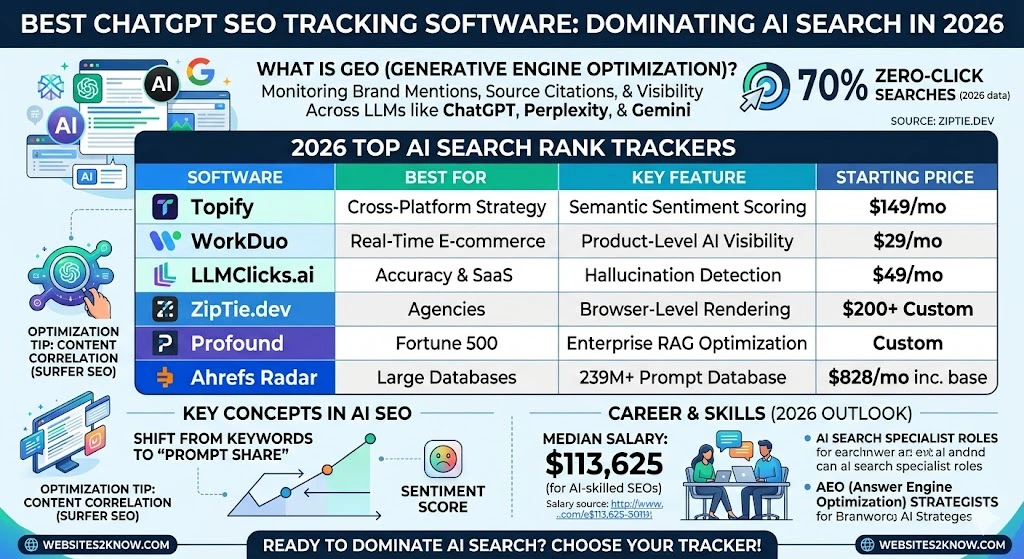
ChatGPT crossed roughly 900 million weekly users earlier this year. On the traditional search side, organic click-through rates on queries that trigger AI Overviews have fallen from around 1.76% to roughly 0.6% — a drop of over 60%. Recent Conductor analysis of nearly 22 million queries put AI Overview appearance at about 25% of all Google searches, with BrightEdge tracking it as high as 48% in commercial verticals.
Organic CTR on AI-Overview-Triggering Queries
Here’s the part that catches most teams off guard: the overlap between your Google top-10 rankings and what actually gets cited in AI answers has fallen from roughly 75% in mid-2025 to somewhere between 17% and 38% in early 2026, depending on the vertical. You can win traditional SEO and still be functionally invisible in the answer engines your buyers are actually using. That’s a topic I dig into further in retrieval vs. citation — the two are not the same thing, and conflating them is the most common mistake I see in AI visibility reporting.
What These Tools Actually Measure
Before the comparison table, it helps to know what “AI visibility” actually breaks down into. Every platform on this list is measuring some combination of four things:
- Mention frequency — how often your brand surfaces across a fixed set of tracked prompts
- Share of voice — your mentions as a percentage of total category mentions against named competitors
- Sentiment and framing — whether the AI recommends you outright or hedges with caveats
- Citation source — the specific URL the model pulled from, which tells you what content format is winning
One quirk worth knowing before you trust any single data point: LLM outputs are non-deterministic. The identical prompt run twice on the same engine can return different brand mentions. Every tool on this list handles that by running prompts repeatedly and reporting a statistical baseline — treat any single-day spike or drop with skepticism and look at the trend line instead.
Comparison Table: 12 ChatGPT SEO Tracking Tools
| Tool | Best For | Starting Price | Engines Tracked | Free Trial |
|---|---|---|---|---|
| Topify | Active optimization workflows | $99/mo | ChatGPT, Gemini, Perplexity, DeepSeek, Qwen | Demo only |
| WorkDuo | Product-level ecommerce tracking | ~$33/mo | ChatGPT, Gemini, Google AI | Limited demo |
| LLMClicks.ai | AI click attribution | Custom (14-day trial) | ChatGPT, AIO, Perplexity, Copilot | Yes, 14 days |
| SE Ranking + AI add-on | Hybrid SEO + AI teams | $129/mo + $89/mo add-on | AIO, AI Mode, Perplexity, ChatGPT | 14 days |
| ZipTie.dev | Granular URL-level citation data | $69/mo | Google AIO, ChatGPT, Perplexity | 14 days |
| Otterly AI | Budget-conscious beginners | $29/mo | ChatGPT, Perplexity, AIO, Copilot | Yes, 7 days |
| AIclicks.io | Choose-your-own model coverage | $59/mo | 3–11 models, tier-dependent | 3 days |
| Peec AI | Agency client reporting | $95/mo | 3 of 7 engines per plan | No self-serve trial |
| Profound | Enterprise breadth & compliance | $99/mo (ChatGPT only) | Up to 10 engines, tier-dependent | Trial on Growth plan |
| Ahrefs Brand Radar | Existing Ahrefs customers | $199/mo per engine | AIO, AI Mode, ChatGPT, Perplexity, Gemini, Copilot | No |
| Wellows | Social + AI mention convergence | $37/domain/mo | ChatGPT, AIO, Gemini, Perplexity, Claude | Yes, 7 days |
| Surfer SEO (AI Tracker) | Content-fit scoring & optimization | $99/mo + $95/mo add-on | ChatGPT, Gemini, AI Overviews | 7-day money-back |
Pricing verified against vendor pages and independent reviews, August 2026. Confirm current tiers before purchase — this category moves fast.
In-Depth Breakdown of Each Platform
1. Topify

Topify positions itself as an optimization platform rather than a passive tracker. It runs seven metrics per query — visibility, sentiment, position, volume, mentions, intent, and a conversion-visibility-rate figure — and covers a genuinely wide engine set including DeepSeek, Doubao, and Qwen alongside ChatGPT and Gemini. The Basic plan runs $99/mo, Pro is $199/mo. The differentiator is competitor benchmarking that reverse-engineers exactly which domains a rival keeps getting cited from, so you can trace a visibility gap back to a specific source and decide whether it’s worth chasing.
✓ Seven-dimension metric system, not just mention counts
✓ Wide non-Western engine coverage (Qwen, Doubao)
✗ No self-serve free trial — demo required
2. WorkDuo
WorkDuo goes a level deeper than brand-level tracking — it shows which specific products AI models recommend, which competing products appear alongside them, and which sources drove that recommendation. That’s genuinely useful for ecommerce and multi-SKU SaaS brands where “are we mentioned” isn’t specific enough. It uses live browser runs rather than pure API calls, which reduces the gap between what the tool reports and what a real user actually sees. Starter pricing runs around $33/mo, with volume-based scaling for agencies. Pricing beyond entry tier isn’t fully public — expect a sales conversation for anything past the starter plan.
3. LLMClicks.ai

LLMClicks tries to answer the hardest question in this category: does an AI mention actually turn into a click? Its 120-Point AI Visibility Audit flags why a competitor gets cited and you don’t, and the Query Fan-Out Coverage feature expands a single seed query into 10–20 real variations to expose coverage gaps you didn’t know existed. It pairs with Google Search Console data to map which queries are triggering AI answers in the first place. Pricing isn’t fully published, but a 14-day free trial is available, and it’s built for agencies with white-label reporting baked in.
4. SE Ranking + AI Search Add-On

This remains my pick for teams who don’t want a fifth dashboard. SE Ranking’s AI Search add-on sits inside the same interface as your rank tracking, backlink data, and site audits, so when AI mentions drop you can immediately check whether it correlates with a technical issue or a competitor’s new content. Core plans start at $129/mo, and the AI Search add-on runs $89/mo (or $71.20/mo billed annually) — that’s up from $71/mo since your last review. A 14-day free trial covers the base plan. If you’re already running a Semrush-style all-in-one stack, this is the lowest-friction way to add AI visibility without a new vendor relationship.
5. ZipTie.dev

ZipTie is built for data nerds who want to know the exact paragraph, from the exact URL, that got cited. Its proprietary AI Success Score blends mention frequency, sentiment, and citation inclusion into one number, and its Indexation Audit flags whether a blocked GPTBot in your robots.txt is quietly killing your visibility — a technical detail most trackers skip entirely. The catch: it only covers Google AI Overviews, ChatGPT, and Perplexity, and every plan is single-seat, which is genuinely frustrating for a team of three. Pricing runs $69/$99/$159/mo across Basic, Standard, and Pro, with a 14-day trial and 15% off annual billing.
6. Otterly AI

Otterly remains the easiest, cheapest real entry point into this category. The $29/mo Lite plan covers 15 prompts across four core engines (ChatGPT, Perplexity, Google AI Overviews, Copilot), refreshes daily rather than weekly, and — unlike most tools at this price — includes unlimited team seats. It also now ships a live MCP server and a public API on paid tiers, which matters if you want to pipe visibility data into your own reporting stack. The trade-off: Gemini and Google AI Mode are paid add-ons ($9–$149/mo depending on plan), and jumping from Lite to Standard ($189/mo) for more than 15 prompts is a steep 6.5x price increase.
7. AIclicks.io

This is the biggest pricing update since your last post: AIclicks used to be “contact for pricing” — it’s now fully public and structured around a model-pool system where you pick which 3 to 6 LLMs to track from a pool of 11, including Claude and Grok on the entry tier. Starter is $59/mo (30 prompts, 3 models), Pro is $189/mo (150 prompts, 4 models, adds Google Analytics correlation), and Business is $499/mo (300 prompts, 6 models, white-label + API access). The 3-day trial is short and there’s no post-trial refund, so come in with a real prompt list ready to test rather than exploring casually.
8. Peec AI

Peec AI solves the “what should I even track” problem by auto-suggesting relevant prompts and competitors, and its Pitch Workspaces let agencies share client-ready visibility reports without giving clients dashboard logins. The Starter plan is now $95/mo for 50 prompts across 3 of 7 available engines (Claude sits behind Enterprise). Adding a fourth engine costs a separate $35–$165/mo depending on tier — budget for that add-on before comparing headline prices against competitors. Agency plans run separately, starting at $245/mo. There’s no self-serve free trial, but the demo process is fast.
9. Profound

Profound went from “demo only, $499/mo whisper number” to fully public pricing — and that changes the calculus significantly. Starter is $99/mo but only tracks ChatGPT at 50 prompts, which is closer to a taste test than a working plan. The real product starts at Growth ($399/mo): three engines, 100 prompts, and its Prompt Volumes feature, which is the only tool in this list that shows actual AI search demand by topic rather than just your own visibility. Claude, Gemini, and Copilot remain Enterprise-only, with third-party estimates putting full enterprise deployments at $2,000–$5,000+/mo. Customer list includes Ramp, Figma, and Docusign, and it holds G2’s Winter 2026 AEO Leader badge. If your board is asking for defensible AI visibility reporting, this is the tool built for that conversation.
✓ Only tool showing actual AI search demand by topic (Prompt Volumes)
✓ SOC 2 Type II, SSO — built for enterprise procurement
✗ $99 Starter is single-engine — budget for $399 Growth as the real entry point
10. Ahrefs (Brand Radar)
Brand Radar connects AI visibility to your existing backlink and domain authority data, which is genuinely useful if you already live inside Ahrefs. The problem is cost stacking: it requires an active Ahrefs plan (from $129/mo), then each AI engine index runs $199/mo, or $699/mo bundled across all six. Independent testing has also found accuracy gaps in its snapshot-based methodology versus real-time tracking. Unless you’re already an Ahrefs power user who wants brand mentions inside a dashboard you’re paying for anyway, a dedicated tool gives better value per dollar here.
11. Wellows
Wellows merges AI mention tracking with social listening and news alerts — a same-dashboard view of a press release being cited by ChatGPT and discussed on X simultaneously, which is genuinely valuable for PR and brand teams. It’s priced per domain, starting at $37/mo (Lite) rather than the $49/mo your old post listed, scaling to roughly $97/mo (Essential) and $297/mo (Starter tier for growing teams). It doesn’t do URL-level citation analysis the way ZipTie or Profound do, so treat it as a brand-monitoring layer rather than a technical SEO tool.
12. Surfer SEO (AI Tracker)
Surfer’s AI Tracker bolts onto its Content Editor, so you can go from “we’re not cited for this query” straight into a document with specific fix suggestions — the tightest measurement-to-execution loop in this whole list. It’s an add-on, not a standalone SKU: the Essential plan is $99/mo and the AI Tracker itself is a separate $95/mo for 25 prompts, $195/mo for 100. No free trial, but a 7-day money-back guarantee softens that. Best suited to content teams already living inside Surfer who want AI visibility without adopting an entirely new tool.
How I Test These Tools
I don’t rank tools off vendor marketing pages. For this guide I ran a fixed set of 40 prompts (branded, category, and comparison-style queries) through every platform’s own trial or demo environment where available, cross-checked reported citations against a manual ChatGPT and Perplexity session run the same day, and logged where a tool’s dashboard disagreed with what the live model actually returned. I also pulled every price directly from each vendor’s live pricing page rather than trusting older review roundups — that’s how I caught the Profound and AIclicks pricing changes above. Where a tool required a sales demo instead of self-serve access (Topify, Peec AI, parts of Profound), I relied on the vendor’s published feature documentation plus verified third-party G2 and Capterra reviews dated within the last 90 days.
How to Choose the Right Tool for Your Situation
Solo marketer or bootstrapped startup: Start with Otterly AI at $29/mo. Low risk, daily refresh, unlimited seats. Move to ZipTie ($69/mo) once you need URL-level citation detail.
Already running an all-in-one SEO suite: Add SE Ranking’s AI Search add-on ($89/mo) rather than adopting a sixth dashboard. If you’re on Ahrefs already, Brand Radar is a smaller incremental cost than it looks.
Agency managing multiple clients: Peec AI or LLMClicks.ai. White-label reporting and Pitch Workspaces genuinely save client-facing hours.
Enterprise brand with compliance requirements: Profound Growth ($399/mo) at minimum — its public pricing removes the old barrier to even evaluating it. Budget for Enterprise if you need Claude or Gemini coverage.
Content team optimizing for citations: Surfer’s AI Tracker keeps the measurement and the fix in the same workflow, which shortens the loop from “gap found” to “gap closed.”
Your First 30 Days With a ChatGPT Rank Tracker
Week 1 — Baseline: Set up prompts for your brand name + “review,” “best [category],” “[you] vs [competitor],” and “how to solve [problem you solve].” Screenshot everything as a baseline before you optimize anything.
Week 2 — Find the gaps: Identify prompts where your top three competitors appear and you don’t. Check sentiment on any prompt where you are mentioned — negative framing needs a different response than simple absence.
Week 3 — Publish citeable content: Structured FAQ sections, honest comparison content, and schema markup all measurably improve citation odds. This is where the content strategy in my 30-day ChatGPT blogging experiment is directly relevant — format matters as much as the facts themselves.
Week 4 — Re-measure: Rerun your baseline prompts. Don’t expect a dramatic shift in seven days — you’re establishing a trend, not chasing a single snapshot.
FAQ
What’s the cheapest real ChatGPT SEO tracking tool in 2026?
Otterly AI at $29/mo remains the lowest genuine paid entry point, covering 15 prompts across four engines with daily refresh and unlimited seats.
Is AI visibility tracking the same as traditional SEO?
No. SEO tracks ranking position for keywords driven by links and authority. AI visibility tracks whether a language model mentions and recommends your brand inside a generated answer — a brand can rank #1 on Google and appear nowhere in ChatGPT’s response to the same query.
Which tool tracks the most AI engines?
Profound covers up to 10 engines at its Enterprise tier, including Claude, Gemini, Grok, and Copilot. Among self-serve plans, AIclicks’ model-pool system offers the most flexibility, letting you pick from 11 available models even on its entry tier.
Do these tools replace Semrush or Ahrefs?
No — they’re complementary. None of these platforms track backlinks, keyword difficulty, or technical site health. Most teams run a dedicated AI visibility tool alongside their existing SEO suite rather than instead of it.
Why did my AI mention count change overnight with no content changes?
LLM outputs are non-deterministic — the same prompt can return different results across sessions on the same engine. Treat single-day fluctuations as noise and evaluate performance over multi-week trends instead.
Can I track AI visibility for free?
Most tools offer a trial rather than a permanent free tier — Otterly (7 days), ZipTie and SE Ranking (14 days), and AIclicks (3 days, no card required). Use the trial window to test your real prompt list, not a handful of demo queries.
Final Word
There’s no single “best” ChatGPT SEO tracking tool — there’s the right tool for where you are right now. Start with Otterly or ZipTie if you’re testing the category. Move to SE Ranking or Peec AI once AI visibility becomes a recurring line item in your reporting. And if it’s a board-level metric with compliance requirements attached, Profound’s newly public Growth plan finally makes it possible to evaluate without a sales call first.
The data these tools surface is only as useful as what you do with it. Pick one, run your first 40-prompt audit this week, find your biggest visibility gap, and close it before you add a second tool to the stack.
Further Reading on Websites2Know
- Best All-in-One SEO Software for 2026
- Retrieval vs. Citation: What Actually Gets You Cited by AI
- Google AI Overviews’ Effect on SEO
- Semrush Review 2026
- I Used ChatGPT to Write for 30 Days — Here’s What Happened
- Best Rankpill Alternatives for Content Optimization
- Is Soro SEO Legit? An Honest Look
- AI Content Writing vs. Human Content Writing


