Hands-On Comparison · Updated August 2026
My Experience With 6 Offshore Web Development Companies: Which Ones Are Actually Worth Considering?
I went hands-on with Toptal, BairesDev, ELEKS, ScienceSoft, Code District, and STX Next. Here’s the honest breakdown of who’s actually worth your money, and who isn’t.
By Oyekale Olawale · 12 min read · 6 Companies Compared
⚡ Quick Answer
There’s no single “best” offshore web development company here — it depends on the job. Toptal wins for adding one or two elite freelance developers to a team you already run. BairesDev wins for a nearshore engineering team that works your hours. ScienceSoft and ELEKS win for complex, regulated enterprise software. Code District is the strongest pick if you’re modernizing an old system with AI. STX Next is my personal favorite for a Python-based SaaS or AI product. None of them is the right call for a simple five-page website.
There are genuinely good companies in this space. But there are also huge differences between hiring a talent marketplace like Toptal, outsourcing an entire product to a large development company, and simply adding a couple of developers to a team you already have. After going down the rabbit hole with Toptal, BairesDev, ELEKS, ScienceSoft, Code District, and STX Next, my biggest takeaway is that I wouldn’t pick any of them because their homepage says “top talent” or “cost-effective development.” The real question is what kind of development relationship you actually need. And interestingly, my favorite picks aren’t the cheapest ones.
How I Tested These Companies
Before ranking anyone, I looked at three things for each company: what they actually say about themselves versus what independent client reviews (Clutch, G2, third-party audits) confirm, what their published pricing signals actually mean in practice, and where their model breaks down. I cross-checked team size, founding dates, certifications, and rate ranges against multiple sources rather than trusting a single “About Us” page. If you’re earlier in the process and trying to figure out how to vet a development partner in general, I’ve written a more detailed walkthrough on choosing a software development company that covers the questions to ask before you sign anything.
Quick Comparison: All 6 Companies at a Glance
| Company | Model | Rate Range* | Best For |
|---|---|---|---|
| Toptal | Vetted freelance marketplace | $60–$200+/hr | Adding elite individual talent |
| BairesDev | Nearshore staff augmentation | $35–$130/hr | Larger nearshore engineering team |
| ELEKS | Full-cycle engineering firm | Custom quote | Complex enterprise / R&D software |
| ScienceSoft | Full outsourcing / dedicated teams | ~$40–$100/hr | Regulated, mission-critical systems |
| Code District | Boutique dev + AI automation | ~$25–$49/hr | Modernization, AI, and automation |
| STX Next | Python-first engineering house | $50–$99/hr | Python/AI-heavy SaaS products |
*Rate ranges are third-party estimates gathered from public reviews, directories, and client-reported data — none of these companies publish a single fixed rate card, so treat these as ballparks, not quotes.
1. Toptal
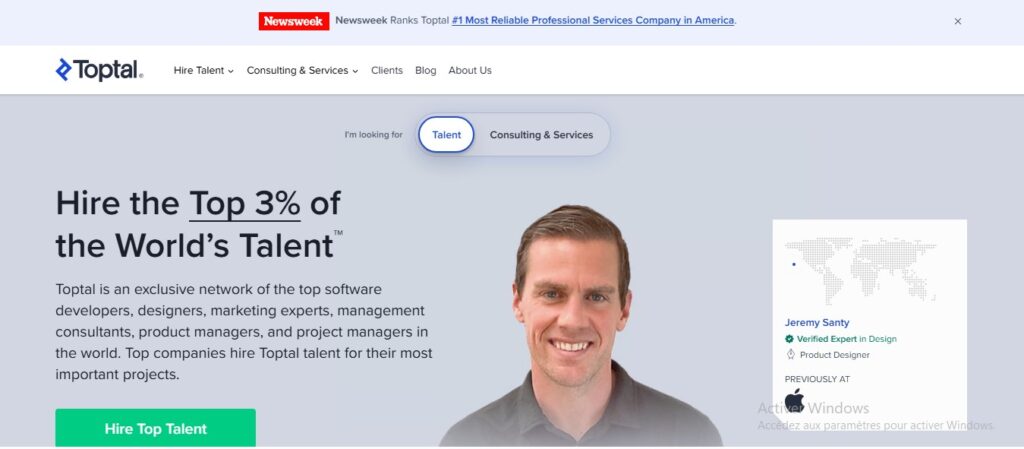
Toptal is the easiest of the six to understand, because its value proposition is genuinely different from a traditional offshore development company. You’re paying Toptal to solve the hard part of finding good freelance technical talent, not to hand over an entire project.
That sounds simple, but it’s a valuable thing to outsource. Toptal accepts a reported top 3% of applicants who apply, running them through a multi-stage screen that covers language and communication, a live technical test, a timed skill review, and a test project before anyone joins the network. Developers can be hired hourly, part-time, or full-time, and Toptal backs every engagement with a two-week no-risk trial — you only pay if you’re satisfied. What I like most is the flexibility. If I already had a product manager, designer, and technical lead but needed a genuinely strong React developer for three months, I wouldn’t want to sign a large outsourcing contract. Toptal makes far more sense here, and if you’re assembling a lean team of contractors and tools around a core hire like this, it’s worth pairing with the right productivity stack for freelancers and small teams to keep everyone in sync.
The quality filter is one of Toptal’s strongest selling points — I’m not sifting through hundreds of freelancer profiles hoping the person claiming to be “senior” actually is. But there’s a catch: Toptal isn’t where I’d go for the cheapest development possible. Rates commonly run $60 to $200+ an hour depending on seniority, location, and engagement structure, and most engagements start with a deposit (commonly reported around $500–$1,000) applied to your first invoice. Toptal doesn’t publish one universal rate card, which is the part smaller businesses need to understand going in — this is the premium shortcut to talent, not the “cheap offshore developer” option. I also wouldn’t default to it for a complete, large-scale product where I want one company to own product discovery, UX, architecture, QA, DevOps, and long-term maintenance. Toptal can support that through its consulting arm, but its core strength is still the talent network.
✓ Pros
Genuinely elite talent · Matching often under 48 hours · Two-week risk-free trial · Full flexibility to scale up or down
✗ Cons
Not the cheapest option · No published rate card · You largely manage the talent yourself · Less of a full “managed service” feel
My verdict: One of the safest choices if you need individual senior developers or flexible technical talent — not where I’d start if the goal is the lowest possible development cost.
2. BairesDev

BairesDev was probably the company that made me think hardest about the difference between “cheap development” and “cheap development that actually works.” Founded in Buenos Aires in 2009, it operates primarily as a nearshore provider for U.S. companies, drawing engineers from across Latin America rather than the traditional far-offshore model, with a reported bench of 4,000+ engineers.
BairesDev argues its nearshore model runs roughly 30–50% cheaper than the fully loaded cost of a U.S. hire, and independent nearshore comparisons put the realistic range closer to 30–70% depending on role and region, while still preserving meaningful U.S. time-zone overlap. Honestly, the time-zone argument holds up. One of the biggest hidden costs of outsourcing is communication — you save on an hourly rate and then lose it to delays, misread requirements, and meetings at strange hours. That’s where BairesDev’s positioning is strong, and it’s the same logic I’d apply if you’re weighing full-time nearshore hires against an employer-of-record platform for building your own distributed team instead of going through an agency.
BairesDev is also unusually direct about the pricing problem, walking clients through fixed-price, time-and-materials, and monthly-retainer models rather than pretending there’s one magic number. Third-party rate trackers put senior engineers somewhere in the $50–$130/hour range, with reported minimum engagement sizes above $50,000 — which tells you who this isn’t for. If you’re a small business owner thinking “I need a basic WordPress site for $1,500,” this is overkill; you’re bringing a large engineering organization into a problem that doesn’t need one.
✓ Pros
Strong U.S. time-zone overlap · 4,000+ engineer bench · Transparent about pricing models · 4.9 Clutch rating from real client reviews
✗ Cons
$50,000+ project minimums reported · Overkill for very small sites · Not the cheapest nearshore option available
My verdict: One of the better options for U.S. companies that want the benefits of outsourcing without a huge time-zone gap — a strong fit for a SaaS product, custom web app, or an existing product that needs more engineering capacity.
3. ELEKS

ELEKS feels much more like a traditional software engineering company than a freelancer marketplace, and that’s exactly what I like about it. Founded in 1991, ELEKS now runs a delivery bench of 2,000+ professionals across Eastern Europe with sales offices in the U.S., UK, and Canada, and it was recognized in the 2026 IAOP Global Outsourcing 100 evaluation.
When you get past simple websites and start talking about complicated integrations, IoT, cybersecurity audits, or genuine R&D, the question changes from “can someone code this?” to “can someone architect and maintain this properly?” That’s where a company like ELEKS starts making sense — it built its reputation serving Fortune 500 clients and reports roughly $487.5 million in annual revenue, which tells you this is a serious engineering organization, not a boutique shop. If part of your project involves stitching together several existing systems, it’s worth reading through this comparison of unified API platforms for connecting SaaS tools before you scope the integration work with a vendor like this.
My hesitation is that this type of provider can feel like a lot of company for a relatively small project. If you’re building something modest, the organizational overhead — project management, architecture reviews, formal QA gates — isn’t necessarily an advantage; you could pay for layers you don’t need. But if getting the architecture wrong could cost you six months and real money, I’d take this model over a loose collection of freelancers every time. The thing I’d pay close attention to is the actual team assigned to your project — a big brand name doesn’t tell you which engineers are doing your work, so ask before signing anything.
✓ Pros
35+ years in business · 2,000+ engineers · Fortune 500 track record · Deep R&D, cybersecurity, and data/AI capability
✗ Cons
No published rate card — custom quotes only · Heavy for small projects · Structured process can feel slower than a startup agency
My verdict: A serious choice for companies building serious software — probably excessive for a small web project.
4. ScienceSoft

ScienceSoft is probably the one on this list that surprised me most from a maturity standpoint. This isn’t a young outsourcing operation trying to convince you that five developers can build an enterprise platform in two months. ScienceSoft has been in IT consulting and software development since 1989 — 36 years — with a reported 750+ IT specialists and more than 4,200 completed projects across 80+ countries and 30+ industries. That’s a completely different proposition.
What I really like here is the emphasis on structured development rather than simply throwing bodies at the problem. ScienceSoft offers full outsourcing, dedicated teams, and team augmentation, so there are multiple ways to work with them, and it holds ISO 9001, ISO/IEC 27001, and ISO 13485 certifications — the kind of documented quality management enterprise procurement teams actually check for. Third-party pricing trackers put hourly rates somewhere around $40–$100/hour, with reported project costs ranging from roughly $8,000 for smaller scopes up to well over $1 million for large, data-heavy systems. That immediately tells you who this isn’t for: if you’re a small website owner looking for a marketing site redesign, this is the wrong door. If your company needs software that integrates with existing business systems, meets security requirements, and needs to survive for years, ScienceSoft starts looking a lot more attractive — particularly for finance-adjacent builds where you’d also want to check out these AI tools built for accountants inside B2B SaaS products if reporting and compliance workflows are part of the build.
The downside is obvious: this is not cheap development, and I don’t think you should expect it to be. The other thing I’d watch for is bureaucracy — a mature enterprise provider gives you excellent process, but process can also slow things down for a small team that wants to move fast.
✓ Pros
36 years in business · ISO 9001 / 27001 / 13485 certified · 4,200+ completed projects · Transparent, published pricing models
✗ Cons
Not cheap · Enterprise process can feel slow · Overkill for a small marketing website
My verdict: One of my strongest recommendations for complex business software — one of my weakest recommendations for a simple website.
5. Code District

Code District sits somewhere between a traditional offshore development company and a modern AI-first software consultancy. It markets classic offshore web and app development and says clients can reduce costs by around 40% — but what caught my attention more was the shift toward AI. Code District, headquartered in Washington, D.C., now positions itself around AI agents, intelligent process automation, application development, and legacy modernization, with the company citing 11+ years of industry experience and a delivery team in the low hundreds of engineers, data scientists, and project managers.
I actually like this positioning. There are thousands of development companies that can tell you they know React, Node.js, and Python — that doesn’t tell me much anymore. What interests me is whether a company can look at an existing business process and say, “you don’t need another developer here, we can automate this.” That’s a more valuable conversation, and if you’re weighing whether to have a vendor build custom automation versus stitching together off-the-shelf tools yourself, it’s worth first browsing AI tools built specifically for small U.S. businesses — sometimes the cheaper answer is a $30/month subscription, not a development contract.
Code District also seems particularly suited to companies that already know what they want built and need an engineering team to execute — Clutch reviews put its average hourly rate around $25–$49/hour with project minimums starting near $10,000, noticeably leaner than most names on this list. The downside is that I’d want to be careful about scope. “AI-first” is becoming a phrase every development company reaches for, and I wouldn’t pay a premium simply because a vendor says it uses AI. I’d want to know exactly where AI is used, what humans review, and what happens when the AI-generated implementation is wrong.
✓ Pros
Leaner pricing than most enterprise names · Strong AI/automation angle · Lower project minimums · Good for legacy modernization
✗ Cons
“AI-first” claims need scoping — ask exactly where AI is used · Smaller bench than the enterprise players on this list
My verdict: One of the more compelling choices if your project involves modernization, automation, or AI rather than plain conventional web development.
6. STX Next

STX Next is the company I’d be most interested in if I were building a technically sophisticated web application today, and the reason is simple: Python. Founded in Poznań, Poland in 2005, STX Next has grown into Poland’s largest Python software house, with a reported bench of 500–600 engineers across delivery centers in Poland, Ukraine, and Mexico, and a 4.7/5 rating across 93 verified Clutch reviews — a genuinely large sample size for this industry.
Its web development stack wasn’t generic “we build websites” marketing when I looked closer. It covers Django, Flask, FastAPI, Node.js, React, TypeScript, AWS, Azure, GCP, Kubernetes, Terraform, CI/CD, and automated testing — a serious DevOps stack built for real applications, not brochure sites. STX Next’s AI-augmented development approach is also genuinely interesting: the company says it uses tools like Claude Code, Cursor, and GitHub Copilot inside a structured engineering workflow rather than letting developers “vibe code.” I agree with that philosophy — AI can make mediocre developers faster at producing mediocre code, and the real advantage shows up when experienced engineers use AI inside disciplined architecture, testing, and code-review practices. If your team is running into its own AI-tooling friction, this rundown on fixing Cursor’s AI context limit issues and this overview of what generative AI can and can’t reliably generate in code are both worth a read before you scope an AI-heavy engagement with any vendor.
The downside is another one I wouldn’t recommend for a basic website. If your requirement is “I need a five-page company site,” you’re looking in the wrong place. If it’s “I need a scalable SaaS application with a Python backend, React frontend, cloud infrastructure, and AI functionality,” STX Next makes a lot more sense.
✓ Pros
20+ years, Poland’s largest Python house · 93 verified Clutch reviews at 4.7/5 · Disciplined AI-augmented workflow · Serious modern DevOps stack
✗ Cons
Narrow fit if you don’t need Python/AI depth · Not built for simple brochure sites · Mid-to-premium rate range ($50–$99/hr)
My verdict: Probably my favorite technical fit on this list for modern SaaS, AI-heavy web applications, and companies that care deeply about engineering discipline.
Where Each Company Actually Fits
Instead of a made-up “score” out of 10, here’s how I’d map each company against project complexity — from a simple marketing site up to a full-blown enterprise platform. This is based on the model each company sells, not a claim about code quality.
Toptal — Individual talent, plug into your own team
BairesDev — Mid-to-large nearshore engineering team
ELEKS — Complex, high-stakes enterprise engineering
ScienceSoft — Regulated, mission-critical business software
Code District — Modernization, automation, AI-driven builds
STX Next — Python/AI-heavy SaaS and technical products
Bar length reflects the relative complexity/scale of project each company is built to serve — not a quality ranking.
So Which Ones Would I Actually Recommend?
After looking at all six, I wouldn’t hand you one blanket winner because they aren’t really competing for the same job.
If I were a startup founder who already had a technical lead and just needed one or two excellent developers, I’d look hardest at Toptal. If I were a U.S. company that wanted a larger nearshore engineering team and valued overlapping working hours with America, BairesDev would be high on my list. If I had a complicated enterprise system and didn’t want to take shortcuts, ScienceSoft would be one of the companies I’d seriously investigate. If I needed large-scale engineering and enterprise software capabilities, ELEKS would deserve a conversation. If my existing software was a mess and I wanted modernization, automation, or AI introduced into the business, Code District would be particularly interesting. And if I were building a technically sophisticated SaaS or AI product where Python, cloud infrastructure, and modern engineering practices were central, STX Next would probably be my first conversation.
The biggest mistake I’d make is choosing based purely on the hourly rate. BairesDev makes essentially this same argument in its own outsourcing material: the cheapest developer isn’t necessarily the cheapest developer once you factor in rework, management overhead, communication problems, and technical debt. After looking at these six companies, I think that’s exactly right. A $25/hour developer who needs constant supervision can end up costing far more than a $60/hour developer who understands the architecture, asks the right questions, and gets the feature right the first time.
That’s why I wouldn’t even ask “which offshore company is cheapest?” I’d ask a more useful question: which company has the development model that actually matches the complexity of what I’m trying to build? For a basic website, honestly, I wouldn’t hire any of these six. For a serious SaaS product, custom web application, enterprise platform, or AI-powered software product, that’s where this list starts getting interesting — and once the software is live, keeping your books and back-office in order matters just as much, which is where a look at QuickBooks alternatives for growing small businesses tends to come in handy.
FAQ
Which offshore development company is cheapest?
Of the six, Code District and BairesDev tend to run leaner than Toptal, ELEKS, or ScienceSoft on a per-hour basis, but “cheapest” isn’t the same as “best value.” A lower rate with more rework or oversight needed can cost more in the end than a higher rate from a team that gets it right the first time.
What’s the difference between offshore and nearshore development?
Offshore typically means a development team in a distant time zone with little to no working-hours overlap with the U.S. Nearshore, like BairesDev’s Latin American model, keeps the team in a time zone that overlaps significantly with U.S. business hours, which usually improves communication and turnaround.
Is Toptal actually the top 3% of talent?
Toptal reports accepting roughly 3% of applicants through a multi-stage screening process covering language, live technical tests, and a test project. It’s a marketing figure the company has repeated for years, but the screening process itself is independently corroborated across multiple third-party reviews and appears to be real, not just a slogan.
Should a small business hire any of these companies for a basic website?
Generally, no. All six companies here are built for web applications, SaaS products, or enterprise systems — not a five-page marketing site. For something that simple, a freelancer, a website builder, or a small local agency is almost always a better fit on cost and speed.
How much can outsourcing actually save compared to a U.S. hire?
Third-party benchmarks generally put realistic savings somewhere between 30% and 70% versus a fully loaded U.S. hire, depending on the region, seniority, and how much management overhead the offshore relationship adds back in. Treat any single “guaranteed” savings percentage from a vendor with some skepticism.
The Bottom Line
None of these six companies is a bad choice in the abstract — they’re just built for different jobs. Toptal solves the “I need one great developer, fast” problem. BairesDev solves the “I need a nearshore team that works my hours” problem. ELEKS and ScienceSoft solve the “this has to be right the first time” problem. Code District solves the “my software is outdated and I want AI in the mix” problem. STX Next solves the “I’m building something technically serious in Python” problem.
The mistake isn’t picking a company from this list — it’s picking one before you’ve actually named which problem you’re solving. Match the model to the project, not the project to whichever company had the best-looking homepage, and you’ll save yourself a lot of the pain I went through testing all six.


