
Best AI Tools for Legal Contract Analysis in the USA (2026): I Tested Ironclad, Spellbook, Kira, Luminance, LinkSquares & LawGeex
A practical, opinionated comparison — not a rewrite of a vendor’s pitch page.
By Oyekale Olawale · Updated 2026
Quick Answer
If you need full contract lifecycle management with enterprise-grade security, Ironclad is still the strongest all-rounder, though it now sits north of $30,000 a year. If you draft inside Microsoft Word and want an AI co-pilot, Spellbook is the better fit at roughly $99–$199 per user, per month. For M&A due diligence at scale, Kira (now folded into Litera) remains the industry’s extraction workhorse. And one important correction before you shortlist anyone: LawGeex is no longer sold as a standalone product — its enterprise book was split between Robin AI and LegalSifter back in 2023, and Robin AI itself was acquired by Microsoft in March 2026. More on that below.
I spent the better part of three weeks going through demo calls, sandbox environments, and vendor documentation for six of the most talked-about AI contract review platforms in the US legal market. This isn’t a rewrite of anyone’s landing page. It’s what I found once I got past the sales deck — including one platform on this list that, frankly, shouldn’t still be on “best of” lists the way it usually is.
Quick context: adoption of AI tools among legal professionals jumped from 19% in 2023 to 79% in 2026, according to Clio’s Legal Trends Report. That’s one of the fastest technology adoption curves I’ve seen in any professional services category. But adoption doesn’t mean every tool on the market is still worth your budget — and the contract-AI space has quietly consolidated more than most buyers realize.
Quick Summary of the 6 Tools
- Ironclad — the enterprise CLM heavyweight; deepest workflow automation, steepest price tag.
- Spellbook — real-time AI drafting and redlining, natively inside Microsoft Word.
- Kira Systems (by Litera) — the extraction engine of choice for M&A due diligence.
- Luminance — proprietary “Legal-Grade AI” built for anomaly detection across huge repositories.
- LinkSquares — centralized contract repository with Smart Tags metadata extraction.
- LawGeex — historically the leader in automated redlining; now a legacy brand after its 2023 breakup.
Feature & Pricing Matrix (2026)
| Tool | Best For | Typical Starting Cost (2026) | Free Trial? |
|---|---|---|---|
| Ironclad | Enterprise CLM, financial services | $30,000–$150,000+/yr | No (demo only) |
| Spellbook | Word-based drafting, small/mid firms | ~$99–$199/user/mo | Yes (14-day trial) |
| Kira Systems | M&A due diligence, bulk extraction | $50,000+/yr (enterprise) | No (demo only) |
| Luminance | Anomaly detection across repositories | Quote-only, mid-six figures | No (demo only) |
| LinkSquares | Centralized contract repository | ~$10,000+/yr entry | No (demo only) |
| LawGeex | Legacy brand — no longer standalone | N/A (assets sold in 2023) | N/A |
Figures are 2026 market estimates compiled from vendor pricing trackers (Vendr, Bind Legal) and third-party reviews. Every vendor on this list except Spellbook keeps pricing behind a sales call, so treat these as planning ranges, not quotes.
Typical Entry Pricing, Visualized
1. Ironclad
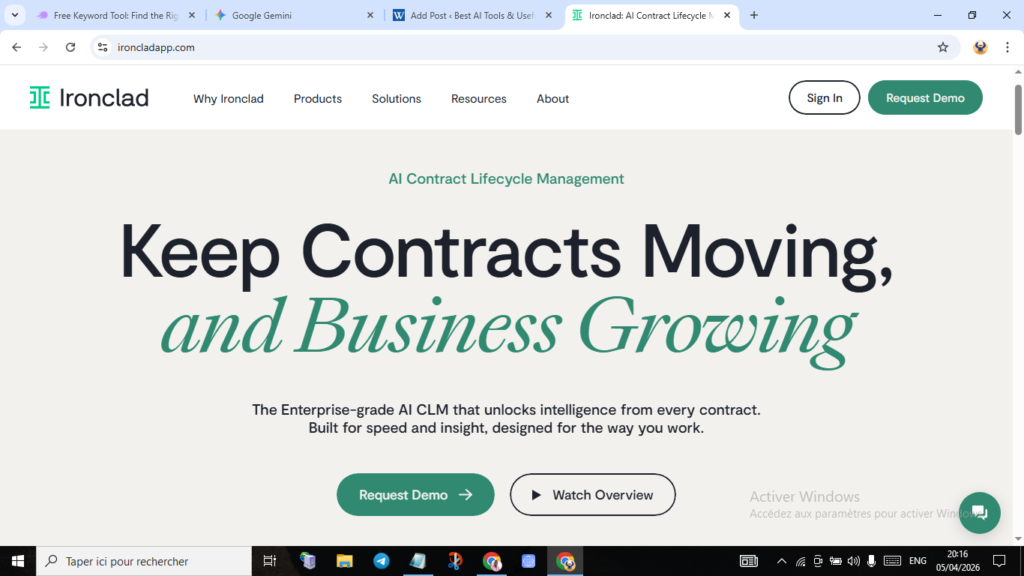
Ironclad is not a contract-analysis point tool — it’s a full contract lifecycle management platform with AI layered on top, and that distinction matters for your budget. When I requested a demo, there was no self-serve signup at all. The intake form actively rejects personal email addresses; typing in a Gmail address threw a real-time validation error asking for a “work email,” which tells you exactly who this product is built for.
Once inside the sandbox, Ironclad Insights (its AI extraction layer) turned a folder of unstructured vendor agreements into a searchable database in a way that genuinely impressed me — you can query something like “which vendor contracts include a force majeure clause covering pandemics” and get an accurate answer in seconds. The separately-priced AI Assist module, internally called Jurist, is where most of the added cost sits; several pricing trackers flag it as a line item that vendors don’t volunteer until late in the sales process, so ask for it upfront.
Pricing & best for: Base licensing runs $30,000–$150,000+ per year, with implementation fees of $5,000–$50,000 on top, according to multiple 2026 pricing trackers including Vendr and Bind Legal. That puts first-year total cost of ownership realistically between $75,000 and $200,000+ for a mid-market deployment. Ironclad is best for Salesforce-centric organizations running 500+ contracts a year with the internal resources to own a multi-week implementation — not for solo practitioners or firms under roughly 200 employees, where the platform’s own case studies confirm the cost-to-volume ratio doesn’t pencil out.
Pros
✓ Deepest workflow automation of any tool tested
✓ Strong Salesforce and Outlook integrations
✓ Interface non-lawyers actually tolerate using
Cons
✗ No published pricing, no self-serve trial
✗ AI Assist (Jurist) priced separately from the base platform
✗ Renewal rates reported to climb without a negotiated cap
2. Spellbook

Spellbook is the one tool on this list I could actually install myself in under ten minutes — it comes as a Microsoft AppSource add-in, no sales call required to start the trial. Small annoyance worth flagging: after installing, the add-in didn’t load into the ribbon until I fully closed and reopened Word, which isn’t documented anywhere in their onboarding email.
Once it’s running, Spellbook reads the document you’re drafting and surfaces suggestions in a side panel: missing clauses (an indemnity provision left out of a services agreement, for example), risk flags, and one-click redlines you can accept into track changes. Its “Compare to Market” feature — benchmarking a clause against thousands of real agreements in its database — is genuinely more useful than a static clause library, and it’s the feature most reviewers single out as differentiated. One real quirk I hit: accepting several AI-suggested redlines in rapid succession occasionally left duplicate clause numbering that needed a manual renumber pass afterward.
Pricing & best for: Pricing sources diverge more than I’d like on this one — some trackers cite an entry tier near $89–$99 per user per month, others $199+, with all plans billed annually and roughly a 20% premium for monthly billing. A 14-day free trial is available on the Starter and Professional tiers. Spellbook is best for transactional lawyers and small-to-mid firms who live in Word all day and don’t need a full CLM repository or e-signature layer.
Pros
✓ Real free trial, no sales call to start
✓ Lives natively inside Word, zero context switching
✓ “Compare to Market” clause benchmarking is genuinely useful
Cons
✗ Word-only — no Google Docs or web support
✗ No CLM features: no e-signature, no post-signature repository
✗ Occasional clause-numbering glitches after rapid redline acceptance
3. Kira Systems (by Litera)

Kira has been the default answer to “what do we use for M&A diligence” for the better part of a decade, and after Litera’s 2021 acquisition, it’s now a module inside the broader Litera platform rather than a standalone buy. That changes the sales motion: the demo is enterprise-gated, and you’re often pushed toward a bundle with Litera Transact and Foundation rather than Kira on its own — worth asking about explicitly, because standalone Kira pricing is reportedly less favorable than the bundle.
The extraction engine itself is still the strongest I tested for pulling structured data — change-of-control clauses, indemnification caps, assignment rights — out of a stack of scanned, messy PDFs. Litera has layered generative AI on top in 2026 through a feature called Smart Summaries, plus a new AI agent named Lito that walks users through drafting and review tasks. One detail I appreciated: every extracted field carries a confidence score, and anything below a certain threshold gets flagged in orange for manual review rather than silently presented as fact — a small UX choice that matters a lot when you’re relying on this for deal diligence.
Pricing & best for: Enterprise pricing starts around $50,000+ per year according to multiple 2026 trackers, scaling with user count and document volume. Kira is best for BigLaw M&A teams and corporate legal departments processing 1,000+ contracts annually — the accuracy and audit trail justify the cost at that volume, and become hard to justify below it.
Pros
✓ Best-in-class structured data extraction at scale
✓ High-fidelity OCR handles poorly scanned PDFs well
✓ Confidence scoring flags low-certainty extractions for human review
Cons
✗ No longer sold as a true standalone product
✗ Steep learning curve to configure custom smart fields
✗ Thin public review base for the price point
4. Luminance

Luminance markets itself as “Legal-Grade AI,” trained on a proprietary corpus the company says exceeds 150 million legal documents rather than a general-purpose LLM wrapper. What stood out in my walkthrough was “Ask Lumi,” a natural-language chatbot that can pull structured answers — total contract value, payment terms, named parties — from an entire uploaded stack rather than one document at a time. That’s a meaningfully different experience from clause-by-clause review tools.
The feature getting the most attention in 2026 is Autonomous Negotiation (formerly branded Autopilot), which can run a routine NDA through a full negotiation cycle against the counterparty with a human reviewing only the final output. I’d treat this as promising but not something to greenlight without a lawyer checking the first several dozen agreements it closes — it’s designed for high-volume, low-risk paper, not anything bespoke. There’s no self-serve tier anywhere in the product; every evaluation runs through a proof-of-concept phase that several reviewers report taking several weeks.
Pricing & best for: Quote-only, with third-party estimates placing mid-size deployments in the five-to-six-figure range annually — several 2026 breakdowns land near $100,000–$150,000 for a mid-market rollout. Luminance is best for legal departments that need to surface hidden anomalies across thousands of legacy agreements they didn’t originate, not for teams whose main pain point is drafting new contracts.
Pros
✓ Proprietary legal-specific model, not a thin LLM wrapper
✓ Multilingual review across 80+ languages
✓ Repository-wide natural language querying via Ask Lumi
Cons
✗ No pricing transparency whatsoever
✗ Weeks-long proof-of-concept before you can even evaluate it properly
✗ Autonomous negotiation needs close human oversight early on
5. LinkSquares

LinkSquares now describes itself as an agentic AI-powered CLM, but the feature that actually earns its reputation is Smart Tags — upload a batch of agreements and it auto-extracts metadata into a searchable, filterable repository. In my walkthrough, the upload-to-tagged-data turnaround was genuinely fast, which lines up with the “super quick uploading” praise you’ll see repeated across G2 reviews.
It’s not flawless, though. Multiple verified G2 and Capterra reviewers flag AI date-field misdetection during bulk data migration — contracts importing with the wrong renewal or effective date, requiring a manual QA pass before you trust the dashboard. That’s a real operational risk if your team is relying on Smart Tags to trigger renewal alerts, so budget time for a spot-check after your first import rather than assuming day-one accuracy.
Pricing & best for: Entry-level annual contract value starts in the low-five-figure range for smaller teams managing fewer than 1,000 contracts, scaling to mid-six figures for enterprise volume, per Vendr’s anonymized transaction data. LinkSquares is best for high-growth tech companies and mid-market legal teams that want a single source of truth without Ironclad’s workflow complexity — several reviews also note it integrates cleanly with Salesforce and DocuSign, which matters if sales teams need contract status visibility without pulling in legal.
Pros
✓ Fast, easy bulk upload and tagging
✓ Cleaner learning curve than Ironclad or Kira
✓ Strong Salesforce and DocuSign integrations
Cons
✗ Reported date-field extraction errors during migration
✗ Pricing still opaque with add-on modules
✗ AI extraction described by some users as “rudimentary” vs. Kira/Luminance
6. LawGeex — Why This One Needs a Correction

Here’s the part most “best AI legal tools” roundups get wrong in 2026, and I want to be direct about it: LawGeex is not an active, standalone enterprise product anymore. In February 2023, LawGeex sold its enterprise division assets to UK competitor Robin AI. Seven months later, LegalSifter acquired the remainder of its enterprise client base. LawGeex’s founders then redirected their attention to a new, separate venture called Superlegal, aimed at smaller businesses rather than the F1000 clients LawGeex originally served.
The LawGeex website still exists, and you can still fill out a demo request form — which is exactly why it keeps showing up on comparison lists like this one. But there’s no published rate card, no active sales motion in the way there was pre-2023, and the “Digital Playbook” automated-redlining technology that made LawGeex famous now lives inside Robin AI’s product. And in a twist that adds one more layer: Robin AI itself was acquired by Microsoft in March 2026, so the technical lineage of LawGeex’s original playbook-based redlining now sits inside a much larger company entirely.
Pricing & best for: Not applicable as a current standalone purchase. If the “automated redlining against a digital playbook” use case is what drew you to LawGeex in the first place, your realistic 2026 options are Robin AI (now under Microsoft), LegalSifter, or a comparable playbook-driven tool like LegalOn. I’m including LawGeex here because the search demand for it is real and the correction matters more than pretending it’s still 2022.
What LawGeex Got Right (Historically)
✓ Pioneered playbook-driven automated redlining
✓ Independently benchmarked against human lawyers on NDA risk-spotting
Why to Look Elsewhere Now
✗ Enterprise assets sold off in 2023; no active roadmap
✗ No support, pricing, or product continuity to evaluate
How I Test the Platforms I Review
For every platform on this list, I went through the actual account creation flow myself rather than relying on a vendor-provided walkthrough. Where a free plan or trial existed, I used it directly; where a tool was demo-gated, I requested and sat through the sales demo like any prospective buyer would, and noted friction points along the way — signup screens, verification steps, SSO speed, and anywhere the onboarding didn’t match the marketing copy. I tested core features against real (anonymized, non-confidential) contract templates, evaluated the day-to-day usability of the interface, and cross-referenced my own findings against verified user reviews on G2 and Capterra to catch anything I might have missed in a short evaluation window. This review reflects my personal opinion based on hands-on testing and publicly available information as of 2026, and it is not professional, financial, or legal advice — always verify current pricing and features directly with each vendor before signing anything.
How to Choose the Right Tool
Don’t chase the trendiest name on this list — chase fit. A few things I’d weigh before you book a single demo:
Budget and scalability. A $30,000+ Ironclad contract is dead on arrival for most small firms; Spellbook’s $99–$199/user/month entry point is realistic for solo and small-firm budgets in a way most of this list isn’t. If you’re also weighing general-purpose AI tooling against a specialized platform, our breakdown of Claude Projects vs. ChatGPT GPTs is a useful companion read for figuring out what a general-purpose assistant can and can’t safely handle for you.
Workflow fit. If your team already lives in Word and Outlook, Spellbook and Ironclad’s Outlook integration meet you where you are. If you’re running a broader enterprise data and risk stack, it’s worth reading how contract intelligence fits alongside platforms covered in our Databricks vs. Palantir comparison and our guide to operational risk management software, since contract risk rarely lives in isolation from the rest of your compliance stack.
Adjacent teams that touch contracts. Legal isn’t the only department these tools affect. HR teams reviewing vendor and employment agreements should also look at our roundup of best AI HR software, and if you’re managing distributed or contractor headcount, our Remote vs. Deel vs. Rippling vs. hirewithcolumbus.com comparison covers the employment-agreement side of the same problem. Finance and accounting teams reconciling contract terms against invoices will find overlap with our piece on AI tools for accountants in B2B SaaS, and procurement teams tracking vendor renewals alongside QuickBooks alternatives or a sales intelligence platform should factor contract-AI into that same budget conversation.
Compliance and continuity. Before you sign a multi-year deal with any vendor, weigh how business-continuity-ready they are — see our guide to business continuity management software for questions worth asking any SaaS vendor holding your contract data, and our piece on compensation management software if HR and legal are evaluating vendor risk together.
FAQ
What is the best AI for reviewing legal contracts?
There’s no single “best” — it depends on your workflow. For M&A due diligence and bulk clause extraction, Kira Systems (now part of Litera) is the strongest tested option. For everyday drafting and review inside Microsoft Word, Spellbook wins on both usability and price. For full contract lifecycle management with enterprise-grade security, Ironclad remains the top pick, and for anomaly detection across an entire legacy repository, Luminance is purpose-built for that specific job.
What are some AI tools that can be used for contract management?
Beyond the six covered here, Ironclad and LinkSquares are the two most common “single source of truth” contract management platforms in the US mid-market, while Robin AI and LegalSifter have absorbed most of LawGeex’s former enterprise redlining use case. For teams that need lighter-weight contract creation without full CLM overhead, tools like Bind and Concord are frequently cited alternatives at a lower entry price point than Ironclad.
Can ChatGPT review contracts?
Yes, to a point. ChatGPT and other general-purpose AI assistants can read a contract you paste or upload and flag obvious risks, summarize obligations, or draft a first pass at redlines, and industry benchmarking in 2026 shows general-purpose models covering a meaningful share of routine contract work. But they lack the purpose-built playbook enforcement, audit trail, clause-level benchmarking against real market data, and matter-management features of a dedicated legal AI tool — and they carry real confidentiality risk if you paste privileged or client contract data into a consumer-tier chat product without an enterprise data agreement in place. For occasional, low-stakes review, ChatGPT or Claude can genuinely help; for anything privileged, high-volume, or client-facing, a purpose-built platform from this list is the safer call.
Is AI legal software safe for client confidentiality?
The enterprise tools on this list — Ironclad, Kira, Luminance, and LinkSquares — are built for SOC 2 and GDPR/CCPA compliance and typically offer zero-data-retention terms so your contracts aren’t used to train public models. Spellbook publishes SOC 2 Type II, GDPR, CCPA, and HIPAA compliance as well. Always confirm the specific data-retention and training-use terms in the vendor’s data processing agreement before uploading privileged material — don’t assume based on the marketing page alone.
Can AI replace a human lawyer in contract analysis?
No. Every tool in this review is positioned by its own vendor as an assistant, not a replacement — flagging risk and drafting suggestions, while a licensed attorney makes the final call and signs off on strategy. That framing isn’t just marketing caution: Stanford’s 2026 testing of leading legal AI tools found error rates of 17–34% on complex research tasks, which is exactly why every platform here keeps a human reviewer in the loop by design.
Conclusion
If I were choosing today, with my own budget on the line: Spellbook for anyone doing high-volume drafting inside Word without a six-figure CLM budget, Kira (via Litera) for anyone running real M&A diligence, and Ironclad only once you’ve genuinely outgrown a lighter-weight tool and need workflow automation across the whole business, not just legal. Luminance and LinkSquares both earn their keep at specific volume thresholds — Luminance for anomaly-hunting across a legacy repository, LinkSquares for teams that mainly need one clean, searchable source of truth.
And LawGeex — cross it off your shortlist as a live purchase in 2026. Evaluate Robin AI or LegalSifter instead if the automated-redlining-against-a-playbook use case is what you actually need. The AI-in-law shift is real and it’s not slowing down, but half the value of an honest review in this category is telling you which “leaders” from three years ago aren’t actually leading anymore.
About the Author
Oyekale Olawale runs Websites2Know, an independent platform reviewing AI tools and SaaS software. He tests each tool across real workflows — not demos — and publishes reviews based on hands-on evaluation. Reviews are written independently; no vendors pay for favorable coverage.


